Driving to the gym

God looks at our best efforts and comes to our help.

Rate this:

I have been trying to establish a regular pattern of walking for exercise, and last week only managed to do a third of what I would have liked and started to get discouraged.  I have a  perfectionistic personality–which I’ve found harder and harder to live with as I’ve gotten older.  🙂  But then I remembered a story that Fr. Tim Gallagher shared during a series of talks he gave at our parish.  I’m not sure if I’ll remember all the details, but I do remember the point.  From what I remember, the story was of a priest who for medical reasons needed to start exercising more regularly.  But he wasn’t a lover of exercise.  He would get up, get dressed, drive to the gym, but then turn around and go home.  The next morning he would get up, get dressed, drive to the gym, turn around and go home–without ever exercising.  Fr. Tim’s point was how good it was that he at least got up, got dressed and drove to the gym.  That was an accomplishment!  A step in the right direction.  So I applied that to my situation last week–at least I walked once that week!  That’s better than nothing.  As long as I keep trying . . .  A good principle for our spiritual lives as well. 

Reminds me of something from Therese.  She uses the analogy of a little child trying to climb the stairs.  She keeps trying to lift her foot to go up the stairs, but is too little to make it.  “At the top of those stairs, he [Jesus] is looking at you lovingly.  Soon conquered by your vain efforts, he will come down himself, and taking you in his arms, will carry you forever into His kingdom where you will not leave him again.  But if you stop lifting your little foot, he will leave you on earth for a long time.” As long as we keep trying . . .  or driving to the gym . . . or trying to be kind . . . or deciding to pray even though it’s very dry and distracted.

and the Angels danced

Heaven’s response at our penitence.

Rate this:

This poem by Mother Mary Francis, a poor Clare, has been on my mind this morning:

Choreography for Angels
“I say to you, that there is joy among the angels
in heaven upon one sinner doing penance . . . ”
(Luke 15:10)

Who spun these Angels into dance
When wars are needing all artillery
Of spirits’ cannonading.  Armistice
Wants first the over-powering wings, and they
Are occupied with pirouettes!  Who did this?

                               Gone penitent, I caused it.  I confess it.

Who tilted flames of Seraphim
In arabesques of pure delightedness?
Is not the cosmic crisis begging fire
For full destruction of hate’s hazarding!
Why Seraphs swirling flames on floors of heaven?

                                  I lit the heavens, when I bent my head.

Who lined mystic corps-de-ballet
Of Cherubim?  Who set in pas-de-deux
This Power with this Principality?
Why these Archangels not on mission sent
Today, but waltzing on the stars, and singing?

                         I am the one who did this.  I confess it.
I smote my errant heart, and Angels danced.

May we remember this is the reality of the Heart of God.

The power of wounding His Heart

The simplest glance of our eyes wounds and ravishes the Heart of Christ.

Rate this:

Healing of the woman with an issue of blood

  Reflecting on today’s Gospel (Mark 5) about the woman with the flow of blood who reaches out and touches Christ’s garment, I remember this pithy quote from Gilbert of Hoyland: “The woman touched but the hem of His garment, and Christ felt virtue go forth from Him.  How much more is it when His Heart is not only lightly touched, but wounded.”  And how do we wound His Heart? The word is meant in a good sense here, as in Song of Songs 4:9: “You have ravished (Vulgate: wounded) my heart, my sister my bride, you have ravished (wounded) my heart with a glance of your eyes, with one jewel of your necklace.”   What power we have over the Heart of our Beloved Lord, that just a single glance from us–throughout our busy days–ravishes and wounds His Heart. . .  Do not underestimate the simplest lifting up of your heart to Him, the simplest glance of your eyes.

Why Saturday is Mary’s Day

Saturday is traditionally observed as the day of Our Lady. John Saward explains why.

Rate this:

Lady of ConsolationHave you ever wondered why Saturday is traditionally observed as the day of Our Lady? A few years ago I was reading a book by John Saward (The Beauty of Holiness, the Holiness of Beauty), and, in a section about our Lady, he described Mary’s unfailing faith through the long, terrible day after Christ’s death when she alone kept faith in her Son.   I had never before heard of this mariological foundation for Saturday being traditionally her day:

The yes [her continued yes to the Lord that began with her Annunciation yes] of Our Lady does not end on Good Friday and [Christ’s] yielding of the spirit . . . . The faith and love of Our Lady last into Holy Saturday.  The dead body of the Son of God lies in the tomb, while His soul descends into Sheol, the Limbo of the Fathers.  Jesus goes down into the hideous kingdom of death to proclaim the power of the Cross and the coming victory of the Resurrection and to open Heaven’s gates to Adam and Eve and all the souls of the just.  The Apostles, hopeless and forlorn, know none of this.  “As yet,” St. John tells us, “they did not know the Scripture, that He must rise from the dead” (Jn 20.9).  In all Israel, is there no faith in Jesus?  On this silent Saturday, this terrible Shabbat, while the Jews’ true Messiah sleeps the sleep of death, who burns the lights of hope?  Is there no loyal remnant?  There is, and its name is Mary.  In the fortitude of faith, she keeps the Sabbath candles alight for her Son.  That is why Saturday, the sacred day of her physical brethren, is Our Lady’s weekly festival.  On the first Holy Saturday, in the person of Mary of  Nazareth, Israel now an unblemished bride, faces her hardest trial and, through the fortitude of the Holy Spirit, is triumphant.

And I take great comfort in knowing that Mary always burns the light of hope for me (and you!) as well.

Parable of the Talents (3)

“Everything that happens is for me a message of the excessive love of God for my soul.”

Rate this:

Continuing from The Gift of Faith:

Only a person who has faith is able to be grateful for everything.  This gratitude will be visible on your face as joy; for everything may be changed into good.  This reflection about talents refers to the teaching of St. Paul and to the famous thesis of St. Augustine: ‘For the ones who love God, all things work for good, even sin’ (Rom 8:28).  Therefore, even a fall, which is a great misfortune, can be an opportunity within which is hidden some kind of talent given to you in that situation, from which you can profit.  You only need your faith or your conversion towards such faith which will enable you to look through the eyes of Jesus.

Thinking along these lines can be transformational.  I can’t help but think of a quote of Bl. Elizabeth of the Trinity: “Everything that happens is for me a message of the excessive love of God for my soul.”  And as Amy Carmichael would say: “Everything means everything.”  There’s a lot to be meditated on in just the word “excessive” . . .  I can remember many times when I’ve said this quote out loud to myself in the midst of something that didn’t feel like His excessive love.  Sometimes it’s big things–like being elected superior–but most of the time it’s little things, like those interruptions that I don’t like or changes of plans.  (You can see where my self-centeredness lies . . .)   Yet if I can just remember that my self-centeredness is indeed also a “talent” . . .

Year for Priests

The Year for Priests decreed by Pope Benedict XVI begins today.

Rate this:

Patron of Parish Priests
"The priesthood is the love of the heart of Jesus." (St. Jeanne Marie Vianney)

I have to add yet one more post for today (#3!) because today starts the Year for Priests decreed by Pope Benedict XVI on the occasion of the 150th anniversary of the death of St. John Marie Vianney, the patron saint of parish priests.  (His is one of the four relics in our altar at Christ the King.)  A plenary indulgence may be gained by all the faithful.  See plenary indulgence.  Let’s pray diligently for all priests this year: those we know, those suffering for the faith, those struggling with serious sin, and seminarians.

It’s no coincidence that it begins today on the Feast of the Sacred Heart.

The Wounded Heart of Jesus

Christ’s Heart was wounded that we might know the depths of His love.

Rate this:

Since it’s such a wonderful Feast today, I can’t help but post a bonus.  The hard part is choosing which quote to post–I have too many. . .  I began to discover the profundity of the pierced Heart of Jesus about five years ago . . .  and am still discovering.  Perhaps one of the most powerful things I read at that time was by Fr. Marie-Dominique Philippe, the founder of the Community of St. John–I can’t remember which book at the moment.  He was writing about Jesus’ cry on the cross, “I thirst!”, and that that was an expression of Christ’s desire to give more to us  than He was able to do humanly by His death.  We are all limited in our human nature, and so was Christ in His. He went on to say that the piercing of Christ’s Heart after His death was a further expression of this desire to give of Himself, to open wide His Heart to us even after His death.  I’m sure you can all recall that scene from The Passion where the soldier who pierced His Heart with the lance is showered with His blood–a very graphic picture of the very thing Fr. Philippe is speaking about.

There is such a rich, rich tradition of writing in the Catholic Church on this.  Just a smattering:

Thy Heart has been wounded so that the visible wound should make us know the invisible wound of love.(St. Bernard)

Thus he was wrong who said: ‘My sin is greater than may be forgiven,’ unless it be that he was not one of Christ’s members, and had no share in Christ’s merits that he might claim them and call them his own, as a member may use what belongs to the head. But as for me, I shall take to myself what is lacking to me from the Heart of the Lord, for mercy flows from it, nor are there wanting openings through which it may flow. They dug His hands and His feet; they opened His side with a lance. And through these clefts I may suck honey from the rock and oil from the hard stone; that is, I may taste and see that the Lord is sweet. … The iron pierced His soul, and His heart has drawn near to us, that no longer should He not know how to compassionate my woes. The secrets of His Heart lie open to me through the cloven body; that mighty sacrament of love lies open, viscera misericordia Dei nostri, in which the Orient from on high has visited us. Why should not the Heart lie open through the wounds? For what shines out more surely from Thy wounds but the truth that ‘the Lord is sweet and merciful and full of pity’? For greater mercy than this no man hath, that he lay down his life not for his friends but for his foes, men doomed to death….(St. Bernard)

Consider, O man, how much I have suffered for you. My head was crowned with thorns, My feet and hands pierced, My blood shed. I have opened My side to you and given you to drink the precious blood that flows from it! What more can you desire? (St. Augustine)

In his human heart Jesus expresses this thirst–hence his extreme desire–to love the Father (in his human heart) beyond the offering of his life, beyond the work of the Cross. Over and above this work, there is a call of pure love for the Father. In his human heart he thirsts for the Father’s love, and he thirsts to love him always more. (Marie-Dominique Philippe, O.P.)

The heart of Jesus is an open heart. Spend your time there. (Bl. Teresa of Calcutta)

The lance in the hand of Longinus went beyond Christ’s heart; it opened God; it pierced the very bosom of the Trinity. This is ‘the Lamb that was slain’ (Rev 13:8). That foundation in the Word is one with eternity. ‘Knock, and it will be opened to you’, Christ said. Very well, we have knocked, and it has been opened to us. It was for this that God became flesh, for this that he procured a heart with the help of the Virgin. We have placed a seal on him, a stigmata. The crucifix has been added to the Trinity–not just a scar, however resplendent, but an open wound. ‘For we have not a high priest who is unable to sympathize with our weakness’, says St. Paul (Heb 4:15). Indeed, there is no quality on which Scripture insists more strongly than that of mercy. (Paul Claudel)

In the pierced heart of the Crucified, God’s own heart is opened up–here we see who God is and what he is like. Heaven is no longer locked up. God has stepped out of his hiddenness. (J. Cardinal Ratzinger)

 

Parable of the Talents (2)

Somtimes we do not recognize things such a suffering and family problems as talents that God is giving us to make use of.

Rate this:

Continuing from Gift of Faith:
(Part 1 was posted yesterday . . .)

If certain situations make you feel tense, it means that your talent is hidden within them, as if a diamond were buried beneath the ashes.  What do you do with it?  How do you make use of it?  Everything is meant to serve towards your sanctification.  In this sense, everything is grace.  Suffering, which overwhelms you or other unfavourable circumstances, is a whole mess of talents.  We, however, are often like blind people or like children who understand very little.  It is only when we stand before God that everything will be made clear to us.  Then we will see the ocean of talents in which we have been immersed.
     There are two kinds of talents: those that are less precious and those that are more precious.  If you are successful, if something comes out right for you–this is certainly a talent.  If however, nothings turns out right–this is a more precious talent.  Failures are the priceless treasures given to you in your life. Just like the master in the Gospel who returned from his travels and demanded an account from his servants, God will someday ask you, how did you make use of your personal failures, which He gave you as an opportunity, as a talent.  Sometimes there are many failures in your life–do you make use of them?

     The parable of the talents is an evangelical call to conversion.  You have to start looking at your life differently; you must look at it with the eyes of faith.  Then you will see God’s endless giving of grace; you will see your whole life as a multitude of hidden chances for continual inner transformation.  You will come to know that everything is grace.  It seems that God, granting you difficult graces, is forcing His gifts into your hands, but you resist and do not want to accept them. Yet, difficult graces are the most valuable talents of your life. Sometimes there are many of them because God wants you to have enough talents to make use of.

To be continued . . .

Parable of the Talents (1)

I am rereading Fr. Dajczer’s book, The Gift of Faith–which I cannot recommend highly enough.  When I first read his take on the parable of the talents it caused a major paradigm shift in my thinking, so I thought I would share him with you over the next few days.  He prefaces his comments on the parable with a discussion of the nature of faith: faith is the ability to see everything with God’s eyes–“Every moment of our lives is permeated with the Presence that loves and bestows.  To live in faith means to be able to see this loving and constantly bestowing Presence.” 

So, on to the parable of the talents:

God waits for us to look with the eyes of faith at all the experiences we live through, especially the difficult ones.  In the parable of the talents, Jesus warns us not to close ourselves off from coming to know Him through faith and not to be slothful in using all things which God is continuously giving us. . . . A talent is a gift and material, but at the same time an opportunity.  Christ , in giving you a talent, trusts you and waits for you to take proper advantage of it.  If He has given you certain abilities, then He is not indifferent as to what you do with them.  And if, however, you did not receive these abilities–this is also a talent.  A talent is not only receiving something, but it is also lacking something.
    
In the light of faith, the good health you have is a talent, but bad health is also a talent.  Jesus in each case asks the question.  What are you doing with this talent?  You can equally waste good health, and even more so, you can waste the lack of health. 
    
It is a talent, for example, if you are unable to pray; yet you consider this a misfortune.  It is important what you do with this inability to pray.  Maybe you have buried this talent and you say to yourself: well, I will not pray.  But you can gain so much from it.  The inability to pray should intensify your hunger for God, and thereby it can become a means contributing to your sanctification.
     The same thing applies when you have problems at home, when the family is quarreling, this also is your talent and an opportunity given to you by God.  What can you do with it?  If you break down, and are discouraged, then you bury it in the ground.  It is not possible for a person of faith not to see the deeper meaning of his own experiences.  The very search of the deeper understanding of personal experiences is to profit from the talent.  If you experience fear, for example, you fear suffering or death–this is also an opportunity offered to you. . . .

To be continued . . .

But she came and worshipped him

This, by Amy Carmichael, has made me reflect on my own response to what I would consider “undeserved” remarks.  (I put “undeserved” in quotation marks because if I really reflect on my true state, I realize how I deserve even more. 🙂  Amy is reflecting on the story of the Canaanite woman who came to Jesus begging healing for her daughter.  If you remember, the disciples wanted to send her away, and Jesus cryptically replied: “I was sent only to the lost sheep of the house of Israel.” 

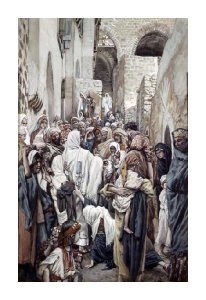
The Canaanite woman (James Tissot)Mt. 15:25  But she came and worshipped Him.

Her prayer had met first silence, and then a perplexing answer, for she must have heard our Lord Jesus’ words to His disciples, and she would know what they meant.  It was all perplexity then, and disappointment.  But she came and worshipped. . . .
     These words spoke to my heart today.  Sometimes our prayer does not at once meet with the response we expected, and the temptation then is to discouragement. “But she came and worshipped.”
     May the Lord work in us both to will and to do, so that conquering the natural inclination of our weak hearts, we shall turn our disappointments to causes and occasions for worship.  Worship may lead to renewed intercession, as it did in this blessed story, but first let there be worship, the adoration of the lover, the quietness of faith.    (Edges of His Ways)

And that brought to mind the incredible response of Job after he lost his servants, sheep, ox, asses, camels, and his sons and daughters (certainly a greater trial than a few hard words): Then Job arose, and rent his robe, and shaved his head, and fell upon the ground and worshipped (Job 1:20). 

May it be the same with us.

[Note: for an excellent exposition of the story of the Canaanite woman–one that I’ve struggled to understand for years–read Erasmo Leiva-Merikakis’s Fire of Mercy, Heart of the Word, Meditations on the Gospel of Matthew, Vol. 1, “Dog in Search of Master.” ]