I have officially moved myself to Substack where there is more interaction with others. This blog will continue to remain open to access the archives–where many treasures can be found. You can now find me here: https://substack.com/@srdorceebeloved Come follow me over there!
On days of weariness
Copied into a journal over 25 years ago. Still so true.
Ancient icons
Sharing two poems this Sunday about icons. I love icons. The first is by Anne Porter. I believe this was one of the first of her poems I ever read and made me fall in love with her poetry.

The Icon
Here in this icon out of ancient Russia
Brown as amber the little Mother of God
Holding her infant to her cheek
Is present to us
In all her wise
And peaceful sorrow
A forest hermit painted this
They say at night his face
Lit up the snow
He befriended robbers
And often gave
The bears his bread.
Anne Porter

This second is by Scott Cairns. I have read his book, Short Trip to the Edge: A Pilgrimage to Prayer, twice now and will probably read it again. Here Scott brings us into the very atmosphere created by icons and candles and incense and poses the question about how we are to bring this beautiful and prayerful culture into the dark world we inhabit.
Orthodoxy
—after Kapouzos [ΝΙΚΟΣ ΚΑΠΟΥΖΟΣ]
Yes, sweet, and very sweet the darkness
of the nave, and also very sweet
the observant surround, these icons
of our ancient fathers and our mothers,
whose images have acquired a warm
chiaroscuro from centuries
of fragrant smoke—incense, beeswax wafting
for centuries attended by seamless
petition and praise. Such prayers as these
yet fill the air with yet another
palpable sweetness.
So often, the world
appears wretched, choked by a broken,
angry and willfully cruel people.
So often, the world proves wretched indeed,
and its darkness is bitter. How then
to mitigate the assault waiting
just beyond the narthex? How to carry
at least some distance into the world
this fragrance, this sweetness, these images?
May 20: Very Early Morning
A Sunday poem by the late Luci Shaw that rings of Gerard Manley. I love it.

May 20: Very Early Morning
All the field praises him/all
dandelions are his glory/gold
and silver all trilliums unfold
white flames above their trinities
of leaves all wild strawberries
and massed wood violets reflect his skies–
clean blue and white
all brambles/all oxeyes
all stalks and stems lift to this light
all young windflower bells
tremble on hair
springs for his air’s
carillon touch/last year’s yarrow (raising
brittle star skeletons) tells
age is not past praising
all small low unknown
unnamed weeds show his impossible greens
all grasses sing
tone on clear tone
all mosses spread a spring–
soft velvet for his feet
and by all means
all leaves/buds/all flowers cup
jewels of fire and ice
holding up
to his kind morning heat
a silver sacrifice
now
make of our hearts a field
to raise your praise
~Luci Shaw
You care to be my friend
Among the most penetrating and amazing words in Scripture is “But I have called you friends.” Who are we that Jesus would care to be our friend? And yet that is his Heart’s desire (and not only to be friend but also to be espoused to us!). What will be our answer when he knocks and shows his face at the lattice of our souls?
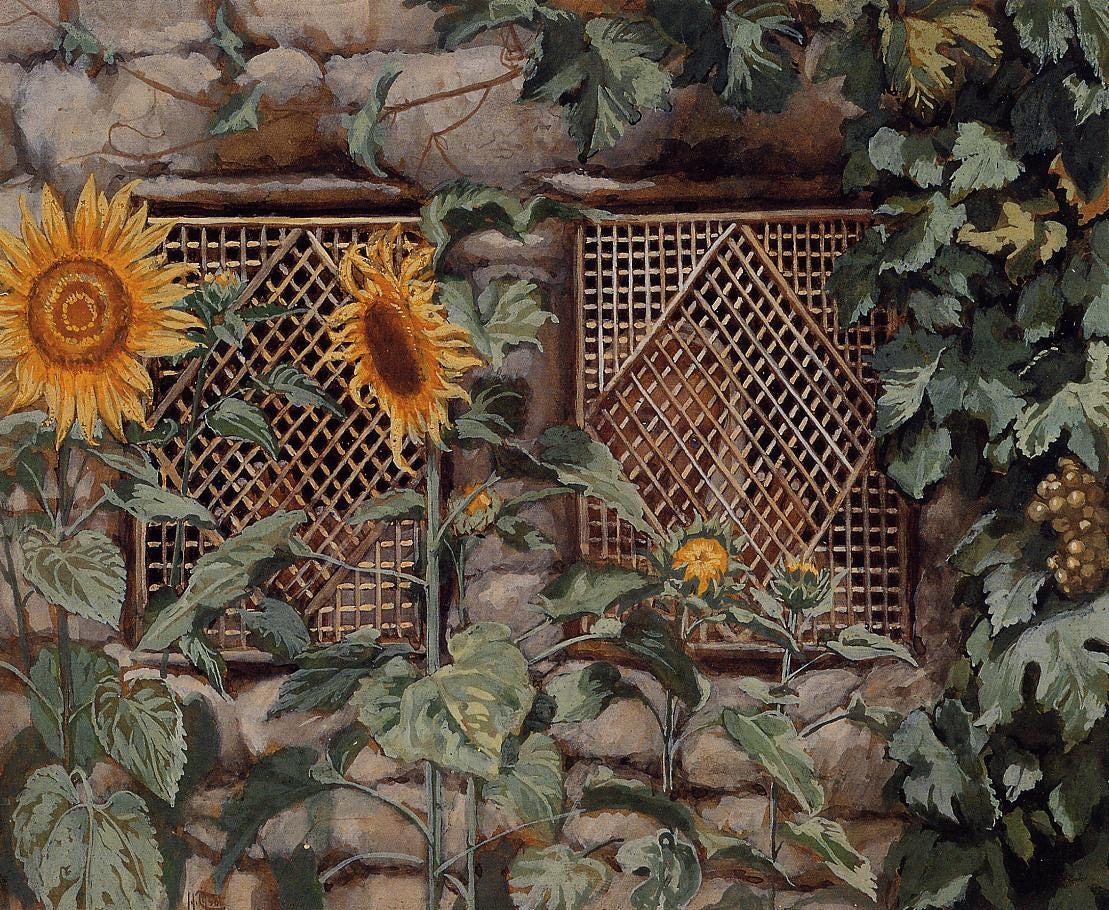
What have I that You care to be my friend?
   What interest could you possibly pursue,
   That at my doorstep, Jesus, drenched with dew
The dismal nights of wintertime You spend?
My insides must be slabs of pure concrete;
   I opened not for You! A monstrous thing,
   If my ingratitude’s raw, icy sting
Dried out the wounds of You most holy feet!
How may times my angel did proclaim:
   “Look out the window now, oh soul, and see
   How He persists to call with love aflame”!
And, oh, how many, Beauteous Majesty,
   “Tomorrow we will open” I would claim
   To have my words the same tomorrow be!

Lope Félix de Vega Carpio
Jesus, rise in me.
It’s still Eastertide. This poem by the lovely poet, Christina Rossetti, speaks of one suffering and longing for a resurrection of soul, pleading to Christ to rise in her. Even during Eastertide, we can easily feel the same as she, our hearts like stone, yet Christ is so, so drawn to those who, like her, long for him.

A Better Resurrection
I have no wit, no words, no tears;
My heart within me like a stone
Is numb’d too much for hopes or fears;
Look right, look left, I dwell alone;
I lift mine eyes, but dimm’d with grief
No everlasting hills I see;
My life is in the falling leaf:
O Jesus, quicken me.
My life is like a faded leaf,
My harvest dwindled to a husk:
Truly my life is void and brief
And tedious in the barren dusk;
My life is like a frozen thing,
No bud nor greenness can I see:
Yet rise it shall—the sap of Spring;
O Jesus, rise in me.
My life is like a broken bowl,
A broken bowl that cannot hold
One drop of water for my soul
Or cordial in the searching cold;
Cast in the fire the perish’d thing;
Melt and remould it, till it be
A royal cup for Him, my King:
O Jesus, drink of me.
Christina Rossetti
The wound of the arrow
In an address to Communion and Liberation in 2002, Cardinal Ratzinger made this beautiful remark on the power of music:
“The encounter with the beautiful can become the wound of the arrow that strikes the heart and in this way opens our eyes, so that later, from this experience, we take the criteria for judgement and can correctly evaluate the arguments. For me an unforgettable experience was the Bach concert that Leonard Bernstein conducted in Munich after the sudden death of Karl Richter. I was sitting next to the Lutheran Bishop Hanselmann. When the last note of one of the great Thomas-Kantor-Cantatas triumphantly faded away, we looked at each other spontaneously and right then we said: “Anyone who has heard this, knows that the faith is true”. The music had such an extraordinary force of reality that we realized, no longer by deduction, but by the impact on our hearts, that it could not have originated from nothingness, but could only have come to be through the power of the Truth that became real in the composer’s inspiration.”
The whole address is worth reading.
This Sunday’s poem by Anne Porter recounts her experience as a child of music wounding her heart, revealing to her that “we were made for Paradise.”

Music
When I was a child
I once sat sobbing on the floor
Beside my mother’s piano
As she played and sang
For there was in her singing
A shy yet solemn glory
My smallness could not hold
And when I was asked
Why I was crying
I had no words for it
I only shook my head
And went on crying
Why is it that music
At its most beautiful
Opens a wound in us
An ache a desolation
Deep as a homesickness
For some far-off
And half-forgotten country
I’ve never understood
Why this is so
But there’s an ancient legend
From the other side of the world
That gives away the secret
Of this mysterious sorrow
For centuries on centuries
We have been wandering
But we were made for Paradise
As deer for the forest
And when music comes to us
With its heavenly beauty
It brings us desolation
For when we hear it
We half remember
That lost native country
We dimly remember the fields
Their fragrant windswept clover
The birdsongs in the orchards
The wild white violets in the moss
By the transparent streams
And shining at the heart of it
Is the longed-for beauty
Of the One who waits for us
Who will always wait for us
In those radiant meadows
Yet also came to live with us
And wanders where we wander.
+ Anne Porter
Beauty now for ashes wear
A blessed Easter to all of you, my friends. An Easter Sunday poem by Hopkins. May you be prodigal in your rejoicing over these next 50 days!
Easter
Break the box and shed the nard;
Stop not now to count the cost;
Hither bring pearl, opal, sard;
Reck not what the poor have lost;
Upon Christ throw all away:
Know ye, this is Easter Day.
Build His church and deck His shrine,
Empty though it be on earth;
Ye have kept your choicest wine—
Let it flow for heavenly mirth;
Pluck the harp and breathe the horn:
Know ye not ‘tis Easter morn?
Gather gladness from the skies;
Take a lesson from the ground;
Flowers do ope their heavenward eyes
And a Spring-time joy have found;
Earth throws Winter’s robes away,
Decks herself for Easter Day.
Beauty now for ashes wear,
Perfumes for the garb of woe,
Chaplets for dishevelled hair,
Dances for sad footsteps slow;
Open wide your hearts that they
Let in joy this Easter Day.
Seek God’s house in happy throng;
Crowded let His table be;
Mingle praises, prayer, and song,
Singing to the Trinity.
Henceforth let your souls alway
Make each morn an Easter Day.
Gerard Manley Hopkins
Still

Still
For Good Friday
This day
let all stand still
in silence,
in sorrow.
Sun and moon
be still.
Earth
be still.
Still
the waters.
Still
the wind.
Let the ground
gape in stunned
lamentation.
Let it weep
as it receives
what it thinks
it will not
give up.
Let it groan
as it gathers
the One
who was thought
forever stilled.
Time
be still.
Watch
and wait.
Still.
—Jan Richardson
from Circle of Grace: A Book of Blessings for the Seasons
remaining always gentle
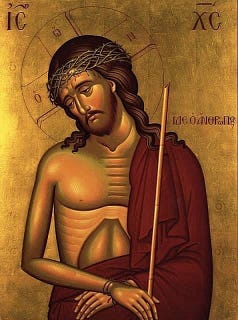
“He who is more fair than all the sons of men offered his fair face to be spat upon by sinful men; he allowed those eyes that rule the universe to be blindfolded by wicked men; he bared his back to the scourges; he submitted that head which strikes terror in principalities and powers to the sharpness of the thorns; he gave himself up to be mocked and reviled, and at the end enduring the cross, the nails, the lance, the gall, the vinegar, remaining always gentle, meek, and full of peace.” (St. Aelred)