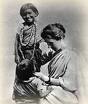
 A woman who has been very instrumental in my life was a Protestant missionary from Ireland to India in the first half of the last century. (A little anecdote: as a child, she prayed for God to change her brown eyes to blue, a prayer God did not answer. Only later when she was in India rescuing children from temple prostitution, did she realize the value of her brown eyes. It made it much easier for her to disguise herself as an Indian. She could darken her skin, but she would never have been able to disguise her blue eyes . . .) As a result of an injury, she ended up spending a good part of her life bedridden and wrote many poems, letters, and meditations from her bed, for which I will be eternally grateful.
For some reason, this excerpt from her book, Edges of His Ways, has been on my mind the past few days:
This is the fruit of my morning’s reading. It is not new, but it came to me as new.
God counts on us to accept whatever answer to our prayers He gives us, whether or not it be the answer that we wished and expected. When Paul wrote to the Christians of Rome, he asked for the kind of prayer that is like wrestling with a strong (though unseen) enemy [cf. Rom 15.30-32]. He asked for prayer for three things, that his service (the offering of alms) might be acceptable to the Jewish Christians; that he might be delivered from the Jews who did not believe; that he might come to them–the Christians of Rome–with joy. The answer to the second of these three prayers was two years in a prison in Caesarea; the answer to the third was two years’ imprisonment in Rome. In both cases his was the kind of imprisonment which required the prisoner’s right hand to be chained to a soldier’s left.
Not many of us love to be under a roof between walls, without being able to go out into the open air. Think what it must have meant to Paul to be not only indoors but never once alone. Think of being chained to a Roman soldier at all hours of the day and night. “That I may come unto you with joy by the will of God, and may with you be refreshed.” There was not much natural joy and refreshment in coming as a chained prisoner.
Nothing was explained. Paul and the men and women of Rome were trusted to accept the unexplained and, like John the Baptist, not to be offended in their Lord.
 Witnesses to Hope