Unconditional poverty

That phrase has been haunting my thoughts the past couple of weeks. It comes from a passage which I will quote in a bit. I have been familiar for a long time with the concept of standing before the Lord in one’s poverty. Learning to do so is not an easy thing. I find myself so often choosing what bits of my poverty to bring to him and hiding others. I’ll come to him with my inability to love my sisters very well, but I’ll hide my failings with keeping my time on social media under control. The temptation is always to hide what causes me the most shame. So I was really struck by this description of “unconditional poverty” because that means that I must stand before the Lord in all of my poverty, every bit and expression of my lack and my failings. But I know that is the only way for me to be open to all of his love for me and not just part. The times when I have responded to the grace to be completely vulnerable to him, hiding nothing, have been the most intimate. So, I pray that that phrase haunt me for ever, for I know I will never have what I most desire–which is his very Self–without unconditional poverty being my continual and habitual state of being before him. Pray for me for that.

“All that I am, all that I have ever felt, known, had, or desired–all shame and fear, all desire and effort, all failure and guilt, all capacities and incapacities, all experience and expectation–everything absolutely everything, is to be laid before him in trusting nakedness, and to be opened wide, in unconditional poverty, to receive his gift as he wishes to give it and this gift is ultimately his very Self . . . .” (Joshua Elzner, Responding to the Thirst of God)

The Heart of Virtue

I have been plagued by Jansenism most of my life, and Lent can be an especially difficult challenge in that regard. But over the past couple of years, God has been freeing me of this heresy by his sovereign intervention in my life and by writings like this by Joshua Elzner (building on my years of reading Thérèse). You can see that I have read and reread these pages a few times now. I share them with hope that your eyes may also be opened to the true heart of virtue.

Let God come to you first

I recently recommended a few of Joshua Elzner’s books. Today I would like to post an excerpt from another of his books. It speaks to me deeply–as I assume it will also to you–because he addresses the times when we feel like we just cannot pray the way that we desire. May it bring you hope, as it did for me this very day.

“I have no desire to forsake prayer, to live it behind and to busy myself instead with superficial things. But I cannot pray in the way that I am accustomed, in the way that I would desire. But how can I go beyond this dilemma: to pray when I am incapable of praying, to rest when I am incapable of resting, to gaze upon God when I am incapable of gazing? The only answer lies in letting God come to me first, in letting him draw near to meet me in the very place where I feel my poverty and incapacity so deeply. I will not find him in the flight from my weakness to the periphery, where I occupy myself with things to distract my attention from the pain, things with which I try to pass the time that I once spent in prayer and recollection and filial play in his presence. But neither will I find him in the forceful effort by which, with the vigorous activity of my will or my intellect, I try to break through my limitations and to achieve what he is not giving. Rather, I will find him only when I sink down into the very heart of my littleness and incapacity, when I let him approach me, touch me, and cradle me at the heart of my deepest weakness, poverty, and greed.

“And when this happens . . . ah, when this happens! Then the very pain and incapacity and weakness that hemmed me in before become a living sacrament of his presence! The very difficulty and suffering that I experience become a living space of his compassionate love, which sensitizes my heart both to his own goodness as well as to the suffering of my brothers and sisters, which, in him and with him, I tenderly take up into my heart and hold in his presence. My suffering, in other words, becomes a living space of yet deeper encounter and get more profound intimacy. Yes, my poverty becomes but the flip side of his abundant fullness; my incapacity becomes a living space of receptivity to the ceaseless activity of his love; my pain and restlessness in the suffering of my body and my spirit, touched by him and surrendered to him, becomes pervaded by a deeper peace and rest and serenity.

“The pain and incapacity do not disappear, as God does not somehow dissolve my limitations and make possible what, in my very suffering, is now impossible. Rather, he permeates the living space of my consciousness with his presence, such that he meets me in my very littleness and limitation, and makes this something radiant and expansive and beautiful. For, after all, what makes something truly great is not what it looks like on the outside, How much it sparkles in the eyes of the world, but simply how much God there is in it, and how totally and intimately it is held by him, permeated by his presence, and filled with the sweetness of his love and tenderness.”

(Joshua Elzner, The Prayer of the Heart)

Book recommendations

I have recommended numerous books on this blog–many are listed under the “Books to read” tab. I realize that not every book that speaks to me personally will necessarily do the same for others, but I would like to at least mention a few books by Joshua Elzner that have greatly impacted my spiritual life over the last couple of years. I would even say that my relationship with the Lord has been significantly transformed as a result of reading his writings. So I offer them here knowing that there might be the possibility of them impacting your spiritual lives as well. 

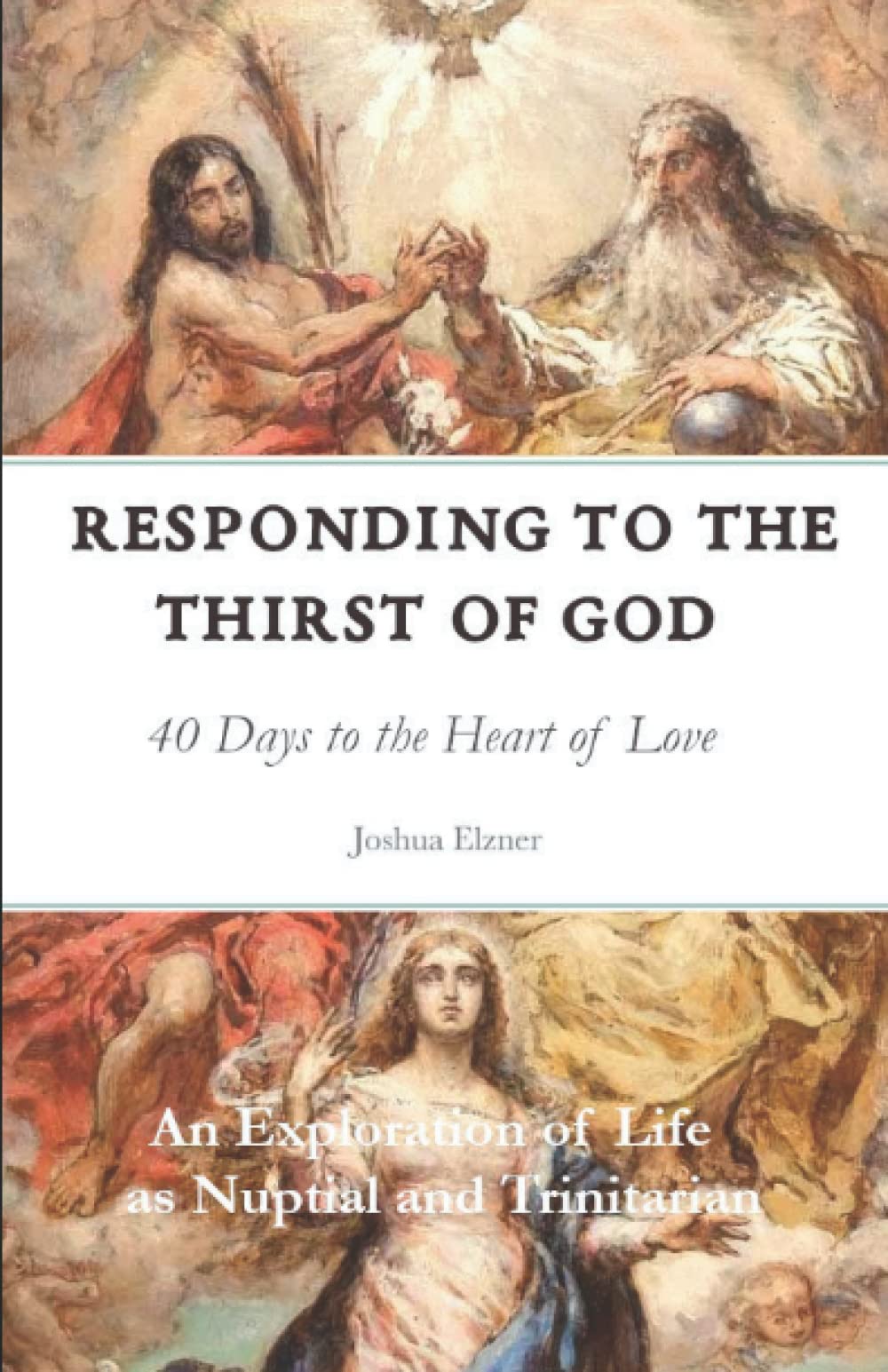
This first book is set up to be read over the span of 40 days. It begins with a short autobiography written by Joshua in order to situate his writings within his own spiritual development. The chapters are short, just enough to chew on for a day. So many things from this book have impacted me. Here’s just a snippet from what I read a couple of days ago:

“All that I am, all that I have ever felt, known, had, or desired–all shame and fear, all desire and effort, all failure and guilt, all capacities and incapacities, all experience and expectation–everything, absolutely everything, is to be laid before him in trusting nakedness, and to be opened wide, in unconditional poverty, to receive his gift as he wishes to give it. And this gift is ultimately his very Self . . . ”

This next book is, as the cover indicates, a commentary on the Song of Songs. I have read many books on the Song of Songs, but this one by far opened up the Song in a way that no other had. If you are longing for intimacy with God, this is the book for you.

These next two have just been recently released and are the first two in the Dawnbringer series. They are written in the style of Tolkien and other great myth creators. This is an incredibly beautiful, well written story that has moved me to tears numerous times by its beauty and goodness. 

They can be purchased here.

I would love to know if you read him. 

Accepting our Limitations

Reflection by Joshua Elzner

“There is a beautiful reality which one discovers through growing in the childlike spontaneity of love, through being enfolded ever more deeply and consciously in the dimension of gift. This is, namely, the truth that holiness does not consist in surpassing our own limitations, either as a creature or as an individual, but rather in accepting them and coming to live joyfully within them. It could be said that the only limitation which we need to fight to overcome is the narrowness of our own sin, which blinds our perspective, isolates us within ourselves in possessiveness, pride, and fear, and draws us to dominate and abuse others and creation. But this sin is precisely a distortion of our creaturehood, not an essential part of it; it is the false effort to be bigger than we truly are, or to be something altogether different. Sanctity, in the last analysis, consists in simply being able to truly be a human being—indeed, more, in being oneself in the eyes of God.

“Precisely by wanting to “be like God” in a false way which went against their creaturely limitation and dependence upon God, Adam and Eve found their nature corrupted and broken. For us, therefore, returning to dependency upon the Father and trustingly accepting our littleness and our limitation is at the heart of our healing from sin, our rediscovery of the happiness of being beloved children. This is the happiness for which God made us.

“It is fear and pride which impel us to strive to be something that we are not, to fashion an “ideal” in our minds toward which we strive. Anyone who has taken a big step in life, whether in embracing a new vocation or a new job or a new way of living, has experienced the human tendency to “imagine” oneself in the new state. Certain ideas crystallize in our minds and we tend to act in a way so as to fashion ourselves according to these ideas. Because of this we can tend to become blind to the actual responsibilities incumbent upon us in our state, to the actual invitation of God that is coming to us in prayer and in the circumstances of our lives. Above all, we lose sight of the gift that each day and each new moment is meant to be for us. Further, we can experience a kind of “self-alienation” when we do not live up to our ideal, and consequently we feel like a failure. We say to ourselves: “This is who I was meant to be, but I am too weak, too broken to live up to it. Now God must truly be frustrated with me, at least as frustrated as I am with myself.”

“This kind of experience of humiliation can be healing, however, for it teaches us not to rely so much upon our own ideas or imagination. Rather, God’s grace seeks to penetrate into this experience of weakness and failure, and to awaken in us something much more pure and profound. We learn to see ourselves, not according to our own limited ideals, which are always more or less impersonal, but as God himself sees us. Then we realize that he loves us just as we are, here and now. He sees and loves in us the deepest and truest personal mystery that is our own. Who we really are is precisely who we are in God’s eyes. And there is nothing in the least impersonal or general about the way that he loves us, nor about the invitation that his love begets in our hearts to become free through responding to this love. He invites us to become, so to speak, “more than we are,” not by becoming someone else, or by living up to an abstract ideal, but by allowing the truth that he has already implanted within us to blossom from within and to express itself outwardly, to come to full maturity.

“The encounter with God’s love in the midst of our own weakness and poverty goes still deeper than this. Ultimately it can lead us to simply entrusting our own limitations, our own brokenness, hopes, desires, and fears, into the hands of the One whom we know loves us—and leaving them there. This is true surrender. Rather than needing to control and fashion our own lives, our own growth, our own sanctity, we simply leave it in the hands of the Father. On our part, all that is ultimately necessary is to receive each new day as he gives it, each moment as it flows from his loving hands, and to respond to it with all of our heart. In his will, indeed, is our peace. If we simply surrender to him and obey him in childlike trust and simplicity, he will, truly, take care of the rest.”