The lady of fair weeping

Mary is beautiful, even in her sorrow.

Rate this:

Today is the Feast of the Sorrowful Mother.  Recalling Cardinal Ratzinger’s words from yesterday’s post, we can see that Mary is beautiful even in her sorrow:

The Blessed Virgin is the lady of fair weeping.  Her tears were beautiful.  These are the sorrows of one who is all beautiful, full free from the deformity of sin. . . No lamentation has been lovelier, no compassion purer . . . .  The sinless Spirit-filled heart of Mary is beautifully centred on the will of the Father and on His and her Son and those for whom He suffers.  (John Saward, The Beauty of Holiness and the Holiness of Beauty)
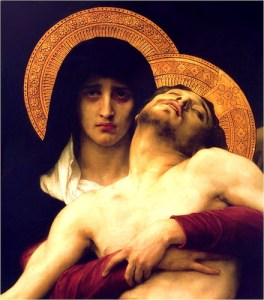
Our Lady of Sorrows

And a little consoling excerpt from Magnificat today: “As the Savior’s dying gift to us, Jesus leads us back to Mary.  For we need the maternal closeness of the Sorrowful Mother to sustain us when overcome by the terrifying trials of life.”

Nativity of Mary

A short hymn in honor of the Feast of the Nativity of Mary, the Theotokos.

Rate this:

Just a short hymn from the Eastern Church in honor of this day.   

          Kontakion (Tone 3)

Today the Virgin Theotokos Mary
The bridal chamber of the Heavenly Bridegroom
By the will of God is born of a barren woman,
Being prepared as the chariot of God the Word.
She was fore-ordained for this, since she is the divine gate and the true Mother of Life.

Nativity of the Theotokos

A shelter for the shelterless

Mary is a shelter for the shelterless.

Rate this:

A quote about Mary, on this Saturday, her day:

“Our Lady’s heart is the most empty of all human hearts, the most empty of self and empty of pride, and therefore the most ready to give a heart’s welcome and shelter to those who are shelterless.” (Fr. Joseph Langford, Mother Teresa in the Shadow of Our Lady, p. 42)

The kind of Queen she is

Today is the memorial of the Queenship of Mary.  Here are two descriptions to ponder of what kind of Queen she is.  The first is by Georges Bernanos:

The Mystery of Mary

She is our Mother.
But she is also our daughter.
A little girl and the Queen of Heaven.
The Queen of the Angels–
And yet she is still a little girl!
Remember this!

And by Eryk Hanut:

Mary is gigantic, but also tiny and hunched with humility.  Far, but never, ever, distant.  She is the bedside lamp that we can [reach] at any moment to dispel the darkness.
     Mary draws millions to her, gives sight to the blind, makes springs gush at Banneux, Lourdes, LaSalette.  Mary makes the sun dance at Fatima and a tree at Beauraing break into blossom in the middle of the winter.  She gives you what you would expect from a Queen–glory.  But she also gives you what you would hope from a mother.  Mary cooks the soup, squinting anxiously at the clock if her child is late.
     Mary is the clock, but she is also the first to forget it.  Everyone knows this who kneels and prays to her. She is there; she can do anything; she has been through everything.  What would be more mind-shattering than the destiny of this tiny Jewish girl, this thirteen-year-old who said “yes” to the plans of God.
     Everyone knows how tremendous Mary’s destiny is.  That is why anyone can ask anything from her.  Everyone, on one day or another, has asked her for something–even those who are closed to her mystery. 
     I often ask myself if the adoration we give her matters at all.  She wants our best.  That is all that matters to her . . . .
     Nothing is more poignant than a person who prays.  To pray is to become a little child again.  It is to talk to your mother without a grill between you.  And the Mother listens, listens, consoles, replies. . .

Take time to talk to your Mother today . . .

Ancient prayer to Mary

Ancient Egyptian prayer to Mary.

Rate this:

On this, our Lady’s day, I thought I would share an ancient prayer to Mary, found on papyrus in Egypt.  (Theotokos means God-bearer.)

Under your
compassion
we take refuge,
Theotokos; do not
overlook our prayers
in the midst of tribulation,
but deliver us
from danger,
O only pure,
only blessed one.

You are my favorite

I used to tell all my students, each of them, “You’re my favorite.”

Rate this:

I taught sixth graders for around eleven years–hey, eleven years of teaching eleven-year-olds!  And I loved every minute of it.  One of the ways God graced me was by giving me a unique love for each child.  I could truthfully say–and often did–to each one, “You are my favorite student.”  Sometimes I would walk around the class while they were doing silent reading and whisper, in all sincerity, in each ear, “You are my favorite student.”  Of course, they would ask, “How can that be true? How can we all be your favorite students?!”  Then, I would pull out a pile of my favorite books.  I would pick each one up and say, “This is my favorite book”, and so on.    I’d talk about how each book was a favorite for a different reason from the others. Then I would ask them, “How many favorite movies do you have?”  And then I would go on to explain how each of them could be my favorite student–and how to God, we are all His favorites.  Even to this day, I’ll have former students say, “Hi, Sr. Dorcee, am I still your favorite student?” and, of course, I’ll say, “Yes!!”

One day, on a Feast of Our Lady–I can’t remember which one–I was at Mass, and I looked up and saw one of my former favorite students across the way, and started thinking about her.  And, out of the blue, a thought passed through my head–which I’m sure was from Our Lady–“You’re my favorite.”  All I could do was smile . . . because I know she says that to each one of us.

Why Saturday is Mary’s Day

Saturday is traditionally observed as the day of Our Lady. John Saward explains why.

Rate this:

Lady of ConsolationHave you ever wondered why Saturday is traditionally observed as the day of Our Lady? A few years ago I was reading a book by John Saward (The Beauty of Holiness, the Holiness of Beauty), and, in a section about our Lady, he described Mary’s unfailing faith through the long, terrible day after Christ’s death when she alone kept faith in her Son.   I had never before heard of this mariological foundation for Saturday being traditionally her day:

The yes [her continued yes to the Lord that began with her Annunciation yes] of Our Lady does not end on Good Friday and [Christ’s] yielding of the spirit . . . . The faith and love of Our Lady last into Holy Saturday.  The dead body of the Son of God lies in the tomb, while His soul descends into Sheol, the Limbo of the Fathers.  Jesus goes down into the hideous kingdom of death to proclaim the power of the Cross and the coming victory of the Resurrection and to open Heaven’s gates to Adam and Eve and all the souls of the just.  The Apostles, hopeless and forlorn, know none of this.  “As yet,” St. John tells us, “they did not know the Scripture, that He must rise from the dead” (Jn 20.9).  In all Israel, is there no faith in Jesus?  On this silent Saturday, this terrible Shabbat, while the Jews’ true Messiah sleeps the sleep of death, who burns the lights of hope?  Is there no loyal remnant?  There is, and its name is Mary.  In the fortitude of faith, she keeps the Sabbath candles alight for her Son.  That is why Saturday, the sacred day of her physical brethren, is Our Lady’s weekly festival.  On the first Holy Saturday, in the person of Mary of  Nazareth, Israel now an unblemished bride, faces her hardest trial and, through the fortitude of the Holy Spirit, is triumphant.

And I take great comfort in knowing that Mary always burns the light of hope for me (and you!) as well.