Mary Magdalene

A Jessica Powers’ poem on Mary Magdalen.

Rate this:

I’ve done a lot of meditating over the years on today’s gospel.  For many long seasons of my life, I have felt that I have been with Mary weeping outside the tomb, Jesus calling my name, but I keep failing to recognize Him.  Learning to trust Him when I think He’s gone and I can’t recognize Him. (See “While it was still dark”)

Two paintings here of Mary before and after her conversion:

The Magdalene before her conversion (Tissot)
The Magdalene before her conversion (James Tissot)
The repentant Mary Magdalen (James Tissot)


On another note, this poem by Jessica Powers came to mind today.  In this poem, she writes about Mary’s encounter with Christ on the Cross and then her later life, where she lived as a contemplative hermit:
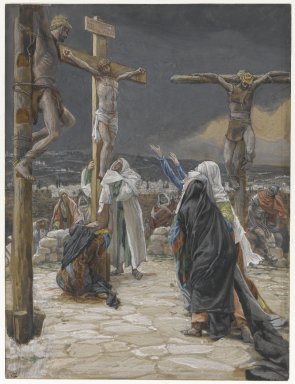
The death of Jesus (James Tissot)

The Blood’s Mystic

Grace guards that moment when the spirit halts
to watch the Magdalen
in the mad turbulence that was her love.
Light hallows those who think about her when
she broke through crowds to the Master’s feet
or ran on Easter morning,
her hair wind-tumbled and cloak awry.
What to her need were the restrictions of
earth’s vain formalities?
She sought, as love so often seeks and finds,
a Radiance that died or seemed to die.

One can surmise she went to Calvary
distraught and weeping, and with loud lament
clung to the cross and beat upon its wood
till Christ’s torn veins spread a soft covering
over her hair and face and colored gown.
She took her First Communion in His Blood.

O the tumultuous Magdalen!  But those
who come upon her in the hush of love
claim the last graces.  A wild parakeet
ceded its being to a mourning dove,
as Bethany had prophesied.  We give
to Old Provence that solitude’s location
where her love brooded, too contemplative
to lift the brief distraction of a wing.
There she became a living consecration
to one remembering.
Magdalen, first to drink the fountained Christ
Whose crimson-signing stills our creature stir,
is the Blood’s mystic.  Was it not the weight
of the warm Blood that slowed and silenced her?

The hands of love

The man born blind

Rate this:

Some things in life are hard to understand and to deal with–especially those terrible  things that happen to the innocent, especially when it’s our own children.  In his ninth chapter, John tells the story of the man born blind.  My brother, Rod, is legally blind as a result of his diabetes, and it has proved a great challenge to him.  I am currently reading the letters of Bede Jarrett, a provincial of the English Province of Dominicans from 1916-1932.  He has a thought-provoking reflection on John 9:

Think what it means to be born blind.  He could do nothing for himself, except what he had learned with great labour and trouble.  It must have seemed the worst possible thing to him.  Think of him as a child, a boy with all his strength for, as far as we know, he was otherwise perfectly healthy, his pent-up energy, and he couldn’t walk, ride or swim without someone coming to help and guide him, and tell him which way to go.  If you described the beauty of a flower, or the bloom of a fruit, to him, it meant nothing; he was born blind.  Horrible, hideous–and yet, what does our Lord say?  The apostles, seeing him, said, ‘Lord, who has sinned, this man or his parents that he should be born blind?’ Of course they put it down to sin (the Pharisees had a doctrine that a man could sin even in his mother’s womb), and our Lord said, ‘Neither hath this man sinned, nor his parents, but that the works of God should be made manifest in him.’ It was just the fact of his being born blind that made the glory of God so manifest.  ‘It has never been heard of since the world began that  man born blind hath received his sight.’ Others, yes, but never one born blind.  So just what seemed so cruel to him turned out to be this wonderful miracle, making manifest the glory of God.
     So we see that all circumstances, however adverse they seem to be to us, are always favorable to God’s plan, always, always, as to the blind man, the best thing for us.
     His hands are strong and powerful hands and we can confidently rest there.  Can we not sometimes see in the hands of a clever artist, or surgeon, the strength and deftness expressive of the mind that directs their action?  But with God, they are not only the hands of power, and not only the hands of wisdom, but of love, and it is only when we leave all things in his hands that we find complete serenity; and then a great peace shall come into our souls.

The blind man washes in the pool of Siloam (James Tissot)

The gift of life

Donating a kidney to my brother gave me a glimpse into God’s desire to give us life.

Rate this:

My brother, Rod, and his wife stopped by for a couple of hours this past Friday on their annual trip to New York to watch a Yankees game.  Three and a half years ago I was able to save his life by donating one of my kidneys to him.  I have to be honest–it didn’t even occur to me to offer when he first told me that he was either going to have to have a transplant or go on dialysis.  (He’s diabetic.)  I got off the phone from that conversation, and then it occurred to me that I could possibly give him one of my kidneys.   So I called him back and offered.  He still tears up when it comes up in conversation.
      You have to go through quite a few tests to determine if you can be a donor–all paid for by the recipient’s insurance.  They want to make sure that you are in good health in order to donate.  I remember before each test begging God that they would just say “yes”.   My desire to save my brother’s life was very great.  It was about half way through the testing process that I realized that the Lord was giving me just a small glimpse into His love for us, His desire to give life to us, to give us His own Son at whatever cost–and because He wanted so badly to do so.
      Well, the doctors kept saying yes, and I was able to donate.  The human body is amazing.  When you donate one, the remaining kidney adjusts to take over for the removed kidney.  Most of the time I forget that I only have one kidney, and when I do remember, I just thank God that I was able to donate.  I’d do it again in a heartbeat.
      My brother wrote me a letter right before surgery.    It’s a treasure I will always keep. I would keep it in that zippered part of my Bible, but it doesn’t really fit.  (See “Courage.”)  I pulled it out today to reread.   It starts: “As we embark on our journey tomorrow, I’d like to say a few things about what you’re doing for me.  I might not have said thank you enough for your gift but I feel you know how I love you for saving my life.”  As I said, he still tears up when we talk about it.  Thinking about that–his continued gratitude to me–convicted me in a new way of how much, much more grateful I should be to the Lord for the gift of life He’s given me, at much more of a cost to Himself than I experienced in order to donate a kidney.  It wouldn’t hurt me to tear up about His gift of life more often . . . .  
     And as I said, I’d do it again in a heartbeat.  And so, I’m sure, would God.

Is my life of any account?

Is my life of any account compared with the likes of Mother Teresa?

Rate this:

Ever have days when you feel that your life is really of no account–I mean, compared with people like Mother Teresa of John Paul II?  You’re “just” at home taking care of three little kids OR you’re “just” working as a clerk in a drug store OR you’re “just ________________. . . you fill in the blank.  Reading this excerpt from the book, Mother Teresa’s Secret Fire, may encourage you.  (The book was written by the co-founder of the Missionaries of Charity priests.)  In God’s eyes, there are no “just”s.

How important can one small, unspectacular life be?  Consider this: the good that each of us can accomplish, even with resources and restricted reach, not even a Mother Teresa could achieve.  . . . No one else on the planet, and no one else in history, possesses the same network of acquaintances and the same combination of talents and gifts as each one of us does–as you do.

So have hope.  God has great confidence in you and in loving those in your life through you.  (And doing it perfectly isn’t really anywhere on his checklist, I assure you.)

Why Saturday is Mary’s Day

Saturday is traditionally observed as the day of Our Lady. John Saward explains why.

Rate this:

Lady of ConsolationHave you ever wondered why Saturday is traditionally observed as the day of Our Lady? A few years ago I was reading a book by John Saward (The Beauty of Holiness, the Holiness of Beauty), and, in a section about our Lady, he described Mary’s unfailing faith through the long, terrible day after Christ’s death when she alone kept faith in her Son.   I had never before heard of this mariological foundation for Saturday being traditionally her day:

The yes [her continued yes to the Lord that began with her Annunciation yes] of Our Lady does not end on Good Friday and [Christ’s] yielding of the spirit . . . . The faith and love of Our Lady last into Holy Saturday.  The dead body of the Son of God lies in the tomb, while His soul descends into Sheol, the Limbo of the Fathers.  Jesus goes down into the hideous kingdom of death to proclaim the power of the Cross and the coming victory of the Resurrection and to open Heaven’s gates to Adam and Eve and all the souls of the just.  The Apostles, hopeless and forlorn, know none of this.  “As yet,” St. John tells us, “they did not know the Scripture, that He must rise from the dead” (Jn 20.9).  In all Israel, is there no faith in Jesus?  On this silent Saturday, this terrible Shabbat, while the Jews’ true Messiah sleeps the sleep of death, who burns the lights of hope?  Is there no loyal remnant?  There is, and its name is Mary.  In the fortitude of faith, she keeps the Sabbath candles alight for her Son.  That is why Saturday, the sacred day of her physical brethren, is Our Lady’s weekly festival.  On the first Holy Saturday, in the person of Mary of  Nazareth, Israel now an unblemished bride, faces her hardest trial and, through the fortitude of the Holy Spirit, is triumphant.

And I take great comfort in knowing that Mary always burns the light of hope for me (and you!) as well.

The top half of the picture

A story we can all learn from from the then Cardinal Ratzinger:

The British doctor Sheila Cassidy (who in 1978 entered the Benedictine order) was imprisoned and tortured in Chile in 1975 for having given medical treatment to a revolutionary.  Shortly after being tortured she was transferred to another cell, where she found a tattered  Bible.  She opened it, and the first thing she saw was a picture of a man prostrate under lightning, thunder and hail. Immediately she identified herself with this man, saw herself in him.  Then she looked further and saw in the upper part of the picture a mighty hand, the hand of God, and the text from the eighth chapter of the Letter to the Romans, a text that comes straight from the center of Resurrection-faith: “Nothing can separate us from the love of Christ” (8:39).  And whereas at first it was the bottom half of the picture which she experienced, her being invaded by all that was terrible, crushing her like a helpless worm, she gradually came to experience more and more the other part of the picture, the powerful hand and the “Nothing that can separate us .”  At first she still prayed, “Lord, let me out of here,” but this interior shaking of the prison bars turned more and more into that truly free composure which prays, with Jesus Christ: “Not my will, but thine, be done.”  Furthermore she discovered that, as a result, she was filled with a great freedom and kindness toward those who hated her: now she could love them, for she saw their hatred as their distress and imprisonment.”   (Co-workers for the Truth)

Tim’s birthday

Yesterday would have been my brother Tim’s 57th birthday.  Three years ago he took his life on St. Patrick’s Day.  (This was the “very challenging time” of the “Courage” post.  See May 7, 2009.)  There were many, many ways that God upheld me through that time and many, many friends who did the same.  One of those friends was Amy Carmichael (see my last post).   Four months after Tim’s death, I read this and it was a great comfort:

For God sees the whole man, and He has a tender way of looking at a soul at its highest, not its lowest.  He does not do as we so often do, misjudge it because of what its diseased mind made its body do in a blind and broken hour.  And we have to do with a Love that can grasp the poor hands that reach out to Him in that darkness–what father would not do that?  And He is our Father.

But when those who have prayed for such a one have no assurance that there was ever any turning to Him who alone can save, then indeed we seem to be viewing a land like that hopeless country the prophet describes, whose streams shall be turned into pitch, and the dust thereof into brimstone. ‘And He shall stretch out upon it the line of confusion and the stones of emptiness.’  But a word of peace comes through the confusion: prayer in the name of His Beloved Son does not fall upon stones of emptiness. Sometimes, somewhere we shall know better than we know now how gracious the Lord is.

from Gold by Moonlight

Fears and emotional wounds as the context for holiness

from Marc Foley’s book on St. Therese of Lisieux, The Context of Holiness (ICS Publications)

“Becoming an adult does not mean that the deep emotional wounds of childhood disappear. Rather, being an adult means choosing to make courageous decisions in the face of powerful emotions.” (p.13)

“When she [Therese] was assigned a job [novice mistress] that she thought was too much for her to handle, she felt overwhelmed, incompetent, unqualified, and inadequate . . . However, Therese does not apologize for her fears. She does not berate herself for feeling like a child; rather her fears and insecurities are the context within which she places her trust in God. It is as if Therese is saying to all of us: ‘There are many situations in life that trigger the deep-seated fears of childhood. I have come to see that this is a normal part of daily life. I have also come to see that our childhood wounds are not obstacles to our spiritual growth but are in some mysterious manner the path on which we find our way back to God. The deep-seated fears of my life have forced me to abandon my self-sufficiency and to rely upon the grace of God.'” (p. 14)

“Therese did not make it a goal to get beyond the effects of her childhood but to do the will of God in the midst of them. Therese understood that the emotional wounds of her childhood were not obstacles to spiritual growth but the context of growing in holiness.” (P. 96)

“Acts of faith are expressed in two ways. The first is our willingness to jump into the darkness, that is, choosing to trust in God’s guidance as we venture into the unknown. The second is our willingness to sit in the darkness, which is continuing to do God’s will when our emotional resources are depleted and life seems hollow, meaningless, and absurd. Therese was willing to sit in this darkness as long as God willed.
“These are the worst times in our life of faith when viewed from a psychological and emotional perspective. But from a spiritual vantage point, they are potentially the best of times. For when we continue to do God’s will without emotional support, our love for God and neighbor grows and is purified.” (pp. 136-7)