Beginning to hope

Today’s post comes from The Magnificat Advent Companion for this year.  I think it is a good meditation for all of us who are aspiring to be Witnesses to Hope:

There is a story of two priests who were speaking about their respective blood brothers, both of whom had strayed from the Catholic faith.  One remarked, “I have been praying for my brother for fifteen years and I’m beginning to lose hope.”  The other responded, not without wisdom, “I’ve been praying for my brother for twenty-five years, and I am beginning to hope.”  The message of the parable is important: when our hearts are tested by the secularism around us (or within us), prayer for others is related to our hope in the power and presence of God’s grace.  Our hope can be tried, but such trials are also related to our own progressive conversion, and therefore serve to our spiritual benefit.  . . .  Advent is a season of hope in the promises of God, hope for the conversion of ourselves and of others.  We should pray ardently for this great good, and allow hope in Christ to change us.  For who are we to underestimate the power of the grace of God?  (Fr. Thomas Joseph White, OP)

“Hidden in our darkness”

Advent, like winter, is a time of hiddenness and darkness.  The leaves are stripped from the trees, and the trees look dead.  We know life is hid within them, but it’s hard to tell.   One can only have hope if you remember Spring is coming.  The same is true for us. We must have faith in the middle of the darkness.

Caryll Houselander, describing Advent, writes:

“It is a time of darkness, of faith.  We shall not see Christ’s radiance in our lives yet: it is still hidden in our darkness; nevertheless, we must believe that he is growing in our lives; we must believe it so firmly that we cannot help relating everything, literally everything, to this almost incredible reality.”  (Reed of God, p. 29)

Advent Visitation

An Advent Sunday-poem from Luci Shaw:

Advent visitation

Even from the cabin window I sensed the wind’s
contagion begin to infect the rags of leaves.
Then the alders gilded to it, obeisant, the way

angels are said to bow, covering their faces with
their wings, not solemn, as we suppose, but
possessed of a sudden, surreptitious hilarity.

When the little satin wind arrived,
I felt it slide through the cracked-open door
(A wisp of prescience? A change in the weather?),

and after the small push of breath–You
entering with your sir of radiant surprise,
I the astonished one.

These still December mornings
I fancy I live in a clear envelope of angels
like a cellophane womb.  Or a soap bubble,

the colors drifting, curling.  Outside
everything’s tinted rose, grape, turquoise,
silver–the stones by the path, the skin of sun

on the pond ice, at night the aureola of
a pregnant moon, like me, irridescent,
almost full-term with light.


Advent: the season of the woman

As we begin Advent, I would like to share an excerpt from a newly published collection of Advent meditations by Mother Mary Clare PCC:

I am quite confident all of us have a deep sense of expectation, joy, and wonderment that Advent is about to begin.  We look at the different facets of this season, turning it like a jewel in our hands.  Certainly it is a season for children.  It is a season of the child, the joy of the Child who came to give joy to the world.  It is a season, certainly, of the family, of the community.  Family life was solidly established in a lowly, humble, poor place, with three persons who loved utterly and were utterly given–even the CHild, from the first moment, because he was divine.  It is a season of great tenderness, and a season of hush. It is a season for everyone.  It is a season particularly of the woman.   It is the woman, especially the religious woman, who has great potential for the spiritual maternity which was so basic in our Lady and which was ratified on Calvary when she became the Mother of all the redeemed: ‘Woman, behold your son.’  It is a precious season.  Advent summons us to fold the wings of our souls.  There is rich meaning in the expression ‘folded wings’.  Wings that remain always folded and are never spread to fly in giving would be wings that would deteriorate in atrophy, whereas wings that are always spread and never folded in intense personal prayer, reflection, contemplation would be wings quickly spent or, perhaps, misspent.  With all of this–the joy, the tenderness, the maternal sense, the deepening of womanhood, the folded wings–Advent is a season of tremendous purpose . . . .

Mother Mary Clare was the abbess of a Poor Clare monastery in Roswell, New Mexico. These conferences to her Sisters were collected posthumously, and I for one am very grateful. I have read every book I could get my hands on by her and was saddened that her writing would cease when she died. I am eternally grateful to her dear Sisters.

How bright our souls should be

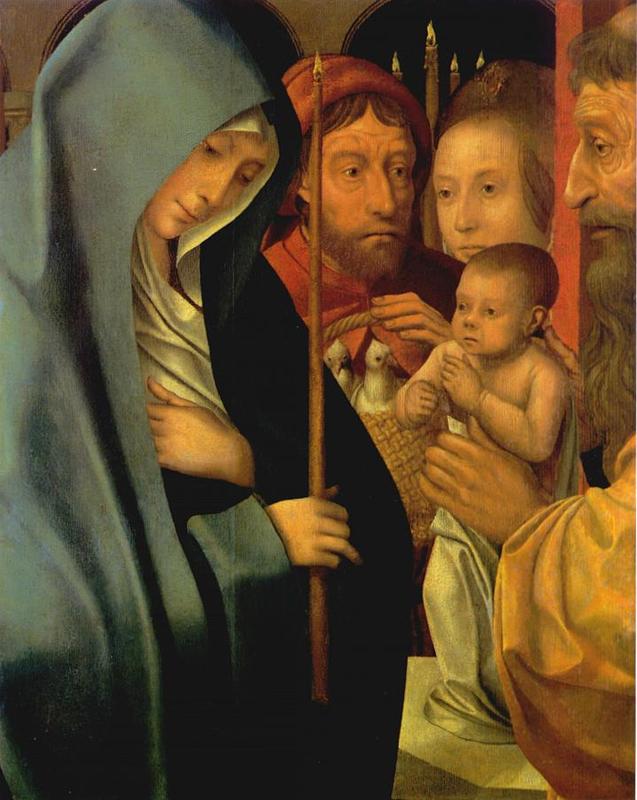
A few weeks ago I wrote about the custom we have in our house of leaving our Christmas lights up until today, the Presentation of the Lord (Candlemas), and the reasons for doing so. (See “God loves to light little lights”)  Well, today is the last day of our Christmas lights.  Even as I write this, I am facing two candles alit in my office windows that won’t be there tomorrow.  I was bemoaning all this to myself this morning until I read the Second Reading for the Office of Readings for today and realized anew that you and I are and will be the ongoing Christmas lights in this world, in season and out of season. (Note: the Eastern Church refers to this feast as The Meeting of the Lord.)

In honor of the divine mystery that we celebrate today, let us all hasten to meet Christ.  Everyone should be eager to join the procession and to carry a light.
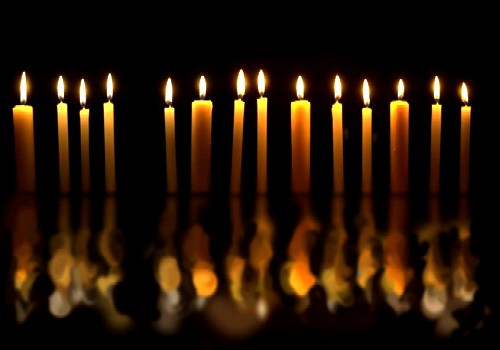
Our lighted candles are a sign of the divine splendor of the one who comes to expel the dark shadows of evil and to make the whole universe radiant with the brilliance of his eternal light.  Our candles also show how bright our souls should be when we go to meet Christ.
The Mother of God, the most pure Virgin, carried the true light in her arms and brought him to those who lay in darkness.  We too should carry a light for all to see and  reflect the radiance of the true light as we hasten to meet him.
The light has come and has shone upon a world enveloped in shadows; the Dayspring from on high has visited us and given light to those who lived in darkness.  This, then, is our feast, and we join in procession with lighted candles to reveal the light that has shone upon us and the glory that is yet to come to us through him.  So let us hasten all together to meet our God.
The true light has come, the light that enlightens every man who is born into this world. Let all of us, brethren, be enlightened and made radiant by this light.  Let all of us share in its splendor, and be so filled with it that no one remains in the darkness.  Let us be shining ourselves as we go together to meet and to receive with the aged Simeon the light whose brilliance is eternal.  (From a sermon by Saint Sophronius, bishop)

This evening we will begin Mass in our chapel with a procession, each of us carrying a lit candle.  I’m praying it will remind me of the true Light that dwells in me.  Tomorrow evening at Night Prayer when the lights are dimmed in our chapel for the singing of the Salve Regina, there will be only one lit candle (besides the sanctuary lamp) and that will be the one before the icon of the Mother of God.  “The Mother of God, the most pure Virgin, carried the true light in her arms and brought him to those who lay in darkness.  We too should carry a light for all to see and  reflect the radiance of the true light as we hasten to meet him.”  O sweet Mother of God, help us to do so.

“This is the night of the Humble One”

A sermon for the Feast of the Nativity by St. Isaac the Syrian.

This Christmas night bestowed peace on the whole world;
So let no one threaten;

This is the night of the Most Gentle One –
Let no one be cruel;

This is the night of the Humble One –
Let no one be proud.

Now is the day of joy –
Let us not revenge;

Now is the day of Good Will –
Let us not be mean.

In this Day of Peace –
Let us not be conquered by anger.

Today the Bountiful impoverished Himself for our sake;
So, rich one, invite the poor to your table.

Today we receive a Gift for which we did not ask;
So let us give alms to those who implore and beg us.

This present Day cast open the heavenly doors to our prayers;
Let us open our door to those who ask our forgiveness.

Today the Divine Being took upon Himself the seal of our humanity,
In order for humanity to be decorated by the Seal of Divinity.

St. Joseph and the Tempter . . . and us

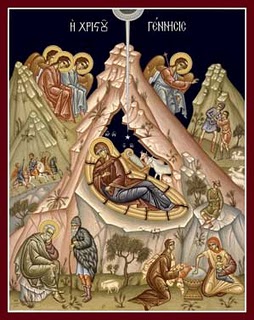
In this more lengthy reading, Pope Benedict explains part of the Christmas icon shown below:

The Christmas icon of the Eastern Orthodox Church developed its essential form as early as the fourth century and in it has captured the complete mystery of Christmas.  It represents the intimate connection between Christmas and Easter, between crib and Cross, the harmony between the Old and the New Testaments, the unity of heaven and earth in the song of the angels and the devotion of the shepherds.  Each figure in it has a profound underlying significance.  Remarkable in all this is the function reserved for St. Joseph.  He is sitting to the side, lost in deep reflection.  In front of him stands the Tempter, disguised as a shepherd, who addresses him, according to the text of the liturgy, in this way: “Just as your root cannot produce leaves, just as an old man cannot become a father anymore, so also the virgin cannot give birth.”  The liturgy then adds: In his heart there raged a storm of contradictory thoughts; he was confused; but enlightened by the Holy Spirit he sings Alleluia.  Through the figure of Saint Joseph the icon presents a drama that recurs time and again–the drama of ourselves.  It is always the same.  Time and again the Tempter tells us: There is nothing but the visible world, there is no Incarnation of God, and there is no birth of the Virgin.  This is the denial that God knows us, that he loves us, that he has the power to be active in the world.  And thus it is, in its core, the refusal to give God the honor.  It is the temptation of our time, which presents itself with so many clever and seemingly brand-new reasons as to appear utterly convincing.  Yet it is still the same old temptation.  We ought to pray to Almighty God that he may send into our hearts also the light of the Holy Spirit.  We ought to pray that he may grant to us also the grace to leave the stubbornness of our own reasoning behind, to gaze at his light with joy and to sing out, “Alleluia”–Christ is truly born, God has become man.  We ought to pray that in us also the words of the Easter liturgy may become reality: “We present to you a Virgin and Mother.  We present to you ourselves as well, more valuable than any gift of money: the wealth of true faith–to you, our God, and Savior of our souls.” Amen.  (Pope Benedict XVI, Lob der Weihnacht, p. 45)

The stars were brighter

Two short Christmas poems:

Starry, Starry Night

     The stars were brighter
         than ever before.
     The night was different,
crackling with new beginnings.
     Something was happening
          in the dark, smelly stable;
Gift of God was before us.      (Anonymous)

Wee One in a Manger

A Wee One in a manger
Praise Him where He lies,
Angels singing carols,
Listening winter skies!   (Hayashi)

Milk or incense?

A beautiful meditation by St Basil on what Mary may have pondered:

She asked Him, “What shall I call you?
Man? But your conception was divine.
God? but you are clothed with our flesh and blood.
What shall I do for you? Shall I nurse you with my milk or glorify you?
Shall I care for you like a mother or worship you like a maidservant?
Shall I kiss you like my son or pray to you like my God?
Should I give you milk or incense?
What an ineffable mystery!
Heaven uses you as a throne and you lie in my arms!
You give yourself wholly to the inhabitants of the earth,
Yet you do not deprive Heaven of your presence.

Christmas is so incarnational

Christmas is so incarnational.  That may sound redundant, but it is worth pondering: the whole mystery of the divine taking on flesh and blood.  Some thoughts about this from Caryll Houselander:

Christ used the flesh and blood of Mary for his life on earth, the Word of love was uttered in her heartbeat.  Christ used his own body to utter his love on hearth; his perfectly real body, with bone and sinew and blood and tears; Christ uses our bodies to express his love on earth, our humanity.
     A Christian life is a sacramental life, it is not a life lived only in the mind, only by the soul; through the bodies of men and women Christ toils and endures and rejoices and loves and dies; in them he is increased, set free, imprisoned, restrained.  In them he is crucified and buried and rises from the dead.
     Our humanity is the substance of the sacramental life of Christ in us, like the wheat for the host, like the grape for the chalice.
     Christ works his love through material as well as spiritual things.  Into his worship, following his own lead, the Church, his Church, brings material things, pure wax, flame, oil, salt, gold, water, linen, the voices of people, the gestures and actions of people, our own souls and bodies–the substance of our flesh and blood.  All this is consistent with the Incarnation, when Christ took the human nature of our Lady to be himself.   (The Comforting of Christ, pp. 26-27)