The Reality of Hope

I would like to refer you to an excellent article I read yesterday at First Things, entitled “The Reality of Hope.”  It’s written by Amy Julia Becker who lost her mother-in-law to cancer six years ago.  She writes about what the word “hope” really means as you live through the experience of losing someone you dearly love. 

After she died, it was as if I had broken my arm. A part of me ached all the time, and something that had been functional was now useless, and everything about my daily routine needed to be navigated differently. It was difficult, for instance, to stand in line at the post office or buy groceries or make dinner. Nothing seemed to matter anymore.

I had spent much of the final six months of her life with her, my mother-in-law, my friend: Penny. And once she was gone, I missed her. I missed the Penny I knew when she was healthy—the woman who had enjoyed kick-boxing, who loved ice cream and didn’t like cilantro, who had hand-addressed our wedding invitations. I missed the Penny I came to know in the midst of her battle against cancer, who, after surgery, laughed so hard in response to a get-well card that staples holding her wound together were dislodged, who walked around the block in sneakers and a nightgown just to get outside, who held my hand as she slept, who said, “thank you” even at the very end.

You can read the rest here.
O Beauty Ancient, O Beauty So New

If any of you are interested in listening to a talk I gave several years ago on beauty, O Beauty Ancient, O Beauty So New, you can click here.  (Then click on “Click here to start download.”  You can then choose to either 1) open it–which takes about five minutes and will then start playing on your media player–or 2) save it to your IPod or some other file.)

Two stones in your pocket

A man should carry two stones in his pocket.

Rate this:

A story from Rabbi Bunam:

A man should carry two stones in his pocket.  On one should be inscribed, “I am but dust and ashes.”  On the other, “For my sake was the world created.”  And he should use each stone as he needs it.

Which stone do you need to use today?

If you were to rewrite this story from a Christian perspective, what would you write on the second stone?

It is impossible for us to forget such splendorous beauty

The Catholic Church has more than one lung . . .

Rate this:

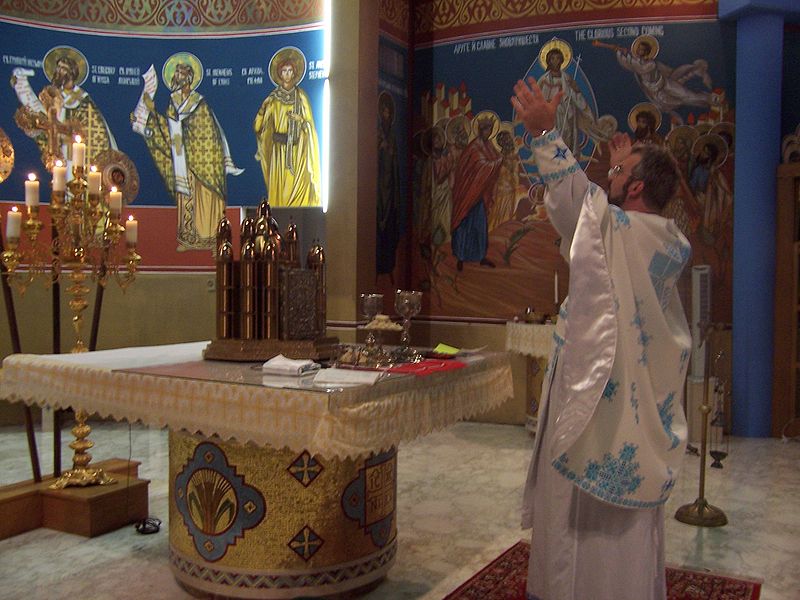
Yesterday I took our two postulants to the Divine Liturgy at Sacred Heart Byzantine Catholic Church in Livonia.  We’re in the middle of a series of talks on ecumenism, which includes a bit about the Eastern Catholic Churches in communion with Rome.  This was their field trip.  🙂

Ukrainian Catholic Liturgy

I’ve been to this church numerous times and love the beauty, the icons, the incense,  the prayers of the Eastern Liturgies.  I have to pinch myself when I’m there to remind myself that this is our Church.  I always remember how John Paul II stressed the need for both lungs in the Church–referring to the Eastern and Western (That’s us–the Latin Church) Churches.  It calls to mind this story:

In the 10th century, the Prince of Kiev [present day Ukraine] sent ambassadors out throughout the world in search of the best religion: to the Muslims, to the Jews, the Latins, and the Greeks.  When the ambassadors that had gone to Constantinople returned and shared about their experience, the story goes that Prince Vladimir decided without any hesitation for Christianity. The ambassadors said, “We knew not whether we were in heaven or on earth, for assuredly on earth such beauty cannot be found anywhere else.  So we do not know what we ought to tell you; but one thing we know well: there God dwells among men who celebrate His glory in such a manner that no other religion on this earth could equal.  It is impossible for us to forget such splendorous beauty.”

There may be many of you who aren’t even aware that the Catholic Church is made up of more than just one church.  There are, I believe, 22 Eastern Churches that are in communion with Rome: the Melkite, the Maronite, etc.  Each has its own liturgy, but we can all participate in each other’s.  This is indeed part of the wonder of the Catholic Church. 

If you ever, ever have a chance to take your family to an Eastern Catholic liturgy, do so!  The one in Livonia is in English–which is, of course, a great help.  And the pastor there used to be a Latin Catholic so he’s sensitive to us not knowing what we’re doing at their liturgy.

Some helpful web sites:
Sacred Heart Byzantine Catholic Church, Livonia, MI
Byzantine Catholic Church in America
The Byzantine Liturgy

A Greek Catholic Church

Christ, the lighted coal

“A friend comes to the rescue in time of need, and if he is aware of the truth of friendship, he directs his friend just as if he were himself and puts his own members at his disposal if he has lost his. … a friend is a lighted coal, and if placed beside it, it can rekindle a dead one.” (Bl. Simon Fidati of Cascia)

Christ is our true Friend, the lighted coal for each one of us, our hope of rekindling.

God is greater than our hearts . . .

I was away on vacation and then doing the proverbial catching up after vacation, and consequently neglecting this blog. Now I’m back.

Last week I read a very thought provoking–and hope provoking–piece in Magnificat by Msgr. Romano Guardini. The beginning may not sound hopeful–hang in there with it.

In the condemnation of the heart, it is God himself who condemns. Wrong has been done to him. Wrong has been done to the gentle and holy life that he has awakened in the heart, to the holy trust that binds him to his child. How can man’s self-defense reach these depths.

What possible help is there? John says, “If our heart condemns, us, God is greater than our heart.” Do you observe that this answer comes from the same depths as the condemnation itself? The answer is not: “You have done right. Your intentions were good. Be of good cheer.” No, the answer is: “God is greater than your heart.”

Your heart is great. That is the first thing, and it is amazing that that should be said at all. But God is still greater. The heart that has been lost is great. But God is greater. The heaviness of the heart to which wrong has been done is so great that it must sink. God is the sea of greatness where everything heavy is made light. The wrong that has been done to life is great. God is the Creator, and God is life and grace. He is greater than everything. The holiness to which wrong has been done partakes of the dignity of God. His trust has been infringed. That is terrible. But he himself, his magnanimity, his creative love, is greater than all this wrong. John does not say, “Cheer up, it isn’t so bad after all.” He does not say, “Don’t take life so seriously.” God says, “Give these things their full weight. Then I will come to you. I am God.”

And when he comes, the creature will become clear to itself. Its self-importance will be dissolved, and everything will be fulfilled.

Let them not, then hide this hope

“They [the laity] show themselves to be children of the promise, if, strong in faith and in hope, they make the most of the present time (cf. Eph. 5:16; Col. 4:5), and with patience await the glory that is to come (cf. Rom. 8:25). Let them not, then hide this hope in the depths of their hearts, but even in the framework of secular life let them express it by a continual turning toward God and by wrestling ‘against the world-rulers of this darkness, against the spiritual forces of wickedness’ (Eph. 6:12).” (from Lumen Gentium 34)