Milk or incense?

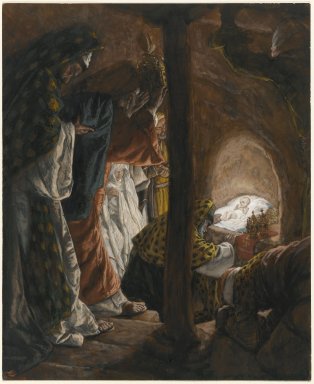
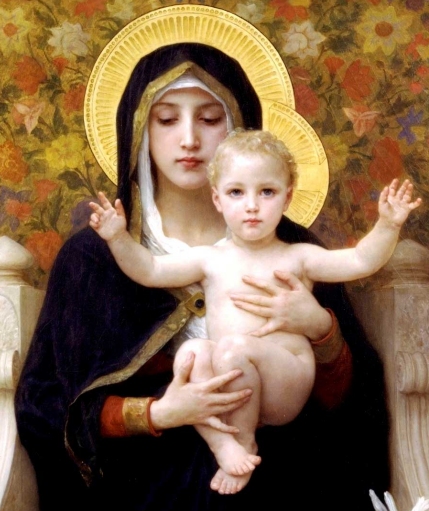
A beautiful meditation by St Basil on what Mary may have pondered:

She asked Him, “What shall I call you?
Man? But your conception was divine.
God? but you are clothed with our flesh and blood.
What shall I do for you? Shall I nurse you with my milk or glorify you?
Shall I care for you like a mother or worship you like a maidservant?
Shall I kiss you like my son or pray to you like my God?
Should I give you milk or incense?
What an ineffable mystery!
Heaven uses you as a throne and you lie in my arms!
You give yourself wholly to the inhabitants of the earth,
Yet you do not deprive Heaven of your presence.

Christmas is so incarnational

Christmas is so incarnational.  That may sound redundant, but it is worth pondering: the whole mystery of the divine taking on flesh and blood.  Some thoughts about this from Caryll Houselander:

Christ used the flesh and blood of Mary for his life on earth, the Word of love was uttered in her heartbeat.  Christ used his own body to utter his love on hearth; his perfectly real body, with bone and sinew and blood and tears; Christ uses our bodies to express his love on earth, our humanity.
     A Christian life is a sacramental life, it is not a life lived only in the mind, only by the soul; through the bodies of men and women Christ toils and endures and rejoices and loves and dies; in them he is increased, set free, imprisoned, restrained.  In them he is crucified and buried and rises from the dead.
     Our humanity is the substance of the sacramental life of Christ in us, like the wheat for the host, like the grape for the chalice.
     Christ works his love through material as well as spiritual things.  Into his worship, following his own lead, the Church, his Church, brings material things, pure wax, flame, oil, salt, gold, water, linen, the voices of people, the gestures and actions of people, our own souls and bodies–the substance of our flesh and blood.  All this is consistent with the Incarnation, when Christ took the human nature of our Lady to be himself.   (The Comforting of Christ, pp. 26-27)

Awake, Mankind!

Awake, Mankind!  For your sake God has become man.  Awake, you who sleep, rise up from the dead, and Christ will enlighten you.  I tell you again, God became man.
     You would have suffered eternal death, had he not been born in time.  Never would you have been freed from sinful flesh, had he not taken on himself the likeness of sinful flesh.  You would have suffered everlasting unhappiness, had it not been for this mercy.  You would never have returned to life, had he not shared your death.  You would have been lost if he had not hastened to your aid.  You would have perished, had he not come.
     Let us then joyfully celebrate the coming of our salvation and redemption.  Let us celebrate the festive day on which he who is the great and eternal day came from the great and endless day of eternity into our own short day of time. 

~St. Augustine, Sermon 185

God’s homely Christmas tree

I am remembering a homily given years ago by a priest friend of mine.  It went something like this.  He and some other priests had moved into a new place together shortly before Christmas. They wanted to put up a Christmas tree, but none of them had ornaments, so they purchased new ones.  It turned out to be a beautiful tree.   On Christmas day, this priest went home to visit his parents and noticed the family Christmas tree, replete with the ornaments they had used all through the years.  Some were quite simple, others were those he had made in school and given to his parents, while others just had so many memories attached to them.  He could look at each ornament with such fondness because of the history behind it, yet this tree was in no way as “beautiful” or perfect as the new one at his home with the other priests. In his homily the priest went on to say that we are the ornaments on God’s Christmas tree and that He looks at each one of us with love and fondness.  We, all together, do not make a “beautiful” tree, but we make up God’s Christmas tree which He loves.

His love for me

A blessed Feast of the Nativity to each of you and your loved ones!

from an ancient writing, the Odes of Solomon:

His love for me brought low his greatness.
He made himself like me so that I might receive him.
He made himself like me so that I might be clothed in him.
I had no fear when I saw him,
for he is mercy for me.
He took my nature so that I might understand him,
my face so that I should not turn away from him.

Songs, music, good feelings

Most years as I approach the Feast of the Nativity, I feel fairly “emotioned” out.  This year seems to be no exception.  There’s been a lot going on on the home front.  It was good to read this meditation from Henri Nouwen, to be reminded that celebration and thanksgiving really are not about emotions and feelings, but about something way beyond them. 

Somehow I realized that songs, music, good feelings, beautiful liturgies, nice presents, big dinners, and many sweet words do not make Christmas.  Christmas is saying “yes” to a hope based on God’s initiative, which has nothing to do with what I think or feel.  Christmas is believing that the salvation of the world is God’s work and not mine.  Things will never look just right or feel just right.  If they did, someone would be lying . . . . But it is into this broken world that a child is born who is called Son of the Most High, Prince of Peace, Savior.  (The Road to Daybreak)

Searching for the Christ Child

Life, for women especially, can be so very busy before this most holy day that is approaching so swiftly.  Sometimes we miss the Christ Child because we are so busy, but take hope from this meditation by Fulton Sheen.  God works everything for the good.

The Russian peasantry for centuries has propagated a curious tradition.  It is about an old woman, the Baboushka, who was at work in her house when the wise men came from the East and passed on their way to Bethlehem to find the Child.  “Come with us,” they said.  “We have seen his star in the East, and we go to worship him.”
     “I will come, but not now.  I have much housework to do, and when that is finished, I will follow and find him.”  But her work was never done.  And the Three Kings had passed on their way across the desert, and the star shone no more in the darkened heavens.
     Baboushka never saw the Christ Child, but she is still living and searching for him.  And though she did not find him, out of love for him, she takes care of all his children . . . . The tradition has it that she believes that in each poor child whom she warms and feeds, she may find the Christ Child whom she neglected long ago.  But she is not doomed to disappointment, for the Divine Child said, “He who receives one of these little ones in my name, receives me.”