November 29, 2000
“The will of God is that we should know he keeps us safely, alike in ‘weal or woe.’ . . . Both are equally his love.” (Julian of Norwich)
November 29, 2000
“The will of God is that we should know he keeps us safely, alike in ‘weal or woe.’ . . . Both are equally his love.” (Julian of Norwich)
November 29, 2000
“Have we not often been like George Tankervil? We have imagined what was coming, and perhaps tested our constancy by some fire of our own kindling, and faith and courage have suddenly collapsed. For grace to endure and to conquer is never given till the moment of need, but when that moment comes? O Savior, who dost not forget Thy Calvary, hast Thou ever failed the soul that trusted Thee? Never, never. By the merits of Thy Blood all is well, all shall be well.” (Amy Carmichael)
November 25, 2000
“True valor lies, not in what the world calls success, but in the dogged going on when everything in the man says Stop.” (Amy Carmichael)
November 25, 2000
“A wise master never wastes his servant’s time, nor a commander his soldier’s–there is great comfort in that.” (Amy Carmichael)
I have two 600 page journals mostly filled with quotes that have struck me, moved my heart, convicted me, strengthened me. I thought I would start going through the first–the blue one–and just passing them on to you. I hope they serve the same purpose in your lives as they have in mine.
November 25, 2000:
“The pledged word of God to man is no puffball to break at a touch and scatter into dust. It is iron. It is gold, the most malleable of all metals. It is more golden than gold. It abideth imperishable for ever. If we wait till we have clear enough vision to see the expected end before we stay our mind on Him who is our Strength, we shall miss an opportunity that will never come again: we shall never know the blessing of the unoffended. Now is the time to say, ‘My heart is fixed, O God, my heart is fixed: I will sing and give praise,’ even though as we say the words there is no sense of exultation. ‘It is possible to gather gold, where it may be had, with moonlight,’ by which I understand something less helpful than daylight would be in the search and the finding of gold. By moonlight, then, let us gather our gold.” (Amy Carmichael)
Whose mother-tongue is love . . .
Pentecost
Today we feel the wind beneath our wings
Today the hidden fountain flows and plays
Today the church draws breath at last and sings
As every flame becomes a Tongue of praise.
This is the feast of fire,air, and water
Poured out and breathed and kindled into earth.
The earth herself awakens to her maker
And is translated out of death to birth.
The right words come today in their right order
And every word spells freedom and release
Today the gospel crosses every border
All tongues are loosened by the Prince of Peace
Today the lost are found in His translation.
Whose mother-tongue is Love, in every nation.
I was just re-reading this wonderful quote this morning, and thought I would share it with you again. A blessed Feast!
Mary arose and went to Elizabeth without Elizabeth having asked her. This is the way Christ is always with us. He comes to us without waiting for us to ask Him. May this Feast remind us of that:
The visit that so honored and overwhelmed Elizabeth had not been sought by her: part of the very honor consisted int he fact that Mary had paid it of her own accord. . . . Our God treats us His poor creatures, in the same way. Whether the sinner who needs converting, or the just who is called to a higher life and the way of perfection, be concerned, He alike comes without waiting for us to ask Him. We are often not thinking of Him specifically at all–we may have forgotten Him; but He seeks us out–goes before us–or as sacred language has it, “prevents” us: we feel and know…
View original post 47 more words
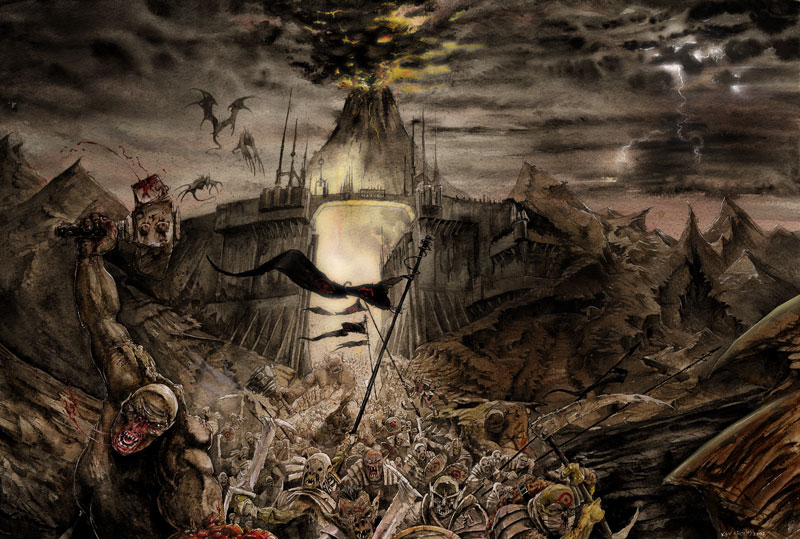
How do we keep going without hope?

A few days after the great battle the armies of the West gather once more upon the Pelennor Fields in order to march towards the Morannon, the same Black Gate that Frodo and Sam saw upon their journey to Mordor and realised was impossible to enter. Tolkien describes the march as a “hopeless journey”, one that must end in inevitable defeat and death, and this begins to weigh upon the hearts of the young soldiers.
For those who have lived their lives in the far provinces of Gondor and of Rohan, Mordor has been but a name only, albeit a dark and fearful one, now it is a living nightmare that is beyond their comprehension. Aragorn treats them with mercy, allowing them to withdraw and to fulfil a mission that they can comprehend. They are to recapture the island of Cair Andros that lies within the waters of the Anduin.
View original post 570 more words
A singular poem about what it was like for our Lady after the Ascension. How could she stand this separation?
Our Lady of the Assumption
Fold your love like hands around the moment.
Keep it for conference with your heart, that exit
Caught on clocks, by dutiful scribes recorded
Less truly than in archives of yor soul.
Turn back from His going, be His still-remaining.
Lift the familiar latch on cottage door . . .
Discover His voice in corners, hear His footfalls
Run down the porches of your thoughts. No powers
However hoarse with joy, no Dominations
Curved with adoration guess what whispers
Of “Mother, look!” and “Mother, hurry!”
Glance off the cottage walls in shafts of glory.
How shall your heart keep swinging longer, Mary?
Quickly, quickly, take the sturdy needle
Before your soul crowds through your flesh! the needle
And stout black thread will save you. Take…
View original post 21 more words

 Witnesses to Hope