“So go forth very bravely with perfect trust in the goodness of him who calls you to this holy task. When has anyone ever hoped in the Lord and been disappointed? Mistrust of your own powers is good as long as it is the groundwork of confidence in God’s power; but if you are ever in any way discouraged, anxious, sad, or melancholy I entreat you to cast this away as the temptation of temptations; and never allow your spirit to argue or reply in any way to any anxiety or downheartedness to which you may feel inclined. Remember this simple truth which is beyond all doubt: God allows many difficulties to beset those who want to serve him but he never lets them sink beneath the burden as long as they trust in him. This, in a few words, is a complete summary of what you most need: never under any pretext whatsoever to yield to the temptation of discouragement, not even on the plausible pretext of humility.” (St. Francis de Sales)
Stories
I have been invited this morning to give a meditation to a group of teachers who are having an in-service on MLK Jr. Day. I used to teach at this school, and the last thing I would want on the morning of a holiday is to hear a meditation. So, what I’m going to do instead is read them some of my favorite inspirations stories. (Everyone loves to be read to. . . ) I’m going to share with them, among others, a few stories from Christopher de Vinck, one of the best story tellers I know (and an excellent poet). I posted this one four years ago, but it’s worth reading again. It’s from his book, Finding Heaven, Stories of Going Home.
A Prediction to Believe In
We are inundated with predictions these days. Political commentators predict the outcomes of elections before the final votes are tallied. Meteorologists predict snowstorms before even a single flake floats down from the mercurial sky. We rely on soothsayers and statisticians to determine the outcome of a football game and the behavior of the stock market. Some people in Japan claim that they can detect an illness before it strikes by scrutinizing the soles of people’s feet. There are those who fear that the world will end in 2012, because that’s when the Maya calendar runs out. People in India visit the town of Kanchipuram and pay to have their lives predicted by people who read palm leaves.
Sometimes it’s entertaining to see whether or not predictions come true. When I was fifteen years old, our black cat, Moses, deposited a wiggling, pink, four-legged newborn creature on the back porch. No one knew what type of animal it was, but everyone had an idea. My brother said it was a kitten. My sister said it would grow up to be a pig. “It’s a rat,” I announced with confidence. My mother looked down with concern. “Well, whatever it is,” she said, “it’s hungry.”
I quickly found a new eyedropper in the medicine cabinet, heated some milk on the stove, and tried feeding the mysterious animal. “Whatever it is,” I said, “it sure can drink.” We fed it day after day until, slowly, the hairless animal developed fur, wide eyes, and a long, full tail. A squirrel. Everyone’s guess was wrong.
Many predictions about the future are based on similar guesswork. We look at something, see some future shape in our imaginations, and confidently make a prediction. Often this imagined future is simply an extension of the past. The stock market will go up next month because it’s gone up for the last three. The Yankees will win the American League pennant because they’ve done so for th past three years. Our news agencies try to report stories before they happen.
It can be great fun when predictions fail. Schools in New Jersey were closed one recent winter day because meteorologists on television and on the radio predicted that we would experience one of the worst snowstorms in fifty years. They were wrong. Several inches of snow fell. I looked at my fifteen-year-old son as he entered the kitchen after sleeping until 8:30. “Why don’t you call some of your friends and go sledding? At least there is enough snow for that.”
Michael looked at me and said, “Hey, that’s a good idea.”
“I’ll pick everybody up,” I suggested, “and they can come back later for hot chocolate, and I’ll treat everyone to pizza.”
Michael logged on to AOL Instant Messenger and called friends on the phone at the same time. Within ten minutes, seven high school sophomores were all set to be picked up at 12:30. I predicted that they would have a great time. The prediction was correct.
The prediction of a catastrophic blizzard followed the pattern of many common prognostications. Something terrible is going to happen; evil will triumph as misfortune overtakes us. I think there’s a difference between predictions based on what has happened in the past or on pessimistic outlooks and predictions based on faith, hope, and goodness. I think predictions of evil are often wrong. Surely they are wrong in an ultimate sense.
I am a person of faith. My mother predicted that my brother Oliver would be the first person to greet me in heaven, and I can hold on to that prediction and believe in it because I have faith.
I say, listen carefully–and skeptically–to what the news organizations are telling you. Listen to CNN, and then look at your children being good. Read Newsweek, and then watch your loved ones live each day with stamina and courage. Don’t believe that news programs and newspapers always project what is really happening in the world, or what might happen. Do not be misled by their dire predictions. Understand that the media experts are trying to grab our attention. A fifteen year old who shoots thirteen people in a high school is terrible news. Goodness, like a rich autumn crop, is not news at all.
I liked watching that hairless animal develop into a fat, gray squirrel. I liked listening to my son’s teenage friends singing together over pizza and soda. I like thinking about dancing with my brother in heaven.
Should I listen to Dan Rather’s view of the world or my mother’s? That’s an easy choice.
The love of God the Father
“God knows not how to be anything other than love, he knows not how to be anyone other than the Father. Those who love are not envious and the one who is the Father is so in his totality. This name admits no compromise, as if God were father in some aspects and not in others”. (St. Hilary of Poitiers)
The wonderful love story
I just began reading this wonderful book, The Jesus Storybook Bible by Sally Lloyd-Jones & illustrated by Jago. Those of you with kids are probably familiar with it. I learned a long time ago that a lot of kids’ books aren’t just for kids–and this is one of them. Here are a favorite couple of pages:
(Pssst. If you click on the picture, you can view it enlarged.)

Abandonment
This is such a profound insight, one that is applicable to all of us in various ways:
” . . . the way Mother Teresa learned to deal with her trial of faith: by converting her feeling of abandonment by God into an act of abandonment to God.” (Carol Zaleski)
The voice of the Father

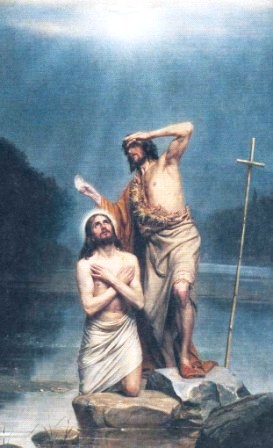 One of the wonders of the Lord’s Baptism, which we celebrate today, is that for the first time Christ heard His Father’s voice as a man. This has incredible meaning for us, this unveiling of the heart of the Father for us:
“It is as man that he now hears his Father and sees the Spirit, and he rejoices that, because he now dwells humbly among the sons of men, the Father can no longer speak to him without his fellow-man feeling something of the vibration of that resounding Voice. Christ brings man not so much a teaching as a dazzling proximity to the inner life of God. And the very essence of the divine life, the very life-breath of the Son, is the good pleasure, the gracious favor and delight of the Father.” (Erasmo Leiva-Merikakis)
Through His baptism by John, Jesus shows us the way to attaining this inner…
View original post 124 more words
Mary words
“Through the Incarnation of the Word the all-holy Virgin has been given to us as an all-powerful intercessor, who protects us from sins, misfortunes and disasters, praying for us day and night, our queen whose power no enemy–visible or invisible–can withstand, truly our mother by grace in accordance with the words uttered by Christ on the cross to the beloved disciple: Behold thy mother! and to her: Behold thy son!” (Father John of Krondstadt)
One child was blind.
A beautiful excerpt from Michael O’Brien’s A Cry of Stone which illustrates well my last post.
In the drowsy sun of an autumn afternoon, she sat sketching the brightly colored trees in a little park not far from the house. The walkways were temporarily deserted and at the moment when she felt most grateful for this haven of peace, a noise of galloping hoofs thundered around a curve in the path. A rushing shape approached through piles of red leaves, scattering them left and right . . . .
Rose tore her eyes from her drawing to see two gasping little girls running hand in hand. They went past at a tremendous clip, leaving in their wake a whir of whipped air, spiraling leaves, and a stream of sound like a long, pure note, as if they were humming together.
One child was blind. Her eyes were gouged and scarred, her head nodding in a sightless headlong plunge, her face intent on nothing save the grip of her companion’s hand the unsuspected thickness of air, and the taste of utter exhilaration. On the face of her seeing friend were other ecstasies–large, open, race-horse eyes, the panting thoroughbred power of giving the impossible thing. The seeing girl had bestowed upon her blind friend a different form of sight, the feeling of wind on skin, of small unused muscles pumping at catastrophic speed, the awesome pitch through treacherous air that always contained within it the threat of collision, and the promise of soaring.
There is my soul, thought Rose. O, O, ay, ay, that I might trust what you are doing with me in this rushing darkness.
If you are that blind child, put your full trust in the One holding your hand.
Seeing the stars
I have been going through my fairly hefty journal filled with mostly quotes. I came across one that I blogged about nearly five years ago, so I thought I would share it again. I love his analogy.
I ran across this piece by Fr. Garrigou-Lagrange when I was going through a very dark time of prayer. What he has to say applies also, of course, to any times of darkness in our lives–times when we can’t see the ending, wondering if it will be good or bad. (Of course, God works everything for the good, but sometimes it’s hard to even see that, isn’t it?) Fr. Garrigou-Lagrange writes: “If we are saddened at the approach of twilight, God could well answer us by saying: How can I otherwise reveal to you all those thousands of stars which can only be seen at night?” Isn’t that the truth–we can only see stars if there is darkness–and a deep darkness at that. And we can only see certain spiritual things (of just as much beauty as the stars on a clear, clear night) if we walk through certain darknesses that God allows. “To You I lift up my eyes, O You who are enthroned in the heavens!” (Ps 123.1) Lift up your eyes!

 Witnesses to Hope