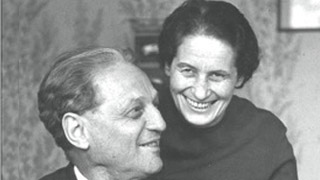
In reading the book by Richard Wurmbrand this past week, it is hard not to think of all those who have gone before us to Christ by the path of martyrdom and the many who tread that path today. This poem by Emily Dickenson succinctly sums up their secret and is an encouragement to all of us.
Through the straight pass of suffering
The martyrs even trod,
Their feet upon temptation
Their faces upon God.
Back in January I started a series on “the difficult love”: loving those whom we find difficult to love. The ultimate test, of course, is loving our enemies . . . which Christ has indeed commanded us to do. I have been reading the life of Richard Wurmbrand, a Jewish Christian pastor who was imprisoned and tortured in Romania during the Communist regime there. His wife’s entire family, who were Jewish, had been killed. Years later, in God’s providence, the man responsible for the killing of Sabina’s family, friend of their landlord, ended up staying in the same apartment building where they were living. When Richard discovered this fact, he spent the entire night in prayer and fasting to prepare himself for meeting him. He made no mention of any of this to Sabina. Richard sought him out with the intention of bringing him to Christ. The man resisted, becoming very angry. The landlord had to forestall a potentially ugly scene. As the conversation progressed and moved in other directions, Richard discovered that the man had a love for Ukrainian songs. Richard, who knew those songs and could play them on the piano, thought, “The fish has entered my net!” He invited him back to his apartment and played some of the songs for him–softly, because his wife was asleep in the next room. He couldn’t help thinking of the power of David’s harp playing over Saul’s troubled spirit. Richard then said to him–Borila was his name–“I have something very important to say to you.” He proceeded to tell him his wife’s story. I’ll let him tell the rest:
He jumped up, his eyes blazing, looking as if he were about to strangle me.
I help up my hand and said, “Now–let’s try an experiment. I shall wake my wife and tell her who you are, and what you have done. i can tell you what will happen. My wife will not speak one word of reproach! She’ll embrace you as if you were her brother. She’ll bring you supper, the best things she has in the house.
“Now, if Sabina, who is a sinner like us all, can forgive and love like this, imagine how Jesus, who is perfect Love, can forgive and love you! Only turn to Him–and everything you have done will be forgiven!”
Borila was not heartless: within, he was consumed by guilt and misery at what he had done, and he had shaken his brutal talk at us as a crab shakes its claws. One tap at his weak spot and his defenses crumbled. The music had already moved his heart, and now came–instead of the attack he expected–words of forgiveness. His reaction was amazing. He jumped up and tore at his collar with both hands, so that his shirt was rent apart. “Oh God, what shall I do, what shall I do?” he cried. He put his head in his hands and sobbed noisily as he rocked himself back and forth. “I’m a murderer, I’m soaked in blood, what shall I do?” Tears ran down his cheeks.
I cried, “In the name of the Lord Jesus Christ, I command the devil of hatred to go out of your soul!”
Borila fell on his knees trembling, and we began to pray aloud. He knew no prayers; he simply asked again and again for forgiveness and said that he hoped and knew it would be granted. We were on our knees together for some time; then we stood up and embraced each other, and I said: “I promised to make an experiment. I shall keep my word.”
I went into the other room and found my wife still sleeping calmly. She was very weak and exhausted at that time. I woke her gently and said, “There is a man here whom you must meet. We believe he has murdered your family, but he has repented, and now he is our brother.”
She came out in her dressing gown and put out her arms to embrace him: then both began to weep and to kiss each other again and again. I have never seen bride and bridegroom kiss with such love and purity as this murderer and the survivor among his victims. Then, as I foretold, Sabina went to the kitchen to bring him food.
. . .
Borila’s happiness was very moving. He stayed with us that night, and when he awoke the next day, he said, “It’s been a long time since I slept like that.” (In God’s Underground, pp. 224-225)
For those of you who have been tempted to “kill” your children when they couldn’t sit still while you were in church or adoration–especially when they knew better: a post I think you’ll enjoy from Betty Duffy.
I noticed something this morning as I was meditating/studying Psalm 42. The psalm seems to fluctuate between feelings of desperation and self-encouragement to hope in God for “I shall again praise him.” The “something” I noticed was a shift from focus in v. 4 to v. 6. In v. 4, the psalmist attempts to lift up his spirits by remembering things in the past, ways that he had led worshipers in giving thanks to God for things He had done, the remembering of which should surely give him hope. Not a bad thing to do when you’re discouraged. Definitely a step in the right direction. But in v. 6, when his “soul is cast down”, he “remembers thee“. He remembers God, and God alone. How much better to lift our minds and hearts to God rather than just dwelling on the things of God? Things and events may change, but God is always immoveable and unchanging, and that implies that His Love is unchanging . . . for He is Love.
Amy Carmichael’s note on this poem of hers: “Ps 109.21. A prayer that may be unfathomable comfort to the ill and tired: ‘Do Thou for them, for him, for her, O God the Lord.’ When one cannot pray minutely or powerfully, this prayer suffices. We need not tell Love what to do; Love knows.” God knows better than we what is best for those we love. Here Amy is simply encouraging us to trust Him who knows how to love best.
Do Thou For Me
Do Thou for me, O God the Lord,
Do Thou for me.
I need not toil to find the word
That carefully
Unfolds my prayer and offers it,
My God, to Thee.
It is enough that Thou wilt do,
And wilt not tire,
Wilt lead by cloud, all the night through
By light of fire,
Till Thou has perfected in me
Thy heart’s desire.
For my beloved I will not fear,
Love knows to do
For him, for her, from year to year,
As hitherto.
Whom my heart cherishes are dear
To Thy heart too.
O blessèd be the love that bears
The burden now,
The love that frames our very prayers,
Well knowing how
To coin our gold. O God the Lord,
Do Thou, Do Thou.
I just realized that I have been posting on this blog for well over a year now. And there’s a lot of good stuff hidden away in those past posts, so I am going to periodically redirect you to one of them–just in case you missed reading it. 🙂 Here’s one from May 2009: Don’t be afraid of being afraid. Hope you enjoy it.
I know I said I was “out of town”. . . but I just had to share this excerpt following up on my post from yesterday. It’s from Never Give Up by John Janaro:
Am I grumbling?
I think it is important to distinguish between the grumble and the lament. Both can express themselves as “God, why are you doing this to me?” But they mean two different things. The lament is a prayer; read the Psalms. It is a cry of pain–the pain that a creature feels under the weight of the transforming pressure of the divine Creator and Lover, who carries out his mysterious plan in my life via an incomprehensible suffering. The grumble, on the other hand, is a loss of trust in God motivated by my own misery. It gets me forty more years in the desert–read the book of Exodus. (p.70)
I have both written about and spoken about lament. It really is important to know the difference between a grumble and a lament. If not, we run the risk of either not speaking to God of our troubles, of deciding to just bottle them up deep inside or of running on and on complaining to Him but not really expressing our trust in Him. God wants to be with usin our suffering.
Suffering must be endured not because life is less important than we had hoped but because it is more important than we can imagine. It is the place where God is with us. (p. 52)
We are called to endure suffering not with stoic resignation but with abandonment to his loving presence. We endure in the conviction that God offers us his love–the only fulfillment of the human heart–here and now, in the midst of our sufferings and the plodding of our daily lives. We are called to put our hearts on the line, to allow ourselves to be wounded by the hope that even in this darkness it is possible to love and to be loved, because he is with us and he loves us now. And we know that love–in the end–is always worth the risk. (p. 53)
The abyss is the hollow of the hands of God. (p. 53)
Life is busy; it’s still too hot for me; I’m not sleeping well; my internet connection is spotty; I’m “leaving town” for a week and a half and have a lot to do before and afterwards; and I have no inspiration. I don’t mean to complain, just to explain. This meditation from Amy Carmichael is for me–but you can read it as well.
I want to give you a word that helped me all yesterday and will help me today. It is the ‘through’ of Psalm 84.6 [“Passing through the valley of Weeping they make it a place of springs”] and of Isaiah 43.2 [“When you pass through the waters, I will be with you; and through the rivers, they shall not overcome you”] taken with Song of Songs 8.5 [“Who is this coming up from the wilderness, leaning upon her beloved?”].
We are never staying in the valley or the rough waters; we are always only passing through them, just as the bride in the Song of Songs is seen coming up from the wilderness leaning upon her Beloved.
So whatever the valley is, or however rough the waters are, we won’t fear. Leaning upon our Beloved we shall come up from the wilderness and, as Psalm 84.6 says, even use the valley as a well, make it a well. We shall find the living waters there and drink of them. (Candles in the Dark, p. 78)
As I said, I’m “out of town” for the next while. Dip into some old posts. There is still some good stuff there! (Just click on “Amy Carmichael” under “Categories”–that will keep you going for awhile!)
We tend to pray with great intensity for the things we want, but do we ever think of praying for what God wants? It is very important that when we pray, we move with the current of God’s will, and not against it. This is true even when we are praying for someone we love tremendously. (Catherine de Hueck Doherty)