Author: Sr. Dorcee, beloved
I am the one whom Jesus loves.
Palm Sunday
This holiest of weeks I would like to share a poem or piece of art each day, hopefully drawing you deeper into the Great Mystery we are celebrating. I begin with one by Malcolm Guite.
Palm Sunday: A Sonnet

We come now, with Palm Sunday, to the beginning of Holy Week and in the sonnets that follow I have explored the truth that what was happening ‘out there’ and ‘back then’ as Christ entered Jerusalem is also happening ‘in here’ and ‘right now’. There is a Jerusalem of the heart. Our inner life also has its temple and palaces, its places of corruption, its gardens of rest, its seat of judgement.
If you would like to join in a discussion of these and my other poems for Holy Week poems you can do so by joining the Literary Life Facebook Page
I am grateful to Linda Richardson who has given me permission to share with you her series of remarkable paintings, ‘The Faces of Holy Week’. These will be on display, together with my poems, in the resurrection chapel in St. Mary’s Linton throughout Holy Week, do look in and see them if you are in the area. You can also look at these paintings and others on Linda’s Webpage.
Linda writes about this picture:
Very often I have thought that I knew what Jesus was about, what he was doing and why he was doing it. Then later I realise it was more than that, something deeper, and my understanding is stretched, and later is stretched again. So it is with Palm Sunday. Jesus is always with me on on my journey but he is always behind me and he is always beyond me.
In this painting Jesus face is elusive, and the features are gestural brush strokes, but energetic and visceral. It is a mixed media painting and within the face is the palm branch that I received at the Palm Sunday service last year. In the painting there is a ceremony from the past, a reminder of the cross that is to come, but if we don’t give our attention, we might miss the present day revelation of Palm Sunday. What will Jesus say to us today? We might imagine there is nothing new to learn, but as our “easy feelings” go through the familiarity of a Palm Sunday service are we still listening?
Palm SundayNow to the gate of my Jerusalem,
The seething holy city of my heart,
The saviour comes. But will I welcome him?
Oh crowds of easy feelings make a start;
They raise their hands, get caught up in the singing,
And think the battle won. Too soon they’ll find
The challenge, the reversal he is bringing
Changes their tune. I know what lies behind
The surface flourish that so quickly fades;
Self-interest, and fearful guardedness,
The hardness of the heart, its barricades,
And at the core, the dreadful emptiness
Of a perverted temple. Jesus come
Break my resistance and make me your home.
“A thousand times a day I will begin again.”

“If I should fall a thousand times a day, a thousand times a day I will begin again, with new awareness of my weakness, promising God, with a peaceful heart, to amend my life. I will never think of God as if he were of our condition and grows weary of our wavering, weakness, and negligence. . . . Rather, I will think of what is truly characteristic of him and what he prizes most highly, that is, his goodness and mercy, knowing that he is a loving Father who understands our weakness, is patient with us, and forgives us.”
Venerable Bruno Lanteri, spiritual counsels
Falling
“When Christ came into our midst to redeem us,he descended so far that after that no one would be able to fall without falling into him.” (von Balthasar)
When you fail
“When you fail to measure up to your Christian privilege, be not discouraged for discouragement is a form of pride. The reason you are sad is because you looked to yourself and not to God; to your failings not to His love. You will shake off your faults more readily when you love God than when you criticize yourself. God is more lenient than you because he is perfectly good and therefore loves you more. Be bold enough then to believe that God is on your side, even when you forget to be on His.” ~ Archbishop Fulton Sheen (Preface to Religion)
You are beautiful
If any one of you feels guilty
“If any one of you feels guilty and you know that you deserve it, fear not. Look at Jesus Christ. You only need to say, ‘Have mercy on me.’ Then, with the eyes of faith . . . see an unseen hand wipe out all your sins and misdemeanors. You will realize you are in paradise because he who is merciful dwells in you. Where he is, there is paradise. It is as simple as that. …
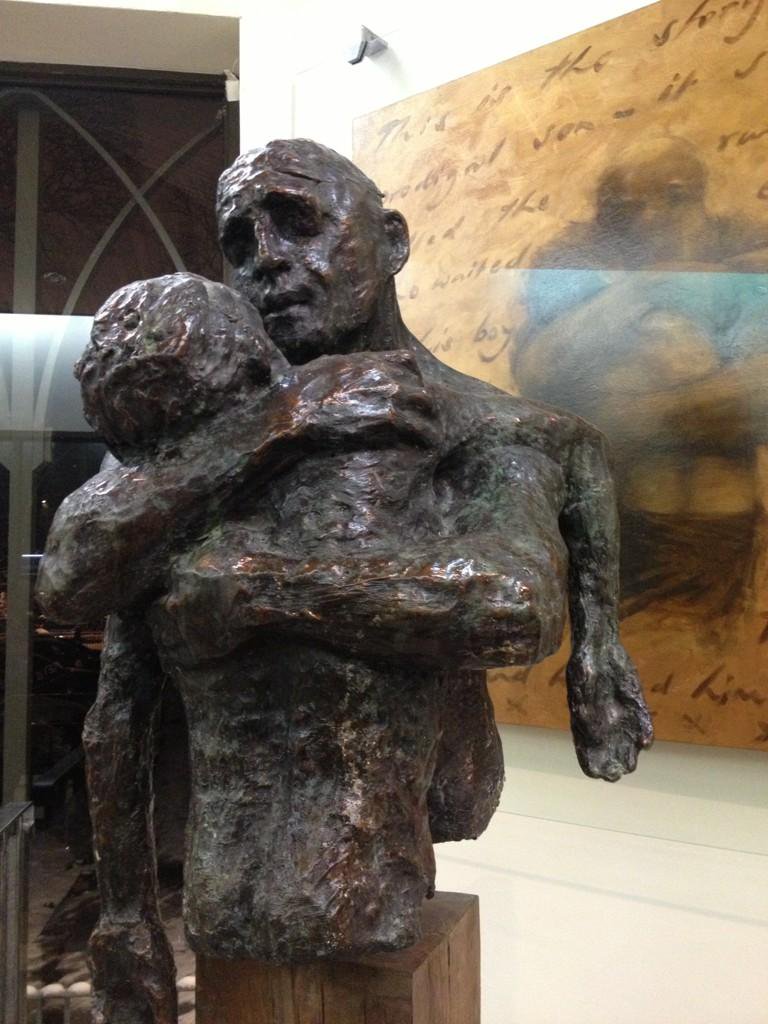
“Faith assures us that when we come close to God with sorrow in our heart, his consuming fire cleanses everything in us. His arms reach out and take us in and rock us back and forth. We rest against his breast and are lulled by the heartbeats of God.” (Servant of God Catherine de Hueck Doherty)
Don’t miss Him
Reposting this from a few years ago:
This morning I was meditating on Simeon and Anna. I know it’s Lent and not the Christmas season! That was part of my meditation. Simeon and Anna didn’t know, at the time, that it was the Christmas season. It was just another day of prayer in the Temple. But if Simeon had not been sensitive to the Holy Spirit, he would have missed the Child he had been waiting for all of his life. Thinking about this made me pray that I wouldn’t miss Christ’s coming to me today in whatever guise He takes. Let’s all keep watch for Him today. Maybe we’ll find that it’s really Christmas during Lent. 
The best thing to give up for Lent
I repost this every Lent. It’s still the best recommendation as far as I am concerned.
This comes from a Magnificat article written by Fr. Peter John Cameron a few years ago. I do not have time to quote the whole article (which is always dangerous because what you read will be edited), but I hope–especially those of you who despair of ever giving up what he suggests we give up–that you will find some hope in what he says:
Here’s what to give this Lent: the doubt that goes, “I can never get closer to God because I’m too sinful, too flawed, too weak.” This is a lethal attitude, for it based on the false presumption that we can possess something of our own–that does not come from God–by which we can please God. Nothing could be farther from the truth. Only what is from God can please God. But as long as such error persists, we estrange ourselves from God. Lent is not about lamenting our inadequacy. Rather, it is a graced moment to receive from God what he is eager to give us so that we can live the friendship with him that he desires. . . .
He goes on to describe how often we try to substitute self-sufficiency for the lack that we find in ourselves–and this usually leads to an experience of darkness in our lives–“we may even wonder if God hates us.” He allows the darkness in order to draw us back to him. “The most reasonable thing we can do when that feeling strikes is “to renew our act of love and confidence in God’s love for us. The Lord allows the darkness precisely to move us to unite ourselves all the more closely to him who alone is the Truth.”
Still–we panic! We feel as if we are obliged to do for God what we know we are unable to do. But the point of the pressure is to convince us to receive everything from God. We can be sure that God himself is the one who, in his mercy, moves us to do what is not within our power. This is the Father’s way of opening us a little more to himself by making us a little more in the likeness of his crucified Son.
For nothing glorifies God like the confidence in his mercy that we display when we feel indicted by our frailty and inability. The experience of our hopelessness is a heaven-sent chance to exercise supremely confident trust. God delights in giving us the grace to trust him.
Sadly, for those who refuse God’s gift of confidence, the darkness can turn to despair. Yet even in despair the miracle of mercy is at work. Father Jean-Baptiste Henri Lacordaire, the nineteenth-century Dominican priest who was responsible for the revival of the Order of Preachers in France after the French Revolution, makes this astonishing remark: “There is in despair a remnant of human greatness, because it includes a contempt for all created things, and consequently an indication of the incomparable capacity of our being.” In our darkness, the incomparable capacity of our being will settle for nothing less than the embrace of the Infinite. Like nothing else, our helplessness moves us to cry out for that embrace in confidence and trust. The cry of forsakenness that Jesus emits from the cross is just this.
Saint Paul wrote, “We were left to feel like men condemned to death so that we might trust, not in ourselves, but in God who raises from the dead” (2 Cor 1.9, NAB). That’s the point. That’s the challenge of Lent. God wants us to have the strength to believe in his love so much that we confidently beg for his mercy no matter how much we feel the horror of death in ourselves. . . .
Let us this Lent, in the face of all ours sins, our limitations, and our weakness cry out with Jesus, “My God, why have you forsaken me?” And let us do so with certainty–not doubt or desperation–because our union with Christ crucified has given us the Way to approach reality. In our asking we hold the Answer.
Peak and Valley


One sees great things from the valley, only small things from the peak.
— G. K. Chesterton



It is all a matter of perspective
and what we perceive from where we stand:
it takes great strength and determination to climb the peak,
and look down upon the valley left far below
where even mountains seem diminished.
Yet what gives life meaning,
what encourages our faith,
and instills hope
is how we thrive while dwelling
deep in the darkest of valleys while
gazing up at the dream-like peaks.

 photo by Josh Scholten — view of Mt Shuksan from the top of Mt. Baker
 photo by Josh Scholten – dawn from the top of Mt. Baker, seeing its shadow to the west


 Witnesses to Hope