Jesus, rise in me.

It’s still Eastertide. This poem by the lovely poet, Christina Rossetti, speaks of one suffering and longing for a resurrection of soul, pleading to Christ to rise in her. Even during Eastertide, we can easily feel the same as she, our hearts like stone, yet Christ is so, so drawn to those who, like her, long for him.

This image captures a poignant moment of loss and impermanence, featuring a broken white ceramic bowl resting on an old, textured wooden surface. The shattered pieces are strewn about, each fragment reflecting the light differently, casting small shadows that accentuate the bowl's fragility. The rustic background complements the ceramic's purity, highlighting the contrast between endurance and the transience of material objects. The scene invokes a blend of beauty and sadness, telling a story of something once whole, now fractured, and the quiet finality of such a moment.

A Better Resurrection

I have no wit, no words, no tears;
My heart within me like a stone
Is numb’d too much for hopes or fears;
Look right, look left, I dwell alone;
I lift mine eyes, but dimm’d with grief
No everlasting hills I see;
My life is in the falling leaf:
O Jesus, quicken me.

My life is like a faded leaf,
My harvest dwindled to a husk:
Truly my life is void and brief
And tedious in the barren dusk;
My life is like a frozen thing,
No bud nor greenness can I see:
Yet rise it shall—the sap of Spring;
O Jesus, rise in me.

My life is like a broken bowl,
A broken bowl that cannot hold
One drop of water for my soul
Or cordial in the searching cold;
Cast in the fire the perish’d thing;
Melt and remould it, till it be
A royal cup for Him, my King:
O Jesus, drink of me.

Christina Rossetti

Beauty now for ashes wear

A blessed Easter to all of you, my friends. An Easter Sunday poem by Hopkins. May you be prodigal in your rejoicing over these next 50 days!

Easter

Break the box and shed the nard;
Stop not now to count the cost;
Hither bring pearl, opal, sard;
Reck not what the poor have lost;
Upon Christ throw all away:
Know ye, this is Easter Day.

Build His church and deck His shrine,
Empty though it be on earth;
Ye have kept your choicest wine—
Let it flow for heavenly mirth;
Pluck the harp and breathe the horn:
Know ye not ‘tis Easter morn?

Gather gladness from the skies;
Take a lesson from the ground;
Flowers do ope their heavenward eyes
And a Spring-time joy have found;
Earth throws Winter’s robes away,
Decks herself for Easter Day.

Beauty now for ashes wear,
Perfumes for the garb of woe,
Chaplets for dishevelled hair,
Dances for sad footsteps slow;
Open wide your hearts that they
Let in joy this Easter Day.

Seek God’s house in happy throng;
Crowded let His table be;
Mingle praises, prayer, and song,
Singing to the Trinity.
Henceforth let your souls alway
Make each morn an Easter Day.

Gerard Manley Hopkins

Still

Still
For Good Friday

This day
let all stand still
in silence,
in sorrow.

Sun and moon
be still.

Earth
be still.

Still
the waters.

Still
the wind.

Let the ground
gape in stunned
lamentation.

Let it weep
as it receives
what it thinks
it will not
give up.

Let it groan
as it gathers
the One
who was thought
forever stilled.

Time
be still.

Watch
and wait.

Still.

—Jan Richardson
from Circle of Grace: A Book of Blessings for the Seasons

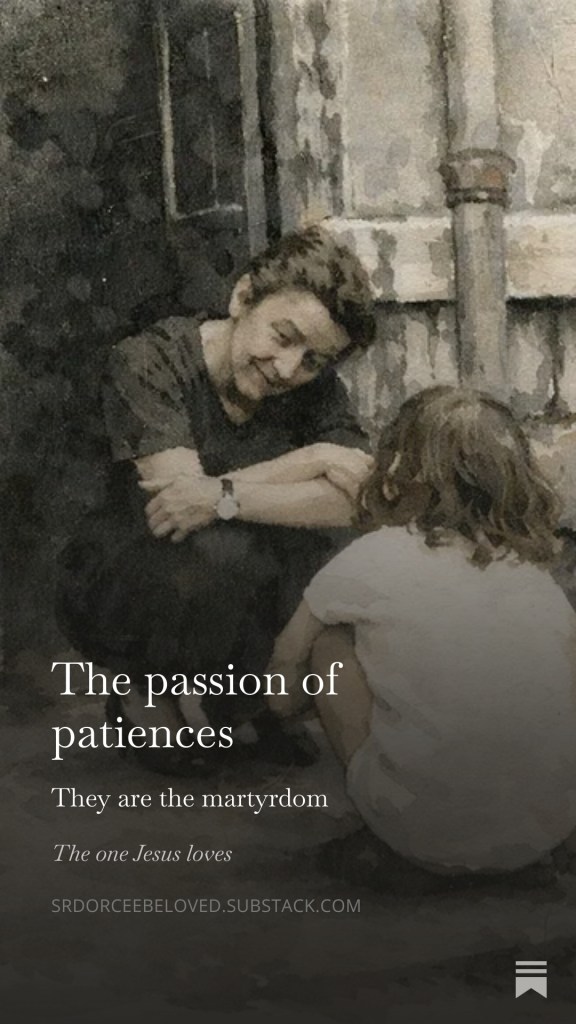
The passion of patiences

The poem I selected for this Sunday is by Venerable Madeleine Delbrêl, a fascinating woman, a mystic, a missionary, a poet. Not surprising, she took inspiration from St. Charles de Foucauld. Her mysticism led her out to the “little people”.

“He’s with me among the people I encounter today. … All of them will be people he’s come looking for — those he’s come to save. … Through the brothers and sisters who are close to us, whom he will make us to serve, love, and save, waves of his love will go out to the end of the world and the end of time.”

I’ve always loved her writing, her down-to-earth, stab-you-through-the-heart writing. In this poem, she writes about the passion—a most apt topic for Lent—one that we can so easily think about in grandiose terms—how we’re going to lay down our lives for Christ. But Madeleine stabs-us-in-the-heart with what it really means for each of us and challenges us to embrace that reality with the same ardor that we embrace our own self-satisfying ideas of self-denial.

Pray for us, Madeleine.


The passion, our passion, sure we are waiting for it.
We know it must come and of course
we intend to live it with a certain grandeur.
We are waiting for the bell to ring that will inform us
that the time has come for us to sacrifice ourselves.
Like a log in the fireplace,
we know that we have to be consumed.
Like a piece of wool cut with scissors,
we have to be separated.
Like young animals that are sent to slaughter,
we have to be destroyed.
We are waiting for our passion but it does not come.
In its place there come small patiences.
Patiences, those small pieces of the passion whose job it is
to kill us gently for your glory, to kill us without
our getting the glory.

From dawn they come to greet us:
our nerves, either too much on edge or too numb….
It is our disgust with our daily ration of life
and the neurotic desire for all that is not ours.

This is the way our patiences come,
in serried ranks or in single file,
and they always forget to remind us of the fact
that they are the martyrdom for which we were preparing.
And scornfully we let them pass by,
as we wait for a cause that would be worth dying for.
If every redemption is a martyrdom,
not every martyrdom involves the spilling of blood.
From the beginning of our lives to the very end,
one by one,
grapes may be picked from the bunch.
This is the passion of patiences.

Madeleine Delbrêl

Lovely in limbs and lovely in eyes

A poem for Sunday.

Some of you are aware that I am reading/praying through Carys Walsh’s, Dappled Beauty, Through Lent with Gerard Manley Hopkins.I have always loved Hopkins and am treasuring every day’s read.

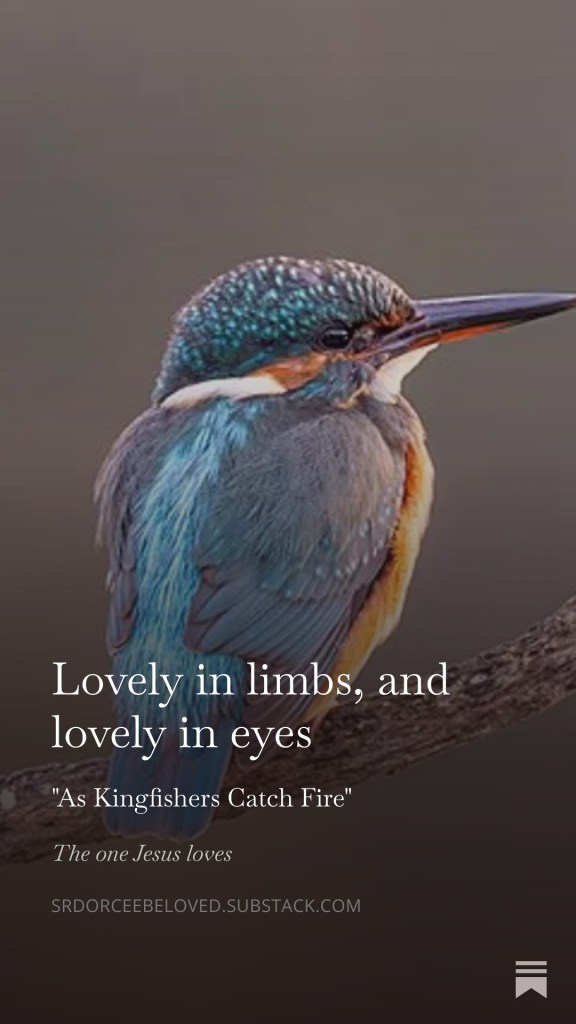
This—”As Kingfishers Catch Fire—is certainly one of my favorites with his famous line: “for Christ plays in ten thousand places,/Lovely in limbs, and lovely in eyes not his/To the Father through the features of men’s faces.”

I am constantly intrigued by the unique and unrepeatable beauty of each person. I dwell upon that mystery constantly. Hopkins, in his own unrepeatable way, expresses this mystery the best I have found.

You can read the poem and the rest of my thoughts by clicking on the photo below.

God’s garments

Two poems this Sunday by two different poets who were both inspired by pondering God’s garments. And both stemming from a felt need to frantically reach out to grab them. We can all feel that way at times, especially during Lent. I’ll just leave them here with the encouragement to try to place yourselves in each poem.

God the Father, Cristoforo Roncalli (Creative Commons Zero, Public Domain Dedication)

Suspended

I had grasped God’s garments in the void
but my hand slipped on the rich silk of it.

The ‘everlasting arms’ my sister loved to remember
must have upheld my leaden weight from falling, even so,

for though I claw at empty air and feel nothing, no embrace,
I have not plummeted.

Denise Levertov


The Garments of God

God sits on a chair of darkness in my soul.
He is God alone, supreme in His majesty.
I sit at His feet, a child in the dark beside Him;
my joy is aware of His glance and my sorrow is tempted
to nest on the thought that His face is turned from me.
He is clothed in the robes of His mercy, voluminous garments–
not velvet or silk and affable to the touch,
but fabric strong for a frantic hand to clutch,
and I hold to it fast with the fingers of my will.
Here is my cry of faith, my deep avowal
to the Divinity that I am but dust.
Here is the loud profession of my trust.
I need not go abroad
to the hills of speech or the hinterlands of music
for a crier to walk in my soul where all is still.
I have this potent prayer through good or ill:
here in the dark I clutch the garments of God.

Jessica Powers

Because we hunkered down

We in the midwest—as well as other parts of the country—have weathered a pretty brutal winter this year. Consequently, many of us are affected by the lack of sun during these hard months. Hence, when I happened upon this sonnet by the venerable Malcolm Guite, I just knew that I had to share it this Sunday.

                    Because We Hunkered Down

These bleak and freezing seasons may mean grace

When they are memory. In time to come

When we speak truth, then they will have their place,

Telling the story of our journey home,

Through dark December and stark January

With all its disappointments, through the murk

And dreariness of frozen February,

When even breathing seemed unwelcome work.


Because through all of these we held together,

Because we shunned the impulse to let go,

Because we hunkered down through our dark weather,

And trusted to the soil beneath the snow,

Slowly, slowly, turning a cold key,

Spring will unlock our hearts and set us free.

Winter Morning

I have been pondering the importance of living in the present moment, being attentive to where God is there. In this Sunday poem, James Crews explores the experience of a winter morning—which so many of us are facing this year—and being grateful for it.

David W Runyan II

Winter Morning

When I can no longer say thank you
for this new day and the waking into it,
for the cold scrape of the kitchen chair
and the ticking of the space heater blowing
orange as it warms the floor near m feet,
I know it is because I have been fooled again
by the selfish, unruly man that lives within me
and believe he only deserves safety
and comfort. But if I pause as I do now,
and watch the street lights outside winking
off one by one like old men closing their
cloudy eyes, if I listen to my tired neighbors
slamming car doors hard against the morning
an see the steaming coffee in their mugs
kissing their chapped lips as they sip and
exhale each of their worries white into
the icy air around their faces—then I can
remember this one life is a gift each of us
was handed and told to open: Untie the bow
and tear off the paper, look inside
and be grateful for whatever you find
even if it is only the scent of a tangerine
that lingers on the fingers long after
you’ve finished eating it.

James Crews