Divinizing your passivities

Father Robert Barron:

Last week I spent six days at a place only about a ten-minute drive from my home, but I had, nevertheless, entered a country as “foreign” to my experience as Botswana or Katmandu. You see, I had taken up residence in Hospitalland. I will spare you all of the gory details, but I was brought in for an emergency appendectomy and then had to undergo a second surgery, due to complications. As a priest, of course, I had visited Hospitalland many times, but I had never actually lived in it for an extended period. Hospitalland has its own completely unique rhythms, customs, language, and semiotic systems. Adjusting to it, consequently, is as complex an undertaking as adjusting to Vienna, Paris, or Tokyo.

For example, the normal rhythm of day and night is interrupted and overturned in Hospitalland. You are only vaguely aware of the movement of the sun across the sky, and people come barging into your room as regularly at two in the morning as two in the afternoon. I found myself frequently asking visitors not only the time of day, but also whether it was morning or evening. Relatedly, the usual distinctions between public and private simply evanesce in Hospitalland. As my mother told me many years ago, upon returning from a long visit to that country, “When you enter the hospital, you place your modesty in a little bag and leave it by the door. Then you pick it up when you go home.” Nurses, nursing aides, medical students, doctors, surgeons, tech assistants—all of them have license to look over any part of your anatomy, pretty much whenever they want. At first, I was appalled by this, but after a few days, I more or less acquiesced: “Anyone else out there that would like to take a look?” Hospitalland has its own very distinctive language, largely conditioned by numbers: blood pressure rates, temperature, hemoglobin counts, etc. It was actually a little bit funny how quickly I began to banter with the nurses and doctors in this arcane jargon. 

But for me the characteristic of Hospitalland is passivity. When you pass through the doors of the hospital, you simply hand your life over to other people. They transport you, clean you, test you, make you wait for results (an excruciating form of psychological torture, by the way), tell you what you have to undergo next, poke you, prod you, take blood out of you, and cut into you. And when you are at your wits’ end, frustrated beyond words, so eager to get home that you can taste it, you have to wait for them to give you permission to leave. You place your modesty in a little bag by the door when you enter the hospital, and you put your autonomy in that same container. 

And this is of more than merely psychological interest. It has, indeed, far-reaching spiritual implications. As I lay on my back in Hospitalland, a phrase kept coming unbidden into my mind: “the divinization of one’s passivities.” This is a line from one of the great spiritual works of the twentieth century, The Divine Milieu by the French Jesuit Pierre Teilhard de Chardin. In that seminal text, Teilhard famously distinguished between the divinization of one’s activities and the divinization of one’s passivities. The former is a noble spiritual move, consisting in the handing over of one’s achievements and accomplishments to the purposes of God. A convinced Jesuit, Teilhard desired to devote all that he did (and he did a lot) ad majorem Dei gloriam (to the greater glory of God).  But this attitude, Teilhard felt, came nowhere near the spiritual power of divinizing one’s passivities. By this he meant the handing over of one’s suffering to God, the surrendering to the Lord of those things that are done to us, those things over which we have no control. We become sick; a loved one dies suddenly; we lose a job; a much-desired position goes to someone else; we are unfairly criticized; we find ourselves, unexpectedly, in the valley of the shadow of death. These experiences lead some people to despair, but the spiritually alert person should see them as a particularly powerful way to come to union with God. A Christian would readily speak here of participating in the cross of Christ. Indeed how strange that the central icon of the Christian faith is not of some great achievement or activity, but rather of something rather horrible being done to a person. The point is that suffering, offered to God, allows the Lord to work his purpose out with unsurpassed power. 

In some ways, Teilhard’s distinction is an echo of St. John of the Cross’s distinction between the “active” and “passive” nights of the soul. For the great Spanish master, the dark night has nothing to do with psychological depression, but rather with a pruning away of attachments that keep one from complete union with God. This pruning can take a conscious and intentional form (the active night) or it can be something endured. In a word, we can rid ourselves of attachments—or God can do it for us. The latter, St. John thinks, is far more powerful and cleansing than the former. 

I do believe that my stay in the foreign country of Hospitalland had a good deal to do with the divinization of my passivities and with the passive night of the soul. I certainly wouldn’t actively seek to go back to that land, but perhaps God might send me there again. May I have the grace to accept it as a gift.
“Why Everything Does Not Happen for a Reason”

An excellent article by John Pavlovitz:

“Why Everything Does Not Happen for a Reason”

That phrase.

We’ve all received it personally gift-wrapped by well-meaning friends, caring loved ones, and kind strangers. It usually comes delivered with the most beautiful of intentions; a buffer of hope raised in the face of the unimaginably painful things we sometimes experience in this life.

It’s a close, desperate lifeline thrown out to us when all other words fail:

Everything happens for a reason.

I’ve never had a tremendous amount of peace with the sentiment. I think it gives the terrible stuff too much power, too much poetry; as if there must be nobility and purpose within the brutal devastation we may find ourselves sitting in. In our profound distress, this idea forces us to run down dark, twisted rabbit trails, looking for the specific part of The Greater Plan that this suffering all fits into.

Read the rest here.

20110619-000808

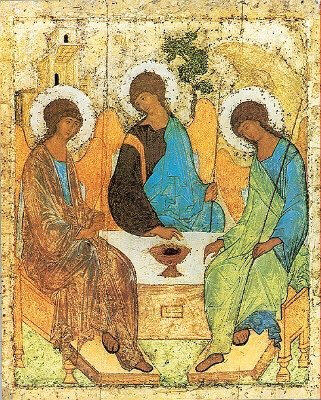
TRINITY SUNDAY

In the Beginning, not in time or space,

But in the quick before both space and time,

In Life, in Love, in co-inherent Grace,

In three in one and one in three, in rhyme,

In music, in the whole creation story,

In His own image, His imagination,

The Triune Poet makes us for His glory,

And makes us each the other’s inspiration.

He calls us out of darkness, chaos, chance,

To improvise a music of our own,

To sing the chord that calls us to the dance,

Three notes resounding from a single tone,

To sing the End in whom we all begin;

Our God beyond, beside us and within.

Malcolm Guite

A Thousand Thousand Reasons

One reason is enough.

barnstormingblog's avatarBarnstorming

tennant11

cedarsprings35

cedarsprings36

viburnum

There are a thousand thousand reasons to live this life, every one of them sufficient.
Marilynne Robinson in Gilead

There are a thousand thousand people on any given day who cannot think of one sufficient reason to live this life.
There are a few thousand who will decide this is their last day.
There are a few who say goodbye.

It is enough for me to find just one reason to live today.
It is enough for me to help someone else find just one reason today.
One is enough.
Fully sufficient.

cedarsprings3

tennantwisteria

View original post

‘The God of hope’ hopes for us

Friday: from the archives.

Sr. Dorcee, beloved's avatarWitnesses to Hope

Some mornings it’s hard for me to choose which gem to share with you.  .  .  but this is the one that I finally decided upon.  It’s another from Amy Carmichael.  She looks at how Jesus always had hope for His disciples, and so this is true for us as well. She’s commenting on Romans 15:13: May the God of hope fill you with all joy and peace in believing, so that by the power of the Holy Spirit you may abound in hope.

     These words have often helped us to go on hoping for those who were disappointing us.  But this morning they came differently to me.
     ‘Ye are they which have continued with Me in My temptations.’  A few hours later — ‘Could ye not watch with Me one hour?’  Very soon after — ‘All the disciples forsook Him and fled.’
     ‘They have kept Thy word’ …

View original post 286 more words

Hoping for the impossible

Another wonderful gem from Ann Voskamp: How You Can Keep On Hoping for What Seems Impossible

Never got over this…
So if you turned right after Clappison’s Corner and drove real slow around the potholes, you might see it?

Sneeze or blink, and yeah, you might not.

But it’s there on the top of a mossy stake, pointing the way you gotta take, either way: Hope.

You don’t want to know where all thother roads lead.

Just down the road from Centerton, thats’s where my Dad grew up on a dairy farm.

Right around the corner from the Dykstra’s* dairy farm. Hank Dykstra had seven kids and a heart attack. Fell over dead to this world and alive to the next when their oldest boy, Richard, was only 14.Sometimes people are so quiet and brave, we forget that they are suffering.

Sometimes people are so quiet and brave, we forget that they are suffering.

 1bbe5cbf766f0b78a8984a501c70fe74

My Dad and Richard Dysktra were both farm boys about to start high school when Richard took over the farm and helped his mom raise the six other kids and milk 40 Holstein cows morning and night, 365 days of the year.

Dad said the high school bus would wait at the end of the lane for Richard and Dad would watch the door of the barn to see if Richard was coming from his cows to class. That only happened less than a handful times a month.

Because sometimes the road you’re on is more important than the bus waiting out on the road that someone else says you have to take.

My Dad grew up milking cows and growing corn, got married at 24, and bought a farm 3 hours west of Centerton.

Richard Dyskstra grew up milking cows, raised up his 4 brothers and 2 sisters, got married at 37, and bought a farm 3 hours east of Centerton.

6 long hours of unwinding road now stretched between the two neighbour farm boys and their farms.

You can read the rest here.

A sonnet for Pentecost

Pentecost

Today we feel the wind beneath our wings
Today  the hidden fountain flows and plays
Today the church draws breath at last and sings
As every flame becomes a Tongue of praise.
This is the feast of fire,air, and water
Poured out and breathed and kindled into earth.
The earth herself awakens to her maker
And is translated out of death to birth.
The right words come today in their right order
And every word spells freedom and release
Today the gospel crosses every border
All tongues are loosened by the Prince of Peace
Today the lost are found in His translation.
Whose mother-tongue is Love, in  every nation.

Malcolm Guite

Prayer to God the Holy Spirit (2)

Sr. Dorcee, beloved's avatarWitnesses to Hope

Come, perpetual joy.
Come, unwitherable wreath.
Come, O purple raiment of our Lord and God.
Come, girdle, clear as crystal and many-coloured with precious gems.
Come, inaccessible refuge.
Come, Thou whom my poor soul desireth and hath desired.
Come, lonely One, to the lonely one–for lonely I am, as Thou canst see.
Come, Thou who hast become my longing, for that Thou hast ordained,
that I must needs long for Thee whom no human breath has ever reached.
Come, my breath and my life.
Come, joy, glory, and my incessant delight.

~Symeon the New Theologian

View original post

Prayer to God the Holy Spirit (1)

Friday from the archives

Sr. Dorcee, beloved's avatarWitnesses to Hope

Come, true light,
Come, eternal life,
Come, secret of hiddenness.
Come, delight that has no name.
Come, unutterableness.
Come, O presence, forever fleeing from human nature.
Come, everlasting jubilee.
Come, light without end.
Come, awaited by all who are in want.
Come, resurrection of the dead.
Come, mighty one, forever creating, recreating, and renewing with a mere wave of Thy hand.
Come, Thou who remainest wholly invisible, for none ever to grasp or to caress.
Come, Thou who flowest in the river of hours,
yet immovably stayest above it,
who dwellest above all heavens,
yet bendest to us who are bowed down.

~Symeon the New Theologian

to be continued . . .

View original post