The less lost

I’m currently reading a book for pre-publication in order that I can write an endorsement. I am absolutely loving this book and can’t wait to recommend it to all of you. I am actually on my second read through, I love it that much. In this morning’s reading, I was struck by a quote the author cites from St. Augustine’s Confessions. It is this: “Saint Augustine said, ‘He who loses himself in his passion is less lost that he who loses his passion.'”

So Saint Augustine seems to be saying that an alcoholic is in a more advantageous place spiritually than a strong Catholic who struggles to suppress every desire and passion. How can this be? Because the heart of our relationship with God is desire, not keeping the law. God thirsts for us, and he has placed an unquenchable thirst for him in each of us, a thirst that is meant to drive us to him. if we lose our passion, therefore, we are in trouble. This thirst is meant to act as a homing device, an internal GPS, that will not be satisfied unless it finds its destination. We may go down side streets and dead ends, but this thirst is meant to eventually bring us to the only One who can and will satisfy us. So someone whose passion is misdirected at least still has passion that has some capacity to be drawn to God, just like a car that is moving will much more likely reach its destination than a car sitting in a parking lot.

This puts a whole new perspective on the work that my Sisters are doing on the east side of Flint. Better to be addicted to something than to have no feeling whatsoever. Addiction is a starting place, a passion to be redirected, to be uncovered and named, a misdirected longing that can only be filled by God. The good news is that, according to Augustine, a person struggling with his addiction is closer to finding God than someone who has suppressed all desire. Each struggling addict on the east side is a potential passionate lover of God.

And the good news is also that any of us who struggle with seemingly less serious addictions can also have hope because God wants to do the same for us as we turn to him and return our passion (for whatever) to him. He will meet us right there in that very misguided longing, redirecting and purifying it until he alone satisfies us.

In our addictions, at least he has a starting place. “He who loses himself in his passion is less lost that he who loses his passion.”
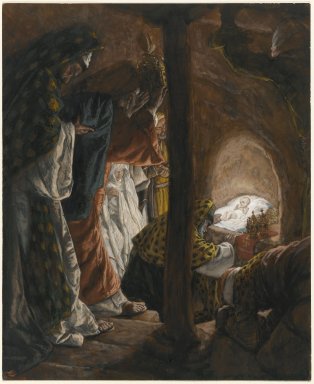
“Let us celebrate the festive day”

Awake, Mankind!  For your sake God has become man.  Awake, you who sleep, rise up from the dead, and Christ will enlighten you.  I tell you again, God became man.
You would have suffered eternal death, had he not been born in time.  Never would you have been freed from sinful flesh, had he not taken on himself the likeness of sinful flesh.  You would have suffered everlasting unhappiness, had it not been for this mercy.  You would never have returned to life, had he not shared your death.  You would have been lost if he had not hastened to your aid.  You would have perished, had he not come.
Let us then joyfully celebrate the coming of our salvation and redemption.  Let us celebrate the festive day on which he who is the great and eternal day came from the great and endless day of eternity into our own short day of time.

~St. Augustine, Sermon 185

Christ asleep in us

Last Saturday’s gospel was the very familiar passage about Jesus sleeping in the boat.  St. Augustine has a fine commentary on it:

When you are insulted, that is the wind.  When you are angry, that is the waves.  So when the winds blow and the waves surge, the boat is in danger, your heart is in jeopardy, your heart is tossed to and fro.  On being insulted, you long to retaliate.  But revenge brings another kind of misfortune–shipwreck.  Why?  Because Christ is asleep in you.  What do I mean?  I mean you have forgotten Christ.  Rouse him, then; remember Christ, let Christ awake within you, give heed to him . . . . “Who is this, that even the winds and sea obey him?”

Your hope

On Saturday evenings, we take turns preparing and sharing something about the Sunday readings.  It was Sr. Sarah’s turn this past Saturday, and she shared this little nugget from St. Augustine.  I said, “I need that for my blog!  This would transform our lives if we lived it.

Let the Lord be your hope; do not hope to get anything else from the Lord God, but let the Lord God Himself be your hope.  Many people hope to get money from God, many hope to get from Him honors that are transitory and perishable, or they want some other things from God, something other than God Himself.  But you, you must simply ask for your God.  (Augustine on Ps 40)

Let the Lord God Himself be your hope . . .

Awake, Mankind!

Awake, Mankind!  For your sake God has become man.  Awake, you who sleep, rise up from the dead, and Christ will enlighten you.  I tell you again, God became man.
     You would have suffered eternal death, had he not been born in time.  Never would you have been freed from sinful flesh, had he not taken on himself the likeness of sinful flesh.  You would have suffered everlasting unhappiness, had it not been for this mercy.  You would never have returned to life, had he not shared your death.  You would have been lost if he had not hastened to your aid.  You would have perished, had he not come.
     Let us then joyfully celebrate the coming of our salvation and redemption.  Let us celebrate the festive day on which he who is the great and eternal day came from the great and endless day of eternity into our own short day of time. 

~St. Augustine, Sermon 185

It is no small reason

There is one thing we can put our hope in, and that is no small reason for rejoicing.

Rate this:

As they say in the traffic report, this post is thanks to “tipster” Lupe.  Lupe grabbed me after Mass yesterday and asked me if I had read the Office of Readings for the day–which I hadn’t yet.  (The Office of Readings is part of the Liturgy of the Hours.)  So, of course, I did as soon as I got home.  The readings this time of year, as we close the liturgical year, are mostly about the Lord coming again or about our going to meet Him in death.  The second reading for yesterday, Wednesday of the thirty-third week of Ordinary Time, is from a sermon by St. Augustine.  He preaches about the sure promise we have of seeing the Lord, but now we walk by faith, not by sight. 

We walk by faith, and not by sight.  When will it be by sight? Beloved, says John, we are now the sons of God; what we shall be has not yet been revealed, but we know that when it is revealed we shall be like him, because we shall see him as he is.  When this prophecy is fulfilled, then it will be by sight.

Then Augustine goes on to point out that we have great reason for rejoicing–and the reason for our rejoicing is that this promise will be fulfilled:

Nevertheless, even now, before that vision comes to us, or before we come to that vision, let us rejoice in the Lord; for it is no small reason for rejoicing to have a hope that will some day be fulfilled.

This got me thinking about the many things we put our hope in, and how often we are then disappointed when they are not fulfilled.  That can lead us to discouragement and to an attitude of “Why hope?”  It is true that we will face many disappointments in life–but this one thing we can–and must–put our hope in: that we shall see Him as He is.  This is a hope that will one day be fullfilled.  We–you–will see Him as He is.  And that is no small reason for rejoicing.

Trusting His mercy

Humility is the gateway to the mercy of God.

Rate this:

Pondering today how hard we try so often to live lives without sin, but usually because we just don’t want to humble ourselves before others and especially before God. We don’t want to take the risk.  We don’t want to admit that we are imperfect human beings.  But humility is the gateway, the door to His mercy. We don’t really trust His love and mercy.  We should be running to Him with our faults, our sins, asking Him to “punish us with a kiss.”

Let us never assume that if we live good lives we will be without sin; our lives should be praised only when we continue to beg for pardon.  (St. Augustine)

[Let] the greatest sinners [place] their trust in My mercy.  They have the right before others to trust in My bottomless mercy.  My daughter, write about My mercy toward tormented souls.  Souls that make an appeal to My mercy delight Me.  To such souls I grant even more graces than they ask.  I cannot punish even the greatest sinner if He makes an appeal to My compassion, but on the contrary, I justify him in My unfathomable and inscrutable mercy.  Write: before I come as a just Judge, I first open wide the door of My mercy.  He who refuses to pass through the door of My mercy must pass through the door of My Justice . . . .   (St. Faustina, Diary 1146)

The Christian life is not a beauty pageant

God “did not love us to leave us to our ugliness but to change us and, disfigured as we were, to make us beautiful.” (Augustine)

Rate this:

I don’t know about you, but most of my life growing up I never considered myself as beautiful.  None of my girl friends really were either.  We weren’t part of the homecoming court or a cheerleader.  So what to do with all that I’ve been sharing about beauty?  Hopefully, most of us have made the important transition in our thinking to the realization that beauty is more than skin deep, as they say.  It’s the beauty of the soul, of the spirit that is most important.
      Unfortunately, too many of us who “know that in our heads” still feel like we fall short.  We don’t feel all that beautiful in our souls.  But the Christian life is not a beauty pageant.  Our beauty comes from within, from God who dwells within us.  St. Augustine says in one of his commentaries:

What then is this love that makes the loving soul beautiful?  God, who is always beautiful, who never loses his beauty, who never changes: he loved us first, he who is always beautiful.  And what were we when he loved us if not ugly and disfigured?  But he did not love us to leave us to our ugliness but to change us and, disfigured as we were, to make us beautiful.

It’s almost like sunbathing. We turn ourselves toward Him, and it is He who makes us beautiful.  We just need to be there in His presence.  It’s the sun that makes us tan; it’s the Son who makes us beautiful.  It’s not what we do, but what He does.  Fr. Blaise Arminjon in his Cantata of Love addresses this very point in his commentary on Song of Songs 4.1 “How beautiful you are, my love, how beautiful you are”:

This is why the Bride [and we are each His bride] would be quite wrong in worrying whether she is truly lovable or not or worthy or not of love since all her beauty is made of her resemblance to her Bridegroom, whole holy face was engraved in her since the very first day and wants to be more and more deeply engraved in her.  Thérèse of Lisieux understands this very well when she reads this verse of the Song: ‘Adorable face of Jesus, only beauty ravishing my heart, deign to imprint on me your divine resemblance so that you may not be able to look into my soul without seeing yourself.’

To be continued tomorrow . . .

“God certainly desires our greatest good . . .”

“God certainly desires our greatest good more than we ourselves desire it.” (St. Augustine)

Rate this:

I have to give you at least one quote from St. Augustine on this, his feast day. Augustine

God certainly desires our greatest good more than we ourselves desire it.  He knows better than we by what way it can come to us, and the choice of ways is wholly in His hands, as it is He who governs and regulates all that occurs in the world.  It is, then, most certain that in all chances that can befall, whatever may happen will always be best for us.”

I get stopped by that first sentence: “God certainly desires our greatest good more than we ourselves desire it.” That is cause for great hope. “Be not afraid!”