Where is Christ today?

This is the day when everything is silent.  We can go about the day not giving much of a thought to it–just seeing it as the day between Good Friday and Easter Sunday. Yet monumental things were happening in the spiritual realm.  Christ descended to hell to set captives free.

This still has meaning for us.  So often we think nothing is happening in our own spiritual lives, yet God is about monumental things.  Have hope in the Unseen.

Christ descended into “Hell” and is therefore close to those cast into it, transforming their darkness into light.  Suffering and torment is still terrible and well-nigh unbearable.  Yet the star of hope has risen–the anchor of the heart reaches the very throne of God.  Instead of evil becoming unleashed within man, the light shines victorious: suffering–without ceasing to be suffering–becomes, despite everything, a hymn of praise. (Pope Benedict XVI, Spe Salvi)
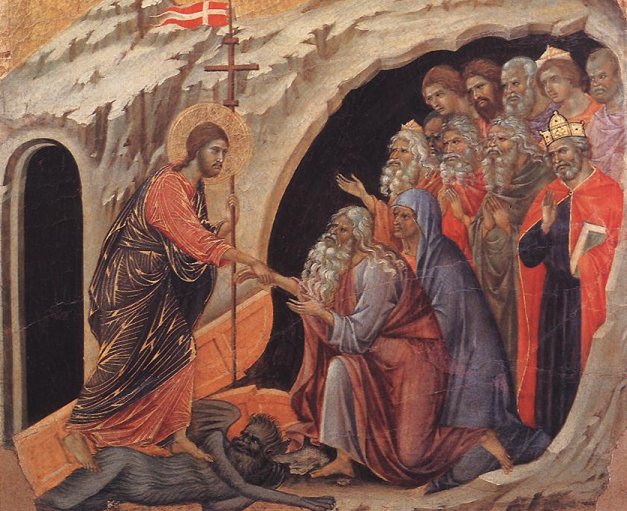
And for those of you who feel that you are living “in darkness and in the shadow of death”, take heart, for you are exactly who he desires to visit.  From an ancient homily on Holy Saturday:

Greatly desiring to visit those who live in darkness and in the shadow of death, he has gone to free from sorrow the captives . . .


True adoration

One of my main purposes in writing this blog is to try to enkindle hope in others.  And, as I say in the sidebar, I’m usually writing for myself!  The last couple of days I have been going back through my journal, re-reading the many quotes I have collected therein, for the purpose of lifting my heart.  I treasure this one from Pope Benedict.  It has redefined for me the meaning of spending an hour in adoration:

Why do we not truly lay our life before Him, including our incapability to believe and to pray?  This is already an act of worship: when we truly say, “Kyrie eleison,” when we truly cry out to God from the depth of our wickedness, this is acknowledgment of what we are, and who He is; it shte adoration of His glory.  (translated from Cardinal Joseph Ratzinger, Dogma and Verkundigung, p. 123f.)

God asks us only for what we can give Him?  And much of the time it is just our emptiness and incapabilities, but that is “already an act of worship.”

Pushing God aside

“At the heart of all temptations is the act of pushing God aside because we perceive him as secondary, if not actually superfluous and annoying, in comparison with all the apparently far more urgent matters that fill our lives.” (Pope Benedict XVI)

And why do we do this?  Is it not because we forget who God truly is?  For if we remembered, we would never push Him aside, would we?  This is, in fact, my biggest temptation these days.  I have brought this to confession numerous times these past months.  For me, I push Him aside not so much because of the urgency of other matters–although that has been a big factor this past week–but because I am one of “little faith”, diminishing God to my idea of who I think He is, reducing His love to my narrow ideas of it.  Over and over again, I have had to decide to trust Him, to put my trust in who He says He is, rather than in my apparent experience at the moment—to let Him lead me out into the “wilderness” and there speak tenderly to my heart . . .  (Cf. Hosea 2.14)

“God loves to light little lights”

When I found out that St. Peter’s keeps their Christmas tree and crèche up in the square until February 2, I decided we would keep our crèche in the chapel and all our Christmas lights up until then as well.   I always felt gypped that there were not 40 days to celebrate after Christmas as there are after Easter.  Then I discovered that February 2, the Presentation of the Lord (Candlemas), is indeed 40 days after Christmas.  So, to me, it makes total sense to keep those Christmas lights lit.  If you drive past our house right now, you will still see our candle lights in the windows. I personally love clusters of little white lights. When we begin the Salve Regina at the end of night prayer, the guitarist dims all the lights in our chapel.  During this season, that leaves only the Christmas lights and the sole candle lit before the icon of the Mother of God. Yet the chapel still seems bright.

In the beginning of his Christmas message, Pope Benedict spoke of how God “loves to light little lights.”  I found that particularly encouraging as I thought of all of us who are desiring to be God’s witnesses to hope.  May it encourage you as well, and may you call it to mind whenever you see Christmas lights and candles:


The liturgy of the Mass at Dawn reminded us that the night is now past, the day has begun; the light radiating from the cave of Bethlehem shines upon us. . . .
At first, beside the manger in Bethlehem, that “us” was almost imperceptible to human eyes.  As the Gospel of St. Luke recounts, it included, in addition to Mary and Joseph, a few lowly shepherds who came to the cave after hearing the message of the Angels. The light of that first Christmas was like a fire kindled in the night.  All about there was darkness, while in the cave there shone the true light “that enlightens every man” (Jn 1.9).  And yet all this took place in simplicity and hiddenness, in the way that God works in all of salvation history.  God loves to light little lights, so as then to illuminate vast spaces.

May we allow God to light each of us, little lights in this darkened world.

St. Joseph and the Tempter . . . and us

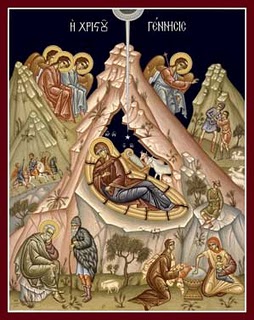
In this more lengthy reading, Pope Benedict explains part of the Christmas icon shown below:

The Christmas icon of the Eastern Orthodox Church developed its essential form as early as the fourth century and in it has captured the complete mystery of Christmas.  It represents the intimate connection between Christmas and Easter, between crib and Cross, the harmony between the Old and the New Testaments, the unity of heaven and earth in the song of the angels and the devotion of the shepherds.  Each figure in it has a profound underlying significance.  Remarkable in all this is the function reserved for St. Joseph.  He is sitting to the side, lost in deep reflection.  In front of him stands the Tempter, disguised as a shepherd, who addresses him, according to the text of the liturgy, in this way: “Just as your root cannot produce leaves, just as an old man cannot become a father anymore, so also the virgin cannot give birth.”  The liturgy then adds: In his heart there raged a storm of contradictory thoughts; he was confused; but enlightened by the Holy Spirit he sings Alleluia.  Through the figure of Saint Joseph the icon presents a drama that recurs time and again–the drama of ourselves.  It is always the same.  Time and again the Tempter tells us: There is nothing but the visible world, there is no Incarnation of God, and there is no birth of the Virgin.  This is the denial that God knows us, that he loves us, that he has the power to be active in the world.  And thus it is, in its core, the refusal to give God the honor.  It is the temptation of our time, which presents itself with so many clever and seemingly brand-new reasons as to appear utterly convincing.  Yet it is still the same old temptation.  We ought to pray to Almighty God that he may send into our hearts also the light of the Holy Spirit.  We ought to pray that he may grant to us also the grace to leave the stubbornness of our own reasoning behind, to gaze at his light with joy and to sing out, “Alleluia”–Christ is truly born, God has become man.  We ought to pray that in us also the words of the Easter liturgy may become reality: “We present to you a Virgin and Mother.  We present to you ourselves as well, more valuable than any gift of money: the wealth of true faith–to you, our God, and Savior of our souls.” Amen.  (Pope Benedict XVI, Lob der Weihnacht, p. 45)

Waiting

This Advent morning I have been pondering the idea, the posture of “waiting.”  What does it mean to wait for the Lord’s coming?  To wait in hope?  I haven’t formulated all my thoughts yet, but one thing that rings true to me about waiting is something that Pope Benedict talked about in his general audience yesterday.  In the context of speaking about St. William of Saint-Thierry (a good friend of St. Bernard of Clairvaux), he wrote: “Human nature, in its most profound essence, consists in loving.  In a word, only one task is entrusted to every human being: to learn to will the good, to love, sincerely, authentically, freely.  However, only at the school of God can this task be accomplished and man can attain the end for which he was created.” 

What struck me was that there is a link between loving and waiting.  If I put all my energy into loving–loving God, receiving His love, loving others as I am loved–then I will indeed be “actively” waiting, actively preparing for His coming.  What better thing could I do than that to prepare for Him who is Love itself?

“An interior diary”

Perhaps many of you have already read Pope Benedict’s homily from First Vespers this past Sunday, but I wanted to draw your attention particularly to this part and encourage you to try to do what he suggests for Advent:

Advent, this intense liturgical time that we are beginning, invites us to pause in silence to grasp a presence. It is an invitation to understand that every event of the day is a gesture that God directs to us, sign of the care he has for each one of us. How many times God makes us perceive something of his love! To have, so to speak, an “interior diary” of this love would be a beautiful and salutary task for our life! Advent invites and stimulates us to contemplate the Lord who is present. Should not the certainty of his presence help us to see the world with different eyes? Should it not help us to see our whole existence as a “visit,” as a way in which he can come to us and be close to us, in each situation?

You can read the entire address here.  (It is worth reading.)  Do try to take some time daily to take note in your “interior diary” of how God has loved you.  (This will remind some of you of Fr. Gallagher’s talks on the examen.) And know that we all wouldn’t mind your sharing an entry or two here as a comment.

“You are the Custodians of Beauty”

A couple of months ago, I began a series of posts on beauty.  Pope Benedict XVI just last week addressed a group of some 250 artists gathered in the Sistine chapel on this very theme. What particularly struck me in his address was the link he made between beauty and hope.

Unfortunately, the present time is marked, not only by negative elements in the social and economic sphere, but also by a weakening of hope, by a certain lack of confidence in human relationships, which gives rise to increasing signs of resignation, aggression and despair.  . .  . What is capable of restoring enthusiasm and confidence, what can encourage the human spirit to rediscover its path, to raise its eyes to the horizon, to dream a life worthy of its vocation–if not beauty? . . . the experience of beauty, beauty that is authentic, not merely transient or artificial, is by no means a supplementary or secondary factor in our search for meaning and happiness; the experience of beauty does not remove us from reality, on the contrary, it leads to a direct encounter with the daily reality of our lives, liberating it form darkness, transfiguring it, making it radiant and beautiful. [You can read the rest of the address here.]

Though this was addressed particularly to artists, I am convinced of the importance of all of us having this mind in the living of our daily lives.  We can all be “custodians of beauty” (Paul VI) wherever we are.  Even if all we do–and by no means of little importance–if all we do is constantly invite the Holy Spirit to make of our souls a thing of beauty, we will be a worthy custodian of beauty.  We each need contact with beauty ourselves, true beauty, that is–art, music, poetry, literature, nature, people–and we each need to be purveyors of beauty to those around us.  And, as we do this, I think we will discover that link that Pope Benedict spoke of between beauty and hope.

Need I say that most of all we need to long for the beauty of God, a longing that will not be fulfilled until we see Him face to face.    “The sweetest thing in all my life has been the longing . . .to find the place where all the beauty came from.” (C.S. Lewis, Till We Have Faces)And isn’t that what Advent is all about?

I would be interested in where you find beauty: what books you’ve read, how you bring beauty into your homes, etc.  Please feel free to comment.

“The arrow of His paradoxical beauty”

Today is one of our community feasts, the Triumph of the Cross.  Many things could be said about this day, but what is coming to mind–since I’ve been thinking about beauty so much these days–is another excerpt from the then Cardinal Ratzinger’s address to the Communion and Liberation community in Rimini.  He started his address by speaking about how on the Monday of Holy Week the Liturgy of the Hours juxtaposes two seemingly contradictory antipons: You are the fairest of the children of men and grace is poured upon your lips (Ps 45.3)and He had neither beauty, no majest, nothing to attract our eyes, no grace to make us delight in him (Is 53.2). He says, “How can we reconcile this?”  and then goes on to talk about true beauty: a love that loves “to the end” (Jn 13.1). 

The One who is the Beauty itself let himself be slapped in the face, spat upon, crowned with thorns; the Shroud of Turin can help us imagine this in a realistic way.  However, in his Face that is so disfigured, there appears the genuine, extreme beauty: the beauty of love that goes “to the very end” . . . Is there anyone who does not konw Dostoyevsky’s often quoted sentence, “The Beautiful will save us”?  However, people usually forget that Dostoyevsky is referring here to the redeeming Beauty of Christ.  We must learn to see Him.  If we know Him, not only in words, but if we are struck by the arrow of His paradoxical beauty, then we will truly know Him, and know Him not only because we have heard others speak about Him.  Then we will have found the beauty of Truth . . .

You can find his entire address here and it is worth reading in its entirety.

And let us let ourselves be wounded by the arrow of Christ’s paradoxical beauty. . .

The impact on our hearts

“The encounter with the beautiful can become the wound of the arrow that strikes the heart . . .” (Ratzinger)

Rate this:

I feel a need to talk about beauty.  Some of you have heard me speak about this, and it is still very much on my heart. I continue to be struck by its lack in our culture and society with the predominant emphasis on technology and efficiency.  So I think my next few posts will be an attempt to remind us of the importance of beauty in our lives.  All true beauty reflects the beauty of God and draws us to Him.

The encounter with the beautiful can become the wound of the arrow that strikes the heart and in this way opens our eyes, so that later, from this experience, we take the criteria for judgement and can correctly evaluate the arguments.  For me an unforgettable experience was the Bach concert that Leonard Bernstein conducted in Munich after the sudden death of Karl Richter.  I was sitting next to the Lutheran Bishop Hanselmann.  When the last note of one of the great Thomas-Kantor-Cantatas triumphantly faded away, we looked at each other spontaneously and right then we said: “Anyone who has heard this, knows that the faith is true.”  The music had such an extraordinary force of reality that we realized, no longer by deduction, but by the impact on our hearts, that it could not have originated from nothingness, but could only have come to be through the power of the Truth that became real in the composer’s inspiration. (emphasis added) 
(Cardinal Ratzinger, Message to the Communion and Liberation meeting at Rimini, 2002)

In another place, Cardinal Ratzinger said:

The only really effective apologia for Christianity comes down to two arguments, namely the saintsthe Church has produced and the art which has grown in her womb.  Better witness is borne to the Lord by the splendour of holiness and art which have arisen in the community of believers than by the clever excuses which apologetics has come up with to justify the dark sides which, sadly, are so frequent in the Church’s human history.  If the Church is to continue to transform and humanize the world, how can she dispense with beauty in her liturgies, that beauty which is so closely linked with love and with the radiance of the Resurrection?  No.  Christians must not be too easily satisfied.  They must make their Church into a place where beauty–is at home.  Without this the world will become the first circle of Hell. (quoted in John Saward, The Beauty of Holiness and the Holiness of Beauty, San Francisco: Ignatius Press, 1997)

How can we bring more beauty into our lives?  Are there ways that we are letting efficiency and technology dominate?  I know for myself, I can feel guilty sometimes for taking time to peruse something beautiful, say, a poem or a piece of art–that I’m wasting time (!).  But I also wonder if there are not more ways to just bring beauty into our daily life.  I think doing so will give us more hope.