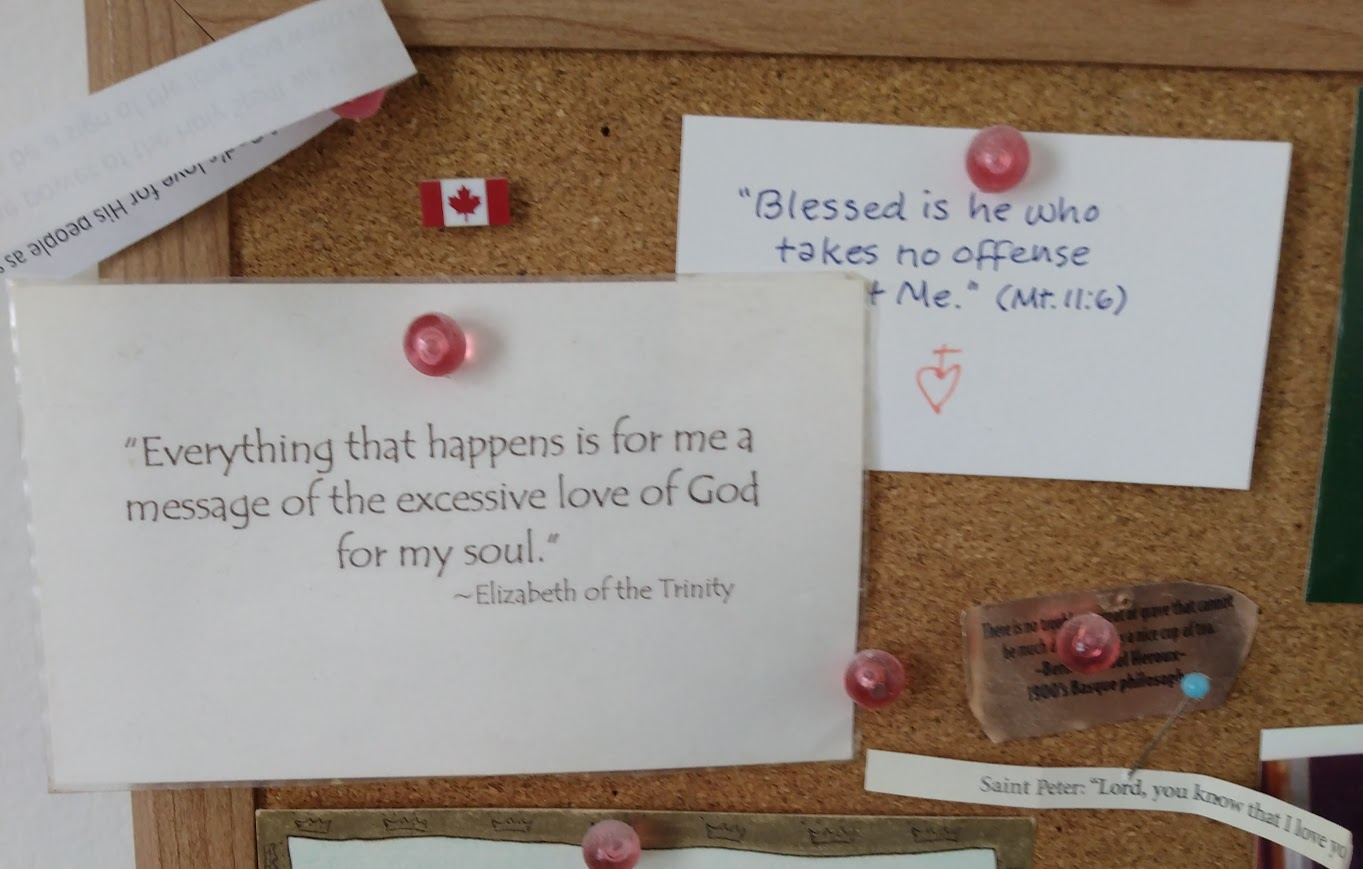
“Blessed is he who takes no offense at me.” (Mt 11:6) For most of my life, this verse has been a “life verse” for me, posted above my desk as a reminder. Amy Carmichael is the one who brought it home to me through her astute reflections. Read through them below and see if they don’t strike you as well.
“I have been reading Luke 1. ‘With God nothing is impossible.’ Then I read Acts 12. James was killed in prison; Peter was set free. God, with whom nothing is impossible, did not answer the prayers of those who loved James in the same way as He answered the prayers of those who loved Peter. He could have done so, but He did not. ‘And blessed is he, whosoever shall not be offended in Me.’ (Lk 7:23) The words seem to me to be written across Acts 12. John must have wondered why the angel was not sent to James, or at least have been tempted to wonder. Again and again in Acts the Lord Jesus seems to say those words under His breath, as it were. Let us turn all our puzzles, all our temptations to wonder why, into opportunities to receive the blessing of the unoffended.”[1]
“This is the fruit of my morning’s reading. It is not new, but it came to me as new.
“God counts on us to accept whatever answer to our prayers He gives us, whether or not it be the answer that we wished and expected. When Paul wrote to the Christians of Rome, he asked for the kind of prayer that is like wrestling with a strong (though unseen) enemy. He asked for prayer for three things, that his service (the offering of alms) might be acceptable to the Jewish Christians; that he might be delivered from the Jews who did not believe; that he might come to them—the Christians of Rome with joy. The answer to the second of these three prayers was two years in a prison in Caesarea; the answer to the third was two years’ imprisonment in Rome. In both cases his was the kind of imprisonment which required the prisoner’s right hand to be chained to a soldier’s left.
“Not many of us love to be under a roof between walls, without being able to go out into the open air. Think what it must have meant to Paul to be not only indoors but never once alone. Think of being chained to a Roman soldier at all hours of the day and night. ‘That I may come to unto you with joy by the will of God, and may with you be refreshed’ (Rom 15.32). There was not much natural joy and refreshment in coming as a chained prisoner.
“Nothing was explained. Paul and the men and women of Rome were trusted to accept the unexplained and, like John the Baptist, not to be offended in their Lord.”[2]
Eph 1.19 (Rotherham) According to the energy of the grasp of his might.
“‘It’s not my grip of Christ, but Christ’s grip of me,’ said one old Scotswoman long ago.
“This is a great word for anyone who feels futile, but it is also a great word for us all.
“And I think of Paul, so conscious of the surpassing greatness of His power (power whose lightest touch could have snapped his chains) that he could describe that power in heaped-up words of wonder. Yet he was so utterly content in his prison—so unoffended—that his Lord could use him to write deathless letters like this. What a God and what a servant! And He, Who made him what he was, is our God, even ours.” [3]
“Our minute may seem endless [cf. Mk 6.48]—‘How long will You forget me’ [Ps 13.1], cried David out of the depth of his—but perhaps looking back we shall see in such an experience a great and shining opportunity. Words are spoken then that are spoken at no other time, such as the immortal words to John the Baptist, And blessed is he who takes no offense at me.’”[4]
“‘She hath neither rusted out, nor burned out. She is burning still.’ I read that in an Australian magazine and I prayed that it might be true of each one of us. We want most earnestly not to rust out, we would gladly be burned out, but till that day comes, the Lord keep us ‘burning still.’
“Perhaps some of us are sorely tempted to think that just now there is not much that is ‘burning’ about our lives. Some are ill, some have duties of a very simple sort—where does the burning come in? Where did it come in when John the Baptist was shut up in prison? He could not do anything but just endure, and not be offended, and not doubt his Lord’s love. But when our Lord Jesus spoke of him, He said he was burning and shining—‘a burning and shining light’ (Jn 5:35).
“It is not the place where we are, or the work that we do or cannot do, that matters, it is something else. It is the fire within that burns and shines, whatever be our circumstances.”[5]
Luke 7.22,23: Go your way, and tell John . . .
“Before they got to the end of the mighty things they were to tell him, his heart must have kindled with new hope: My Lord can do all that, He is doing all that, He is omnipotent. He is my loving Lord, and He is very near. I shall soon be free—He who is opening the prison doors of death will open my prison door. Can you not all but hear him say it, or at least feel him think it, as he listens to the story of ‘what things’ these men of his ‘have seen and heard’? And then, instead of a promise, and quick help, ‘Blessed is he, whosoever shall not be offended in Me’, and that was all. But it was enough. John accepted the unexplained. And a light shone in the cell, and in that light he lived till his prison door opened, and he stepped across its threshold into the Land of Light.
“To many of you this is a familiar word, but it came to me afresh as I read these two verses one after the other last night, and it spoke to me as I thought of the many who are being trusted not to be offended in Him.”[6]
“’ Then they were glad because they had quiet’ [Ps 107.30]; the words were music to me. Then, in reading the different stories of the Lord calming the sea, I found this: ‘He came to them, walking on the sea . . . and would have passed by them’—‘as if intending to pass them’—‘and was wishing to pass by them’ [Mk 6.48]. The more literal the translation, the more startling it is.
“As I pondered the matter I saw that this ‘age-long minute’ was part of the spiritual preparation of these men for a life that at that time was unimagined by them—a life of dauntless faith and witness in the absence of any manifestation of the power of their Lord; and it must be the same today.Such minutes must be in our lives, unless our training is to be unlike that of every saint and warrior who ever lived. Our ‘minute’ may seem endless—‘How long, O LORD? Wilt thou forget me for ever?’ [Ps 13.1], cried David out of the depths of his—but perhaps looking back we shall see in such an experience a great and shining opportunity. Words are spoken then that are spoken at no other time, such as the immortal words to John the Baptist, ‘And blessed is he who takes no offense at me’ [Mt 11.6]. We have a chance to prove our glorious God, to prove that His joy is strength and that His peace passeth all understanding, and to know the love of Christ that passeth knowledge.
“And the ‘minute’ always ends in one way, there is no other ending recorded anywhere: ‘But immediately he spoke to them and said, “Take heart, it is I; have no fear . . . and the wind ceased’ [Mk 6.50].
“’ Then they were glad because they had quiet, and he brought them to their desired haven’ [Ps 107.30].”[7]
[1] Thou Givest . . . They Gather. Fort Washington, PA: CLC, 1977, p. 76.
[2] Edges of His Ways.
[3] ibid.
[4] Edges, p. 144.
[5] ibid., pp. 182-3.
[6]Edges, p. 183
[7] ibid, pp. 143-144.
 Witnesses to Hope