God is always giving. This insightful poem by Jessica Powers underlines the fact that God gives most to those who are needy and empty, yet bold in their cry for more.
The Second Giving
The second giving of God is the great giving
out of the portions of the seraphim,
abundances with which the soul is laden
once it has given up all things for Him.
The second growth of God is the rich growing,
with fruits no constant gathering can remove,
the flourishing of those who by God’s mercy
have cut themselves down to the roots of love.
God seeks a heart with bold and boundless hungers
that sees itself and earth as paltry stuff;
God loves a soul that cast down all He gave it
and stands and cries that it was not enough.
This Sunday’s poem is one by Jessica Powers, written in 1948:
Advent
I live my Advent in the womb of Mary.
And on one night when a great star swings free
from its high mooring and walks down the sky
to be the dot above the Christus i,
I shall be born of her by blessed grace.
I wait in Mary-darkness, faith’s walled place,
with hope’s expectance of nativity.
I knew for long she carried me and fed me,
guarded and loved me, though I could not see.
But only now, with inward jubilee,
I come upon earth’s most amazing knowledge: someone is hidden in this dark with me.
~Jessica Powers, The Selected Poetry of Jessica Powers, p. 81.
I’ve been thinking about how I would answer my own query at the end of yesterday’s post, and one thing that immediately came to mind that brings beauty into my own life is a little photo album of art prints and such that I have collected. For many of them I have an accompanying quote on the facing page. Often I use it as an accompaniment in prayer, a source of meditation. One example of this can be found here. And here is another example:
I find this image of Mary quite beautiful. Its title is Mary, the Mother and Consolation of the Grieving. The following is the poem I have placed opposite it:
THE POOL OF GOD
There was nothing in the Virgin’s soul
that belonged to the Virgin–
no word, no thought, no image, no intent.
She was a pure, transparent pool reflecting
God, only God.
She held His burnished day; she held His night
of planet-glow or shade inscrutable.
God was her sky and she who mirrored Him
became His firmament.
When I so much as turn my thoughts toward her
my spirit is enisled in her repose.
And when I gaze into her selfless depths
an anguish in me grows
to hold such blueness and to hold such fire.
I pray to hollow out my earth and be
filled with these waters of transparency.
I think that one could die of this desire,
seeing oneself dry earth or stubborn sod.
Oh, to become a pure soul like the Virgin,
water that lost the semblances of water
and was a sky like God.
~Jessica Powers
Still thinking a lot about our Homeland, and, of course, about my aunt’s journey there. I was thumbing through my collection of Jessica Power’s poetry and found this most apt poem. (Poetry is one of the solaces in my life.)
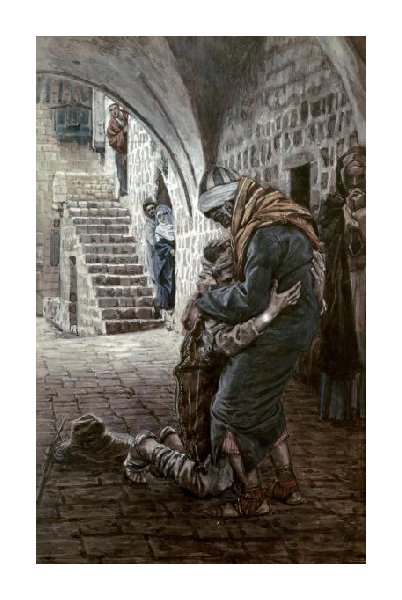
Return of the prodigal son (Tissot)
The Homecoming
The spirit, newly freed from earth,
is all amazed at the surprise
of her belonging: suddenly
as native to eternity
to see herself, to realize
the heritage that lets her be
at home where all this glory lies.
By naught foretold could she have guessed
such welcome home: the robe, the ring,
music and endless banqueting,
these people hers; this place of rest
known, as of long remembering
herself a child of God and pressed
with warm endearments to His breast.
~Jessica Powers, The Selected Poetry of Jessica Powers, p. 53
The same will be true for us: the robe, the ring, the banqueting, and best of all, the warm endearments as we are pressed to His breast.
The poem I have to share with you this Sunday is another by Jessica Powers:
The Garments of God
God sits on a chair of darkness in my soul.
He is God alone, supreme in His majesty.
I sit at His feet, a child in the dark beside Him;
my joy is aware of His glance and my sorrow is tempted
to nest on the thought that His face is turned from me.
He is clothed in the robes of His mercy, voluminous garments–
not velvet or silk and affable to the touch,
but fabric strong for a frantic hand to clutch,
and I hold to it fast with the fingers of my will.
Here is my cry of faith, my deep avowal
to the Divinity that I am but dust.
Here is the loud profession of my trust.
I need not go abroad
to the hills of speech or the hinterlands of music
for a crier to walk in my soul where all is still.
I have this potent prayer through good or ill:
here in the dark I clutch the garments of God.
I’ve done a lot of meditating over the years on today’s gospel. For many long seasons of my life, I have felt that I have been with Mary weeping outside the tomb, Jesus calling my name, but I keep failing to recognize Him. Learning to trust Him when I think He’s gone and I can’t recognize Him. (See “While it was still dark”)
Two paintings here of Mary before and after her conversion:
The Magdalene before her conversion (James Tissot)The repentant Mary Magdalen (James Tissot)
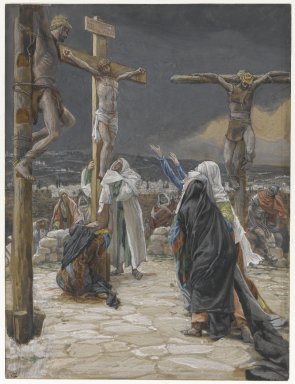
On another note, this poem by Jessica Powers came to mind today. In this poem, she writes about Mary’s encounter with Christ on the Cross and then her later life, where she lived as a contemplative hermit:
The death of Jesus (James Tissot)
The Blood’s Mystic
Grace guards that moment when the spirit halts
to watch the Magdalen
in the mad turbulence that was her love.
Light hallows those who think about her when
she broke through crowds to the Master’s feet
or ran on Easter morning,
her hair wind-tumbled and cloak awry.
What to her need were the restrictions of
earth’s vain formalities?
She sought, as love so often seeks and finds,
a Radiance that died or seemed to die.
One can surmise she went to Calvary
distraught and weeping, and with loud lament
clung to the cross and beat upon its wood
till Christ’s torn veins spread a soft covering
over her hair and face and colored gown.
She took her First Communion in His Blood.
O the tumultuous Magdalen! But those
who come upon her in the hush of love
claim the last graces. A wild parakeet
ceded its being to a mourning dove,
as Bethany had prophesied. We give
to Old Provence that solitude’s location
where her love brooded, too contemplative
to lift the brief distraction of a wing.
There she became a living consecration
to one remembering.
Magdalen, first to drink the fountained Christ
Whose crimson-signing stills our creature stir,
is the Blood’s mystic. Was it not the weight
of the warm Blood that slowed and silenced her?
I was thinking this morning of introducing you to Jessica Powers, a discalced Carmelite nun who wrote poetry. Which poem to share with you first, for whichever I choose will form an opinion of her? I’ll start with the first in the compilation, The Selected Poetry of Jessica Powers:
The Mercy of God
I am copying down in a book from my heart’s archives
the day that I ceased to fear God with a shadowy fear.
Would you name it the day that I measured my column of virtue
and sighted through windows of merit a crown that was near?
Ah, no, it was rather the day I began to see truly
that I came forth from nothing and ever toward nothingness tend,
that the works of my hands are a foolishness wrought in the presence
of the worthiest king in a kingdom that shall never end.
I rose up from the acres of self that I tended with passion
and defended with flurries of pride;
I walked out of myself and went into the woods of God’s mercy,
and here I abide.
There is greenness and calmness and coolness, a soft leafy covering
from the judgment of sun overhead,
and the hush of His peace, and the moss of His mercy to tread.
I have naught but my will seeking God; even love burning in me
is a fragment of infinite loving and never my own.
And I fear God no more; I go forward to wander forever
in a wilderness made of His infinite mercy alone.



 Witnesses to Hope