“You need not be afraid, am I not here?” (The Blessed Mother, to St. Juan Diego)
Category: Mary
Mary words
“Mary’s motherhood is not some vague or abstract sort of thing. It’s concrete and personal. And even though it’s universal, it’s also intensely particular. Mary is your mother. She is my mother. In this light, John Paul thinks it’s significant that Mary’s new motherhood on Calvary is expressed in the singular, ‘Behold, your son’ not ‘Behold, your billions of spiritual children.’ The Pope gets to the heart of it when he says, ‘Even when the same woman is the mother of many children, her personal relationship with each one of them is of the very essence of motherhood.’ In short: Mary is uniquely, particularly, personally your mother and my mother, and she doesn’t lose us in the crowd.” (Michael E. Gaitley, MIC, 33 Days to Morning Glory)
True obedience
The meditation for today from the Magnificat Advent Companion:
 How appropriate that commemoration of the events that lead to the image of Our Lady of Guadalupe begin immediately after the feast of the Immaculate Conception. For Mary, preserved from original sin, knows that the deepest and truest need of our heart is to be loved by God and to experience the unique preference he has for each of us. True obedience flows from our rejoicing over this preference. The serpent lied to Adam and Eve and made them think that the greatest human need is to be as powerful as God. We have sustained this wound, which makes us mistakenly think that to achieve and to impress is more satisfying than simply to be loved, when the merest reflection shows the opposite to be true. We see the interplay between Mary’s sinless clarity and the wound of original sin in her dialogue with Juan Diego, when he complains that he is not accomplished enough to be an emissary to the bishop. Mary reminds him that he is chosen, he has been preferred, and this is all that is necessary; in fact, this is everything. Let us pray to our Lady for our conversion, that our experience may teach us that it is not relying on accomplishments, but rather rejoicing in his love that makes our lives bear the fruit of his presence. (Fr. Richard Veras, emphasis added)
December Eighth
December Eighth

Beloved, Mother of us all,
To-day we remember
That, of all earth’s millions,
You, Mary, in the womb,
Were shining, whole,
And Godward-turned.
You only, O Morning Star,
Lighted the clouds of sin and waiting.
You only, Immaculate Ark,
Glided above the depths of the primal curse;
For you were to bear safely over those waters
Emmanuel, your little Son, from whose baby hand
Streams the rainbow up which we climb to God.
You only, little white moon, are the crystal
Reflection of our Sun.
But for your whiteness, O Gate of Heaven,
We had never entered, nor seen our God.
But for your loveliness, O Mystic Rose,
We had never breathed the Rose of Sharon.
White Tower of David, Ivory Tower,
Princess whose beauty lured Love’s kiss when life began,
Mother, who died a thousand deaths for us,
We thank Him for you.
To-day, when He smiles to see His image in you, clear,
Remember us.
~Sr. St. Francis S.S.J.
“My thought was with St. Mary”
from Fr. Mark Daniel Kirby’s blog, Vultus Christi:
“I was sitting with Abba Poemen one day and I saw him in ecstasy and as I was on terms of great freedom of speech with him, I prostrated myself before him and begged him, saying, ‘Tell me where you were.’ He was forced to answer and he said, ‘My thought was with Saint Mary, the Mother of God, as she wept by the cross of the Saviour. I wish I could always weep like that.'”
Come, O Mother, love’s sweet spring,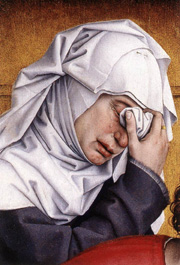
Let me share thy sorrowing,
Let my tears unite with thine.
Let my heart be all on fire,
Still to seek with fond desire
Christ, my God, my Love divine.
Holy Mother, this impart,
Deeply print within my heart,
All the wounds my Saviour bore.
The experience of Abba Poemen in the fourth century, like that of the author of the Stabat Mater, the “queen of sequences” in the Middle Ages, attests to a sweet and compelling gift of the Holy Spirit to souls in every age: the desire to approach the Blessed Virgin Mary in her sorrows and to avail oneself of the grace of her tears.
Saturday: Mary words

“O Queen of Martyrs, sea of sorrows, do not forsake me when, beneath the burden of suffering, I feel my strength and virtue weakening.” (Bl. Barbolo Longo)
Mary words
“When your heart is anxious, turn to Mary and say, ‘Mary, put my heart at peace.’ When your mind is too busy, look to Mary and pray, ‘Mary, settle down my mind.’ When you want to grow and deepen you life, look to Mary and beg, ‘Mary, just as you helped Jesus grow in wisdom and grace, help me also to advance on the spiritual path which God has laid out for me.'” (Fr. Alfred McBride)
Our travel companion
We are not alone. In the selection below, Pope Benedict encourages us to recognize that the Lord has given us Mary as our travel companion in life. What a gift. When we are needed to go to places that we are uncomfortable going to, when we are called to do things beyond our confidence, or even beyond our competence, remember she is with us, and where she is, so is her Son.
“Mary’s is an authentic missionary journey. It is a journey that takes her far from home, drives her to the world, to places that are foreign to her daily customs, makes her reach, in a certain sense, the limits of what she could reach. Herein lies, also for us, the secret of our life as men and women and as Christians. As had already happened to Abraham, we are asked to come out of ourselves, of the places of our security, to go to others, to different places and realms. It is the lord who asks this of us: ‘But you shall receive power when the Holy Spirit has come upon you; and you shall be my witnesses . . . to the end of the earth’ (Acts 1.8).
“And it is always the Lord, who on this journey, places us next to Mary as travel companion and solicitous mother. She gives us security, because she reminds us that her Son Jesus is always with us, according to what he promised: ‘I am with you always, to the close of the age’ (Mt 28.20).”
A Mary word
A “Mary word” for today, Saturday, her day:
All the sins of your life seem to be rising up against you. Don’t give up hope! On the contrary, call your holy mother Mary, with the faith and abandonment of a child. She will bring peace to your soul. ~St. Josemariá Escrivá
You do not suffer in vain
For those of you who are suffering . . . even in this Easter season . . . here is a word from John Paul II:
You have not suffered or do not suffer in vain. Pain matures you in spirit, purifies you in heart, gives you a real sense of the world and of life, enriches you with goodness, patience, and endurance, and–hearing the Lord’s promise reecho in your heart: “Blessed are those who mourn, for they shall be comforted” (Mt 5.4)–gives you the sense of deep peace, perfect joy, and happy hope. Succeed, therefore, in giving a Christian value to your suffering, succeed in sanctifying your suffering with constant and generous hope in him who comforts and gives strength. I want you to know that you are not alone, or separated, or abandoned in your Via Crucis; beside you, each one of you, is the Blessed Virgin, who considers you her most beloved children. (Pope John Paul II, Address at Lourdes, France, May 22, 1979)

 Witnesses to Hope