“And he who had only a Father now had a Mother too”

I would like to share with you today an excerpt from St. John of the Cross’s “Romances”.  In this poem, John reveals the Heart of God behind the Annunciation and the Incarnation:

7. The Incarnation

Now that the time had come
when it would be good
to ransom the bride
serving under the hard yoke
of that law
which Moses had given her,
the Father, with tender love,
spoke in this way:
“Now you see, Son, that your bride
was made in your image,
and so far as she is like you
she will suit you well;
yet she is different, in her flesh,
which your simple being does not have.
In perfect love
this law holds:
that the lover become
like the one he loves;
for the greater their likeness
the greater their delight.
Surely your bride’s delight
would greatly increase
were she to see you like her,
in her own flesh.”
“My will is yours,”
the Son replied,
“and my glory is
that your will be mine.
This is fitting, Father,
what you, the Most High say;
for in this way
your goodness will be more evident,
your great power will be seen
and your justice and wisdom.
I will go and tell the world,
spreading the word
of your beauty and sweetness
and of your sovereignty.
I will go seek my bride
and take upon myself
her weariness and labors
in which she suffers so;
and that she may have life,
I will die for her,
and lifting her out of that deep,
I will restore her to you.”

8. Continues

Then he called
the archangel Gabriel
and sent him to
the virgin Mary,
at whose consent
the mystery was wrought,
in whom the Trinity
clothed the Word with flesh
and through Three work this,
it is wrought in the One;
and the Word lived incarnate
in the womb of Mary.
And he would had only a Father
now had a Mother too,
but she was not like others
who conceive by man.
From her own flesh
he received the flesh,
so he is called
Son of God and of man.

Revisiting past posts (#3)

I haven’t been feeling well this past week, so I’m behind in posting–as some of you may have noticed.

Today is the feast of St. Juan Diego, and Sunday is the Feast of Our Lady of Guadalupe (which is pre-empted this year by the Third Sunday of Advent), and I hate to see them “lost in the shuffle” so here’s a link to last year’s post: “Let it penetrate your heart”.

Two stories in Rome

I have been to Rome twice, and I would like to tell you a little story from each time.  The most recent time was two weeks before John Paul the Great died.  Another Sister and I were riding a bus with a seminarian from our diocese who was studying in Rome and was graciously helping us find our way around.  We started talking about our favorite saints, and he told us that one of his professors told him that we do not choose our favorite saints, but that they, indeed, choose us.  The ones we feel most drawn to are, in fact, drawing us to them.  How theologically sound that is, I don’t know, but I like the sense of it!

The second story precedes this one by a few years, but is very related to it.  It was my first visit to Rome and I was pretty much on my own.  I had only three days, but was within walking distance of St. Peter’s.  Since I didn’t really know how to get around well enough to see much else, I decided to just “do” St. Peter’s in depth.  On one of my last visits–which happened to be on this very date, November 12–I roamed around inside and at some point got tired enough to look for a place to just sit down.  If you’ve ever been to St. Peter’s, you know there aren’t many places to sit down.  I finally  found a side altar way back in a corner that had some chairs set up in front of it.  As I sat there praying, I noticed a person up at the altar, praying before it.  After he left, out of curiosity, I went up to the altar to see who was buried there.  (Remember, I was “doing” St. Peter’s in depth, exploring all the nooks and crannies–and there are plenty of saints in those nooks and crannies!)  Much to my surprise, I found that it was St. Josaphat, whose very feast day it was!  Now I know that he was seeking me out, rather than vice versa.  He has become a special friend since then, especially because of his great work for the unity of the Church.


Altar of relic of St. Josaphat, St. Peter's in Rome

A tremendous yearning

For those of you who do not have access to the Office of Readings for today, All Saints Day–a magnificent reading from a sermon by St. Bernard:

Let us make haste to our brethren who are awaiting us

Why should our praise and glorification, or even the celebration of this feast day mean anything to the saints? What do they care about earthly honours when their heavenly Father honours them by fulfilling the faithful promise of the Son? What does our commendation mean to them? The saints have no need of honour from us; neither does our devotion add the slightest thing to what is theirs. Clearly, if we venerate their memory, it serves us, not them. But I tell you, when I think of them, I feel myself inflamed by a tremendous yearning.
Calling the saints to mind inspires, or rather arouses in us, above all else, a longing to enjoy their company, so desirable in itself. We long to share in the citizenship of heaven, to dwell with the spirits of the blessed, to join the assembly of patriarchs, the ranks of the prophets, the council of apostles, the great host of martyrs, the noble company of confessors and the choir of virgins. In short, we long to be united in happiness with all the saints. But our dispositions change. The Church of all the first followers of Christ awaits us, but we do nothing about it. The saints want us to be with them, and we are indifferent. The souls of the just await us, and we ignore them.
Come, brothers, let us at length spur ourselves on. We must rise again with Christ, we must seek the world which is above and set our mind on the things of heaven. Let us long for those who are longing for us, hasten to those who are waiting for us, and ask those who look for our coming to intercede for us. We should not only want to be with the saints, we should also hope to possess their happiness. While we desire to be in their company, we must also earnestly seek to share in their glory. Do not imagine that there is anything harmful in such an ambition as this; there is no danger in setting our hearts on such glory.
When we commemorate the saints we are inflamed with another yearning: that Christ our life may also appear to us as he appeared to them and that we may one day share in his glory. Until then we see him, not as he is, but as he became for our sake. He is our head, crowned, not with glory, but with the thorns of our sins. As members of that head, crowned with thorns, we should be ashamed to live in luxury; his purple robes are a mockery rather than an honour. When Christ comes again, his death shall no longer be proclaimed, and we shall know that we also have died, and that our life is hidden with him. The glorious head of the Church will appear and his glorified members will shine in splendour with him, when he forms this lowly body anew into such glory as belongs to himself, its head.
Therefore, we should aim at attaining this glory with a wholehearted and prudent desire. That we may rightly hope and strive for such blessedness, we must above all seek the prayers of the saints. Thus, what is beyond our own powers to obtain will be granted through their intercession.

And one last short little word from St. Katharine Drexel:

We are called to be saints, all of us; do not forget that.

(The photo above is of a tapestry panel in Our Lady of the Angels Cathedral in Los Angeles. If you want to see more go here and click on the “Art” tab, then click on “Tapestries”, then “View North Tapestries” or “View South Tapestries.”)

My heart, where have you gone?

A poem for this feast of Our Lady of Sorrows:

Christ and His Mother at the Cross

Christ:
Mother, take my broken heart
For your own to share apart.
John, beloved as you are
Shall be to you a son.

John, my mother here behold;
Take her tenderly and hold
her in your love.  For she is cold,
her heart has come undone.

Mary:
Son, your spirit has gone forth.
Son of all surpassing worth.
My eyes are in their vision dark
And dying is my heart.

Hear me, Son, so innocent,
Son of light magnificent
Spending and now spent,
and only darkness for my part.
Son of whiteness and of rose,
Son unrivaled as the snows,
Son my bosom held so close,
My heart, where have you gone?

John, disciple whom he loved,
your brother must be dead,
for I feel the sword through me
as prophesied.

Jacopone da Todi

“O what it must have cost the angels”

Today we celebrate the birth of Mary.  I have to say that this morning when I woke up, I felt like breaking into a little song to her, at least “Happy birthday to you . . .”–which sounds so trite–but I knew in my heart that that would be dear to her . . . because she is that kind of Mother.

I want to share the first verse of a poem by Rilke because I think it conveys the sense of joy in the heavens at the birth of this great gift of God to us.

Birth of Mary

O what must it have cost the angels
not suddenly to burst into song, as one bursts into tears,
since indeed they knew: on this night the mother is being
born to the boy, the One, who shall soon appear.

(Rainer Maria Rilke, translated from the German by M.D. Herter Norton)

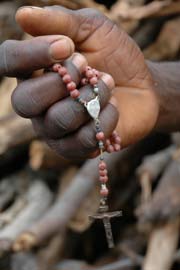
Just holding on to a rosary

On this Saturday, Mary’s day, I want to share this beautiful excerpt from one of Caryll Houselander’s letters (quoted in Magnificat today):

Your own troubles are really very sad indeed; I do feel very deeply for you.  It certainly seems that prayer is the only help–that and taking each trial separately, trying not to look miles ahead with the overwhelming picture of years of succeeding crises to weigh you down.  Prayer does bring such amazing answers that it is reasonable to hope that every separate crisis may be the last: and happiness may come very suddenly, when you least expect it . . .

Do you find help from the rosary?  I find just holding on to it, even, helps.  Of course, some would say that is mere superstition, but it isn’t if it symbolizes holding on to God, as it does for me.  I have been visiting a girl once a week for a doctor; the girl was a baffling nerve case.  She used to have about three attacks a day resembling acute attacks of Saint Vitus’ dance, and followed by palpitations of so violent a nature that the doctors marveled that her heart could stand up to it . . . She had been previously two years in hospital and had seen every specialist, but no one could diagnose her case and she just went on getting worse.  She had no religion, and her only reaction to God–a very vague idea to her–was fear and aversion.

I gave her a rosary and told her to try to say something with it in her hand–her own prayer–or say nothing, but mean to hold on to God.  From the hour she took the rosary into her hand she has been better, and is now almost cured. . . . Her mind has flowered too, literally changed from a narrow self-obsessed mind to a big, objective, clever and loving one.

“I have nothing to offer you.”

On today, Mary’s day, here are some thoughts from Paul Claudel:

Midday.  I see the open church.
It draws me within.
I did not come, Mother of Jesus Christ,
to pray.
I have nothing to offer you.
Nor to ask of you.
I only come, O my Mother,
To gaze at you,
To see you, to cry simply out of joy.
Because I know that I am your child,
And that you are there.
~ Paul Claudel

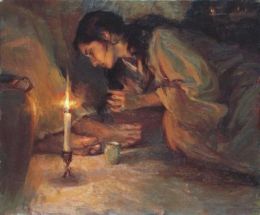
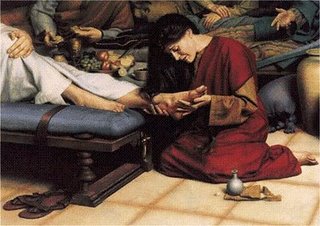
One’s little pot of oinment

Today’s Gospel as we begin Holy Week is the story of Mary of Bethany anointing Jesus’ feet.  A meditation from Amy Carmichael to ponder when we think we have broken our “little pot of ointment” in vain.

Things to remember quietly when one’s little pot of ointment seems to have been broken in vain.  Of Thine own have we given Thee, for love is of God.  The love, then, was His, and to Him first of all it was offered–to the human dear one not first but second.  No pot of ointment was ever broken at His feet wihtout given Him some little quick sense of pleasure. So it was not all in vain.  Then if it seemed to miss what we meant it to do for the one we love down here, it may be only for the moment.  The remembrance may return and be very sweet, like a fragrance.

The more loving the heart is, the more it looks forward to giving a pleasure to the one it loves, the keener therefore the pang of disappointment when it fails, and the fiercer the inrush of depression.  The heart is grieved and cannot rise to be glad.  At such times it does help to know that love cannot be as water spilt on the ground.  For it is of God.  The fragrance of the ointment will yet fill the house.  The one to whom we wanted to bring comfort will in the end find that which we brought.  But the sweet and immediate comfort is-–‘Of Thine own have we given Thee.’  Dear Lord, did it comfort Thee?

A golden moment

There are so many artistic depictions of the Annunciation, but one of my all-time favorites is one that a good friend of mine gave me a few years ago.  You can see it below.  Not too long afterward I came across a poem by Luci Shaw that seemed to have been written for it.  I share that with you as well.  Thank you, Mary, for your earth-changing yes. . .

Annunciation (golden) 001Virgin

As if until that moment
nothing real
had happened since Creation

As if outside the world were empty
so that she and he were all
there was–he mover, she moved upon

As if her submission were the most
dynamic of all works; as if
no one had ever said Yes like that

As if that day the sun had no place
in all the universe to pour its gold
but her small room

(Luci Shaw)