We don’t choose our favorite saints; they choose us.

Someone said to me a few years ago: “We don’t choose our favorite saints; they choose us.”  I feel just that way about St. Thérèse of Lisieux.  She’s been a good friend for a long time.  I’ll let her speak for herself:

therese2Perfection seems easy to reach.  I realize that it is sufficient to recognize one’s own nothingness and to abandon oneself as a child in the arms of God. (LT 226)
The poorer you are the more Jesus will love you.  He will go far, very far, in search of you, if at times you wander off a little.  (LT 211)

Keep in mind the method used to make copper objects shine.  You smear them all over with mud, with things that make them dirty and dull; after this operation, they will shine again like gold.   Okay!  Temptations are like this mud for the soul: they serve for nothing less than to make the virtues which are opposed to these same temptations to shine forth.  (CRM 51)

Love knows how to draw profit from everything: from the good and from the bad that is found in us. (LT 142)

O, Mary, if I were Queen of Heaven, and you were Thérèse, I would wish to be Thérèse so that you could be Queen of Heaven.

More quotes from St. Thérèse can be found here.

“A clean and shining beauty of soul”

Mary has “a clean and shining beauty of soul.”

Rate this:

I can’t write about beauty without, of course, saying something about Mary, the Mother of God, who as John Saward says: “In face and grace, Mary is like Jesus.”

umilen3St. Cyril of Alexandria calls our Lady kallitokos as well as theotokos, “bearer of Him who is true beauty” as well as “bearer of Him who is true God.”

Grace, as the poet [Hopkins] says, is “God’s better beauty,” the splendor of the soul . . . “O pure Theotokos”, sings the Byzantine Church on the feast of the Entry of the Mother of God into the Temple, “thou hast a clean and shining beauty of soul, and art filled from Heaven with the grace of God” (the Festal Menaion).  Grace conforms the soul into the likeness of Christ.  So it is with Mary.

       (John Saward, The Holiness of Beauty and the Beauty of Holiness, p. 122)

The lady of fair weeping

Mary is beautiful, even in her sorrow.

Rate this:

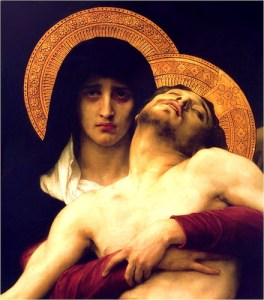
Today is the Feast of the Sorrowful Mother.  Recalling Cardinal Ratzinger’s words from yesterday’s post, we can see that Mary is beautiful even in her sorrow:

The Blessed Virgin is the lady of fair weeping.  Her tears were beautiful.  These are the sorrows of one who is all beautiful, full free from the deformity of sin. . . No lamentation has been lovelier, no compassion purer . . . .  The sinless Spirit-filled heart of Mary is beautifully centred on the will of the Father and on His and her Son and those for whom He suffers.  (John Saward, The Beauty of Holiness and the Holiness of Beauty)

Our Lady of Sorrows

And a little consoling excerpt from Magnificat today: “As the Savior’s dying gift to us, Jesus leads us back to Mary.  For we need the maternal closeness of the Sorrowful Mother to sustain us when overcome by the terrifying trials of life.”

Nativity of Mary

A short hymn in honor of the Feast of the Nativity of Mary, the Theotokos.

Rate this:

Just a short hymn from the Eastern Church in honor of this day.   

          Kontakion (Tone 3)

Today the Virgin Theotokos Mary
The bridal chamber of the Heavenly Bridegroom
By the will of God is born of a barren woman,
Being prepared as the chariot of God the Word.
She was fore-ordained for this, since she is the divine gate and the true Mother of Life.

Nativity of the Theotokos

A shelter for the shelterless

Mary is a shelter for the shelterless.

Rate this:

A quote about Mary, on this Saturday, her day:

“Our Lady’s heart is the most empty of all human hearts, the most empty of self and empty of pride, and therefore the most ready to give a heart’s welcome and shelter to those who are shelterless.” (Fr. Joseph Langford, Mother Teresa in the Shadow of Our Lady, p. 42)

He was not alone

It bothered me for months that the body of my brother had not been found until ten days after he died.

Rate this:

This morning I was remembering a story I first heard about three years ago.  It was told by Fr. Basil Nortz during a series of talks about the angels that we have on CD.  The story was told to him by another priest and goes something like this:  The priest’s mother died suddenly and unexpectedly one day, collapsing on the street after coming out of a store in which she had been shopping.   The priest, upon hearing about her death, was able to accept it in peace, except for one fact: that she had died so publicly on the street, a public spectacle–his mother was a very private person and would never have wanted to have died in such a public manner.  This was very disturbing to him. Why did God allow such a thing to happen?
     A few weeks after the funeral, he happened to be in the neighborhood of the store and stopped in.  The woman who worked there knew him and asked how he was doing.  He relayed his concern about the circumstances of his mother’s death.  She said, “Did no one tell you?” Apparently a young man who had been present came up almost immediately, put his coat around her, and held her in her arms until the EMT folks arrived.  The young man helped her into the vehicle and then took his coat.  The priest was so relieved that the young man had been with her, and, of course, wanted to know who he was so he could thank him.  The woman did not know, nor did others that had been present at his mother’s death.  Still he wanted to find him and thank him.
      Sometime later when the priest was praying, he heard a very distinct voice: “I am the one you are looking for.  I am the guardian angel of your mother.”    He realized that the Lord had allowed his mother’s guardian angel to appear in bodily form in order to protect his mother, even after she had died.  

The reason I share that story is very personal.  As some of you know, my brother, Tim, took his life in March of 2006.  I experienced God’s presence and comfort in untellable ways during those first few days after he died.  But like the priest in the story, in the midst of my grief something continued to disturb me.  My brother died on March 17, but his body was not found until ten days later, and that bothered me–that he was alone for those long ten days, and that haunted me for many months.  Until I heard Fr. Basil’s story.  As soon as he recounted the part where the priest heard the voice saying: “I am the one you are looking for. . .”, I began to weep because I knew the same was true for my brother–that his guardian angel had not left him alone during those ten days.   God’s mercy is so great.  “If I ascend to heaven, you are there!  If I make my bed in Sheol, you are there! . . . Even there your hand shall lead me, and your right hand shall hold me” (Ps 139.8,10).

That is the heart of Christ for us and for all those we love.  He will not leave us alone. 

 I don’t know why that story came to mind this morning.  Perhaps one of you really need to hear it . . .

The kind of Queen she is

Today is the memorial of the Queenship of Mary.  Here are two descriptions to ponder of what kind of Queen she is.  The first is by Georges Bernanos:

The Mystery of Mary

She is our Mother.
But she is also our daughter.
A little girl and the Queen of Heaven.
The Queen of the Angels–
And yet she is still a little girl!
Remember this!

And by Eryk Hanut:

Mary is gigantic, but also tiny and hunched with humility.  Far, but never, ever, distant.  She is the bedside lamp that we can [reach] at any moment to dispel the darkness.
     Mary draws millions to her, gives sight to the blind, makes springs gush at Banneux, Lourdes, LaSalette.  Mary makes the sun dance at Fatima and a tree at Beauraing break into blossom in the middle of the winter.  She gives you what you would expect from a Queen–glory.  But she also gives you what you would hope from a mother.  Mary cooks the soup, squinting anxiously at the clock if her child is late.
     Mary is the clock, but she is also the first to forget it.  Everyone knows this who kneels and prays to her. She is there; she can do anything; she has been through everything.  What would be more mind-shattering than the destiny of this tiny Jewish girl, this thirteen-year-old who said “yes” to the plans of God.
     Everyone knows how tremendous Mary’s destiny is.  That is why anyone can ask anything from her.  Everyone, on one day or another, has asked her for something–even those who are closed to her mystery. 
     I often ask myself if the adoration we give her matters at all.  She wants our best.  That is all that matters to her . . . .
     Nothing is more poignant than a person who prays.  To pray is to become a little child again.  It is to talk to your mother without a grill between you.  And the Mother listens, listens, consoles, replies. . .

Take time to talk to your Mother today . . .

Ancient prayer to Mary

Ancient Egyptian prayer to Mary.

Rate this:

On this, our Lady’s day, I thought I would share an ancient prayer to Mary, found on papyrus in Egypt.  (Theotokos means God-bearer.)

Under your
compassion
we take refuge,
Theotokos; do not
overlook our prayers
in the midst of tribulation,
but deliver us
from danger,
O only pure,
only blessed one.

I am nothing but obstacle

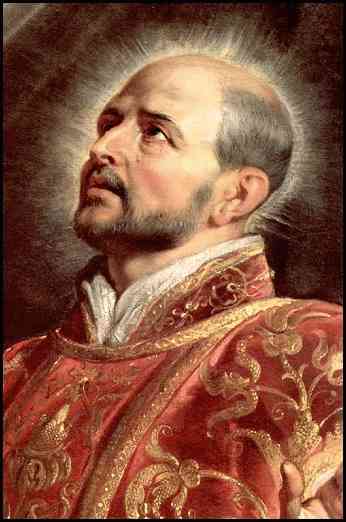
“For myself, I am convinced that I am nothing but obstacle.” (St. Ignatius of Loyola)

Rate this:

Ignatius of LoyolaLast year, on All Saints Day, our house began the custom of each sister drawing the name of a saint, one to get to know more and pray to during the year.  I prefaced our drawing of the slips on which were written the saints’ names with the comment that someone once made to me on a bus in Rome: “We often think that it’s our idea to learn more about a particular saint that then becomes our favorite, but in reality the saint is seeking us out and drawing us to him/herself.”  The saint’s name I drew was St. Ignatius of Loyola. 

Today being his feast day, I thought I would look through my two 600 page journals which are mostly made of quotes I have copied into them. (I have them indexed for obvious reasons. 🙂  The only quote I could find by St. Ignatius was:  “For myself, I am convinced that I am nothing but obstacle.”  (Must have struck home when I read it. 🙂  But what I have written next in my journal is this: “But does that put God off?  Absolutely not!  His love pursues me.  ‘The voice of my beloved!  Behold, he comes, leaping over the mountains, bounding over the hills‘ (Song of Songs 2:8).”  He can leap over any obstacle.  What can separate us from the love of Christ? “I am sure that neither death, nor life . . .” (Rom. 8.38).

You are my favorite

I used to tell all my students, each of them, “You’re my favorite.”

Rate this:

I taught sixth graders for around eleven years–hey, eleven years of teaching eleven-year-olds!  And I loved every minute of it.  One of the ways God graced me was by giving me a unique love for each child.  I could truthfully say–and often did–to each one, “You are my favorite student.”  Sometimes I would walk around the class while they were doing silent reading and whisper, in all sincerity, in each ear, “You are my favorite student.”  Of course, they would ask, “How can that be true? How can we all be your favorite students?!”  Then, I would pull out a pile of my favorite books.  I would pick each one up and say, “This is my favorite book”, and so on.    I’d talk about how each book was a favorite for a different reason from the others. Then I would ask them, “How many favorite movies do you have?”  And then I would go on to explain how each of them could be my favorite student–and how to God, we are all His favorites.  Even to this day, I’ll have former students say, “Hi, Sr. Dorcee, am I still your favorite student?” and, of course, I’ll say, “Yes!!”

One day, on a Feast of Our Lady–I can’t remember which one–I was at Mass, and I looked up and saw one of my former favorite students across the way, and started thinking about her.  And, out of the blue, a thought passed through my head–which I’m sure was from Our Lady–“You’re my favorite.”  All I could do was smile . . . because I know she says that to each one of us.