The measure of a father’s love

For the last week and a half I have been pondering a piece written by Fr. Peter John Cameron for this month’s Magnificat.  Perhaps you’ve seen it as well?  For those who haven’t, I would like to include a few sections because he brings together two passages that it never would have occurred to me to juxtapose.  The first is the gospel reading for this coming Sunday, the story of the prodigal son.  The second–well, read on. He begins:

What was it that turned the prodigal son against his father (see Lk 15:11-32)?  Maybe the father was like the famous landowner in the parable of the workers hired late (Mt 20.1-16) who goes out five different times in the course of a single day to employ laborers for his vineyard.  At five o’clock in the evening he hires yet more workers.  And even though these men toil barely an hour, the landowner pays them the usual daily wage–the same salary as all the other laborers.  This sparks an outcry among the workers who have labored all day long bearing “the day’s burden and heat.”  Perhaps the prodigal son was among those who bitterly grumbled against the landowner.  Maybe it was the father’s extravagant display of generosity that provoked the son to demand, “Father, give me the share of your estate that should come to me.”  As if to say: “If you want to be so foolish and wasteful with your money, then give it to me, because I can’t stand being around here anymore if this is the way you want to act.”
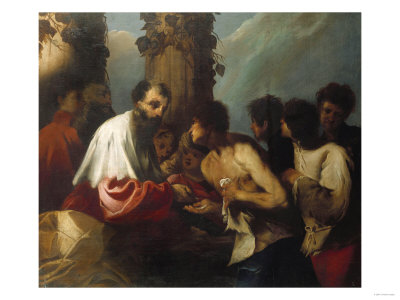
And as Fr. Peter goes on to say: “What can the father do?”  What can we do when someone rails against our generosity? What is our Father to do when we rail against His generosity?

What can the father do?  If he refuses his son, the son will grow sullen and resentful, harboring a grudge that would wreak havoc on the household.  But to give his son the sum and let him go would be like setting the boy on the path of his own self-destruction.  Ironically, the prodigal son forces his father to become a kind of Abraham on Mount Moriah, where God commanded Abraham to sacrifice his son Isaac (see Gen 22.1-14).  In order not to sin against heaven, the father had to put his son in peril: “Then [Abraham] reached out and took the knife to slaughter his son” (Gen 22.10).  Commenting on the father of the parable, the Venerable John Paul II wrote, “The love of the son that springs from the very essence of fatherhood in a way obliges the father to be concerned about the son’s dignity.  This concern is the measure of his love.”  Thus the father hands over the inheritance and lets his son go.

We know the ending, a happy one.  It’s always a risk, but a risk the Father is willing to take–because that’s how much He loves us. When our life seems to be going badly, perhaps it is a result of the Lord letting us go our own way . . . because that is the measure of a Father’s love.
Never an option

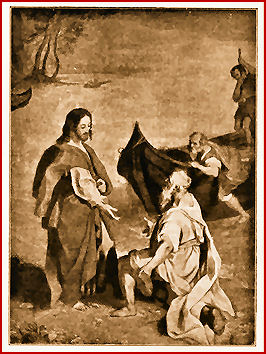
I was so struck this morning by this introductory comment to today’s Mass readings from Magnificat.  The gospel recounts the story of Peter asking Christ to depart from him because he is a sinful man.  Magnificat comments:

Peter relies on his limited expertise instead of upon the humble authority of Jesus Christ . . . even regarding fishing.  . . . When Peter’s sin of presumption fills him with shame, he begs Jesus to depart from him–a request that Christ will never honor.

What a Savior we have–One who will never depart from us, even if we beg Him. . .

Fight against those who fight against me

A little encouragement from Amy Carmichael this morning:

Ps 35.1 Fight against those who fight against me.
Ps 35.3 (Kay) Be a barrier against my pursuers.

What are the things that fight against me?  Let us not lose the comfort and power that is in this word for us by relating the prayer to the larger things only, it touches the smallest.  The wave that sweeps over the great rock, is the same that sweeps over the tiny shell on the shore.  It is the little things of life, the minute unimportant-looking things, that are most likely to shatter our peace; because they are so small that we are very likely to fight them ourselves, instead of looking up at once to our Strong God, our Barrier between us and them.  “Close the gate, or bar up the way:–as the cloudy pillar formed a barricade between the Egyptians and Israel” is Kay’s note.

Fight against those who fight against me–the feelings, the little foolish feelings that want to keep us back from saying to the blessed Will of God “I am content to do it” [Ps 40.10], fight Thou against them, O God; “and my soul shall be joyful in the Lord: it shall rejoice in His salvation . . . Lord, Who is like unto Thee, Who deliverest the poor from him that is too strong for him?” [Ps 35.9, 10]

What a joyful life ours is, continually proving His tenderness in the very little things.  There is nothing too small for Him to help.  He is indeed a Barrier between us and our pursuers.  How precious is His lovingkindness. [Ps 36.7]  Now for a day of joy!

His love has no end

I have been meditating on Ps 136 this past weekend.  The RSV begins: O give thanks to the Lord, for he is good, for his steadfast love endures for ever–or as Derek Kidner points out, the better translation is: for his love has no end. This phrase repeats itself after every verse of the psalm–for his love has no end, for his love has no end, for his love has no end. Fr. Patrick Henry Reardon, an Orthodox pastor,  has a wonderful commentary on this phrase:

Psalm 136 insists, literally in every verse, that the root of all God’s activity in this world, beginning even with the world’s creation, is mercy–hesed.  This mercy is eternal–le’olam–“forever.”  Mercy is the cause and reason of all that God does. He does nothing, except as an expression of His mercy.  his mercy stretches out to both extremes of infinity.  “For His mercy endures forever” is the palimpsest that lies under each line of Holy Scripture.  Thus, too, from beginning to end of any Orthodox service, the word “mercy” appears more than any other word.  The encounter with God’s mercy is the root of all Christian worship.  Everything else that can be said of God is but an aspect of His mercy.  Mercy is the defining explanation of everything that God has revealed of Himself.  Every Orthodox service of worship, from Nocturnes to Compline, is a polyeleion, a celebration of God’s sustained and abundant mercy.  What we touch, or see, or hear, or taste–from the flames that flicker before the icons and the prayers our voices pour forth, to the billowing incense and the mystic contents of the Chalice–all is mercy.  Mercy is the explanation of every single thought that God has with respect to us.  When we deal with God, everything is mercy; all we will every discover of God will be the deepening levels of His great, abundant, overflowing, rich and endless mercy.  “For His mercy endures forever” is the eternal song of the saints.  (Christ in the Psalms, p. 272)

“I found myself . . .”

When you find yourself in a trial or difficult situation, do you see it as the hand of God.  Here’s another excerpt from the book I was talking about last time, Green Leaf in Drought, by Isobel Kuhn.  It’s  from one of Arthur Mathews’ letters home:

John says, I FOUND myself in the isle which is called Patmos–not one jot of credit does he give to the might of Rome.  A not one mention escapes him of what he must have endured before eventually “finding” himself there.

He was “found” there just as Philip was “found” at Azotus, and the Mathews’ family is “found” here.  The means, circumstances, decisions that led to his finding himself there are unimportant.  Faith discerns even behind the Beast the hand of God–for second causes make good disguises and baffle any eyes but the eyes of faith.  So to enlarge on the why and the wherefore; to blame himself or his charges; to weigh past decisions for or against . . . is not on John’s mind; nor does he allow any wishful sightings to occupy his thoughts.  A more ideal field for just such thoughts could hardly be found.  So there is a great deal of comfort for us in John’s early verses of the Revelation.   (Green Leaf in Drought, p. 55)

If

I have been reading quite a bit of the writings of Isobel Kuhn, a protestant missionary to China right before Communism took over.  The excerpt below is from a book about a married couple and child who were trapped in China at the onset of Communism and not allowed to leave for quite awhile.  Isobel focuses in on the question that can tempt us all at various times in our lives: “If only . . .”  The woman she is writing about is the wife and mother in the family.

“If only that letter had not come, inviting us here.”  What about the “if”?  She got them [a tract she had on “If”] and read:

Lord, if you had been here, my brother would not have died” [Jn 11.32b]”  And He could have been there; He was not far away.  He knew all about it, and He let him die.  I think it was very hard for that woman . . . It is something God could  have made different, if He had chosen, because He has all power; and He has allowed that “if” to be there.

I do not discount the “if” in your life.  No matter what it is . . . Come to the Lord with your “if” and let Him say to you what He said to Martha.  He met her “if” with His “if”!  “Did I not tell you that IF you would believe you would see the glory of God” [Jn 11.40]” The glory of God is to come out of the “if” in your life. . .

Do not be thinking of your “if.”  Make a power out of your “if” for God. . .

Do you know that  light is to fall on your “if” some day?  Then take in the possibilities and say, “Nothing has ever come to me, nothing has ever gone from me, that I shall be better for God by it . . .”

Face the “if” in your life and say, For this I have Jesus.

But there is nothing to be ashamed of if you experience those “ifs” plaguing you, as Isobel Kuhn goes on to write:

[O]ur Lord never scolded Martha for her “if”; nor Mary (who accompanied the same “if” with mute worship, prostrating herself at His feet), but with her, He wept.  Wept at the sorrow which must accompany spiritual growth in our lives: for by suffering He also learned obedience.  (Green Leaf in Drought, p. 36)

“I remember Thee”

I noticed something this morning as I was meditating/studying Psalm 42.  The psalm seems to fluctuate between feelings of desperation and self-encouragement to hope in God for “I shall again praise him.”  The “something” I noticed was a shift from focus in v. 4 to v. 6.  In v. 4, the psalmist attempts to lift up his spirits by remembering things in the past, ways that he had led worshipers in giving thanks to God for things He had done, the remembering of which should surely give him hope.  Not a bad thing to do when you’re discouraged.  Definitely a step in the right direction. But in v. 6, when his “soul is cast down”, he “remembers thee“.  He remembers God, and God alone.  How much better to lift our minds and hearts to God rather than just dwelling on the things of God?  Things and events may change, but God is always immoveable and unchanging, and that implies that His Love is unchanging . . . for He is Love.

A great word for us all

A selection from Amy Carmichael about hope, about continuing to hope when things are turning out the way we expect:

Rom 15.13 May the God of hope fill you with all joy and peace in believing, so that by the power of the Holy Spirit you may abound in hope.

This is a great word for us all.  We need to be continually renewed in hope because, although there are always happy things happening, the devil does not forget us.  Every now and then we are sharply reminded that he is either a roaring lion, walking about among us, seeking whom he may devour; or he is a serpent, the kind that does not shrink away when he hears us coming, but is quite ready to attack and shoot venom at us, as some snakes are said to do so.  I often thank God that He is a God of hope.

It is also a great word for all who love enough to suffer when those who were trusted have disappointed us.  Paul wrote it in one of his earlier letters.  About thirteen years later he wrote his last letter.  The space between those two letters was filled with experiences of joy and sorrow, most of which are unrecorded.  Among these is a story which comes very close to all of us who have had much to do with souls.

We know Paul loved and trusted his children in the faith who had become his fellow-workers.  Twice we find one of these mentioned in the loving list of names at the end of two of his letters [cf. Col. 4.14; Philem. 24].  Then there is silence.  What pangs, what strivings, what prayers, filled that silent space?  We are told nothing of them, but our hearts tell us what his heart went through before he wrote of that same one in his last letter, “Demas, in love with this present world, has deserted me” [2 Tim 4.10].

And yet–and it this that comes close to us–there is no weakening in that last letter, no discouragement, no whisper of loss of faith in others, no fear.  “For God did not give us a spirit of fear, but of power and of love and of a sound mind . . . . I know whom I have believed, the God, not of despondency, but of hope” [2 Tim 1.7, 12].

But if not

Facing another day of high heat today made me think of the three young men in the fiery furnace.  Now that you’re smiling, I actually did meditate on that passage from Daniel today.  The attitude of those men in the midst of a life-threatening situation–much more serious than this heat crisis :-)– is amazing.  I just want to share a few thoughts:

  1. When Nebuchadnezzar announces that he will throw them into the fiery furnace if they do not worship his gods, they respond: “If it be so, our God whom we serve is able to deliver us from the burning fiery furnace; and he will deliver us out of your hand, O king.  But if not, be it known to you, O king, that we will not serve your gods or worship the golden image which you have set up.” (Daniel 3.17-18 emphasis added)  Amy Carmichael did a little meditation on these verses, highlighting the “but if not.”  If things do not turn out the way we prefer, will we keep abandoning ourselves to Him, trusting wholeheartedly in His love?
  2. This verse really struck home: And they walked about in the midst of the flames, singing hymns to God and blessing the Lord. This verse always makes me think of Isaiah 43.2b: When you walk through fire you shall not be burned, and the flame shall not consume you. No grumbling allowed for me when it’s hot, hot, hot.  Only singing hymns and blessing the Lord.  (If you’re like me, it’s easier to handle the big “heats” in life than the small ones. . .)
  3. And most importantly, a fourth man was seen walking in the midst of the fire with the three.  Jesus is always with us in the midst of our own fires.

So bless the Lord, O my soul . . .  He saves us from the eternal fire, which is the most important.

I trust

A thought from Amy Carmichael on trusting that God loves us:

1 John 4.16 (Rotherham) We have come to understand and to trust the love which God hath in us.

I have been thinking much of this translation.  We can never fully understand that love, but we can begin to understand it even here and now, and as we understand, we trust.  This means that we trust all that the love of God does; all He gives, and all He does not give; all He says, and all He does not say.  To it all we say, by His loving enabling, I trust.  Let us be content with the Lord’s will, and tell Him so, and not disappoint Him by wishing for anything He does not give.  The more we understand His love, the more we trust.  (Edges of His Ways, p. 145)