Delivered from all your fears

I have been “living” in the psalms this past year, relying on Derek Kidner’s commentaries and, more recently, working through some of Amy Carmichael’s comments on various psalms.  I thought I would share this one on Psalm 34 with you today:

Psalm 34.4, 6:  From all my fears . . . Out of all his troubles. 

My fear is not yours, but nearly everyone has, somewhere inside, a weary little fear which keeps cropping up.  But every time the fear pushes out its head, there, waiting to end it, is that glorious word, ‘delivered from all my fears.’ (Not from some, or from most, but from all.)

Out of all his troubles: this may find someone in trouble.  We may have to pass through the waters, but we shall be delivered out of them.  They will not overflow us. ‘This poor man cried, and the Lord heard him, and saved him out of all his troubles.’  There again, it is not out of some, or out of most, but out of all.”  (Edges of His Ways, p. 23)

A word to last all through your day

A reflection from Amy Carmichael on Ps 68.28: Thy God hath sent forth strength for Thee (P.B.V.)

Many of us know what it is to receive a word in the early morning that lasts all through the day.  We live on that word; we ‘feed on faithfulness’ [Ps 37.3 RV margin].

These few words from the Psalm for the day have been with me all through the hours. ‘Thy God hath sent forth strength for thee’.  The day lies before us.  It will bring us things that in ourselves we have no strength to meet.  That does not matter.  Our God has already sent forth strength for us.  It is like that other word, ‘My God with His lovingkindness shall come to meet me’ [Ps 59.10 Amer. Ver.].  Strength and lovingkindness—what more do we need?  That duty, that difficulty, which we see coming to meet us, what of it?  Our God hath already sent forth strength for us, and before the thing we fear can meet us on the road, our God with His lovingkindness shall meet us there.” (Edges of His Ways, pp. 21-22)

But then I remember

I have intermittent internet access in my office.  Yesterday, it was mostly non-connected.  I finally began this at 8:30 last night.  Then I had to take a non-expected long distance phone call.  Just to let you know, I really am trying to post. 🙂

I picked up a book at the library–a children’s book–called Psalms for Young Children.  I’m usually wary of “paraphrased” scripture books for children.  I think it’s better to just expose them to the Word of God directly.  On the other hand, I have found concepts so brilliantly distilled in books for children.  So this book caught my attention.  The first page says: “This selection of Psalms, paraphrased for young readers, uses language and imagery appropriate for children while remaining faithful to the spirit of the biblical texts.”

Psalm 13

Sometimes when I’m very sad,
I worry that you will
forget about me, God.
But then I remember that
you love me always.
So I will sing and be happy!

Derek Kidner, in his commentary on the psalms, points out that in almost every psalm in which the psalmist is complaining of trials and hardships, there comes a turning point, a “but” point, when the attitude of the psalmist changes.  One can see that point so clearly in this rendition of Psalm 13.  May it be an encouragement to any of you who are worrying that God will forget about you.  May you remember that He does love you always, and may a song rise in your hearts.

“This is eternal life . . .”

What do you think when you hear the words: “eternal life”?  Life after death, I presume.  That’s what I thought until I read this thought-provoking piece by Pope Benedict (from his new book, Jesus of Nazareth, Holy Week).  I have to say I kept thinking of Bl. John Paul as I read it . . .

“Eternal life” is not–as the modern reader might immediately assume–life after death, in contrast to this present life, which is transient and not eternal.  “Eternal life” is life itself, real life, which can also be lived in the present age and is no longer challenged by physical death.  This is the point: to seize “life” here and now, real life that can no longer be destroyed by anything or anyone.

This meaning of “eternal life” appears very clearly in the account of the raising of Lazarus: “He who believes in me, though he die, yet shall he live, and whoever lives and believes in me shall never die” (Jn 11:25-26).  “because I live, you will live also”, says Jesus to his disciples at the Last Supper (Jn 14.19), and he thereby reveals once again that a distinguishing feature of the disciple of Jesus is that he “lives”: beyond the mere fact of existing, he has found and embraced the real life that everyone is seeking.  On the basis of such texts, the early Christians called themselves simply “the living” (hoi zōntes).  They had found what all are seeking–life itself, full and, hence, indestructible life.

Pope Benedict then goes on to describe how, in fact, we obtain this life:

The high-priestly prayer gives an answer that may surprise us, even though in the context of biblical thought it was already present.  “eternal life” is gained through “recognition”, presupposing here the Old Testament concept of recognition: recognizing creates communion; it is union of being with the one recognized.  But of course the key to life is not any kind of recognition, but to “know you the only true God, and Jesus Christ whom you have sent” (17.3). . . .

“Eternal life” is thus a relational event. . . .

Man has found life because he adheres to him who is himself Life.  Then much that pertains to him can be destroyed.  Death may remove him from the biosphere, but the life that reaches beyond it–real life–remains.  This life, which John calls zōē as opposed to bios, is man’s goal.  The relationship to God in Jesus Christ is the source of a life that no death can take away.

Isn’t this what we witnessed in Bl. John Paul in his latter days, this zōē that so clearly sprang from his relationship with the living Christ?
Even in our weeping

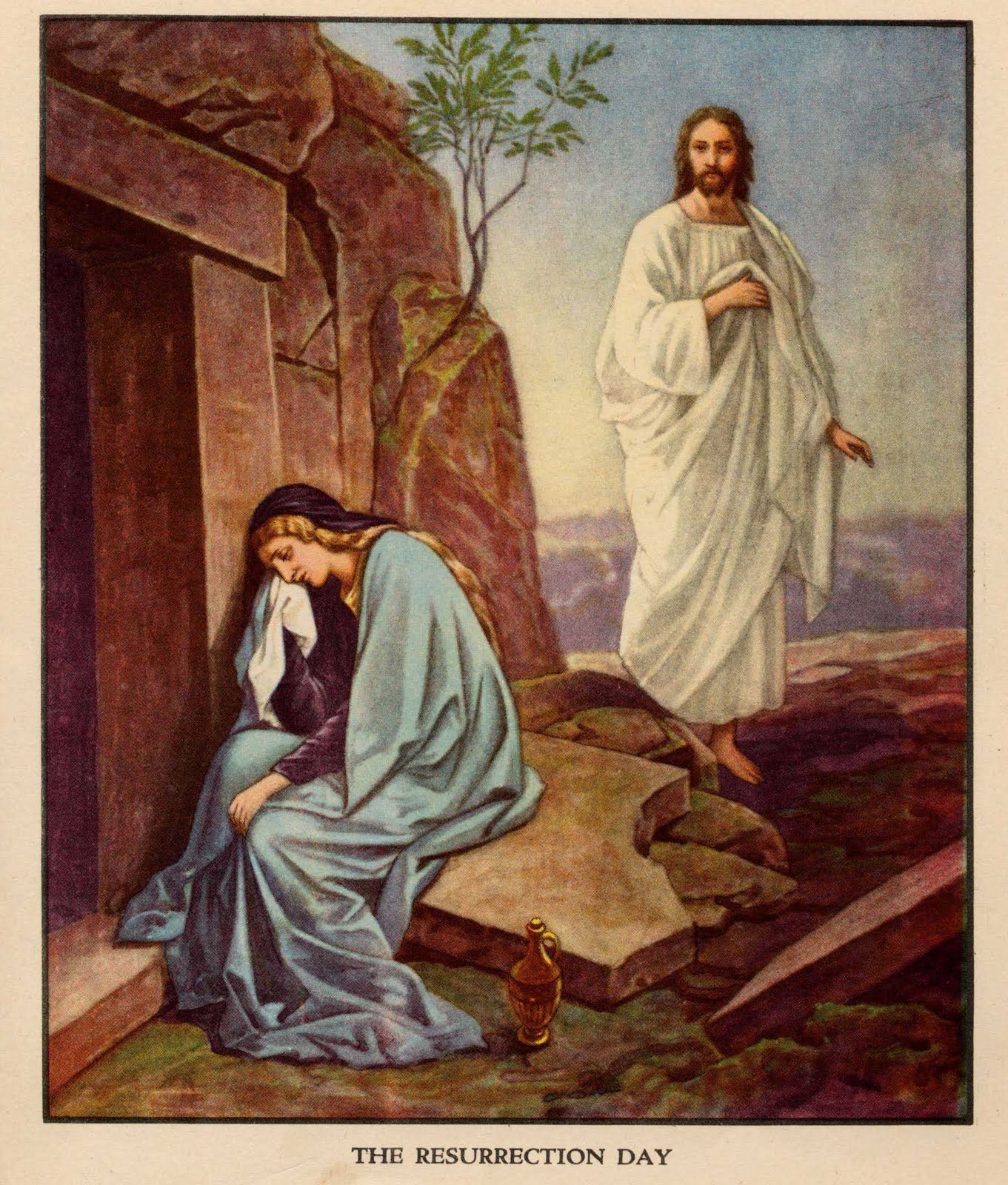
I have always been intrigued by the story of Mary Magdalene at the tomb.  Perhaps this is because I have spent too many hours of my life not recognizing the Lord even as He is standing there beside me.  I can get stuck in the mode of: “They have taken my Lord, and I don’t know where they laid him.”  I too easily focus on that, rather than on having faith that He will never, ever forsake me.  My prayer should instead be: “Lord, give me eyes to see.”

Needless to say, I was struck by this reflection in Magnificat on yesterday’s readings:

Despite the miraculous apparition of two angels sitting in the open tomb, “one at the head and one at the feet where the Body of Jesus had been,” Mary Magdalene remains unmoved, consumed only by her grief.  Two times heaven has to ask her (once via the angels, the second time by the risen Lord himself), “Woman, why are you weeping?” She has come to her own fatalistic conclusion about what happened to Christ–“They have taken my Lord, and I don’t know where they laid him”–and it is from this pessimism that she must be converted.  When the risen Jesus speaks her name–“Mary!”–the Magdalene, like the Jewish people on the day of Pentecost, was “cut to the heart.”  The risen Christ’s command to “stop holding on” pertains to our preconceptions and stubbornness as well.  Something Greater than our sorrow is now at work in the world.  It is the reason why, even in our weeping, we bend over and peer into the tomb, full of expectation.

First, we must cry out

Here’s a comforting take on the story of the road to Emmaus by Fr. David May from Madonna House:

The Gospel is the story of the two disciples on the road to Emmaus.  They are discussing the events of the Lord’s passion and death when suddenly Jesus comes up and joins them on the way.  They take him for a stranger and are astonished that he seems unaware of what has happened.

Have you ever had that experience?  When it seems that Jesus Christ is the only one who doesn’t know what is happening down here!

“What things?” he asks. “What things?!

In his wisdom, the Lord wants to draw out of his disciples all the pain and sorrow they are carrying.  It seems that the Lord has more respect and understanding of our human nature than we do ourselves.

He knows our grief; he understands all our suffering.  But he also knows that first we must speak our pain to him.  First, we must cry out.

For how will we be able to hear what he has to offer until we do so?  And he has far more to offer us than mere sympathy for our plight.

Fr. David goes on to speak of what Jesus offers to these disciples in pain, and what He offers as well to us:

He offers them more than sympathy because as the Risen Lord, he can offer them a hope they had not dared to imagine.  He offers them a victory that comes only through suffering and death: Resurrection from the dead.

He will surely come:

In an instant, in the twinkling of an eye, the Lord can reveal himself, and after that, everything is transformed.  In a second, at the breaking of the bread, he is recognizable to his disciples in Emmaus.  And then he vanishes from sight!

This, too, is part of his mystery, of his unfathomable ways.

A personal feast day

We all have personal feast days, days that we celebrate for different reasons, usually because of a saint we’re named after or one to whom we have great devotion. Over the last few years I have come to look at Holy Saturday as a personal feast day.  Ever since my brother, Tim, died, it has taken on great meaning: this day during which it looks like nothing is happening, when, in fact, great and “terrible” things are happening.  Jesus is setting the captives free. Christ has descended into our loneliness,  into our grief, into those spaces in our lives–and of those we love–where darkness seems to reign. And that is Good News.  We are no longer alone.  He is, indeed, God-with-us.  That is the wonder and consolation of this day.  That was so true for me as I walked through those dark days after Tim took his life.  Christ gave me such an assurance of His being with my brother during those dark, dark moments in his life. . . and an assurance of the same for myself.  “Though I walk through the shadow of death, I fear no evil, for you are with me.” (Ps 23.4)

Christ is there with us, whether we perceive Him or not.

Holy Saturday is the day of the ‘death of God,’ the day which expresses the unparalleled experience of our age, anticipating the fact that God is simply absent, that the grave hides him, that he no longer awakes, no longer speaks, so that one no longer needs to gainsay him but can simply overlook him . . . Christ strode through the gate of our final lonelienss; in his passion he went down into the abyss of our abandonment.  Where no voice can reach us any longer, there is he.  Hell is thereby overcome, or, to be more accurate, death, which was previously hell, is hell no longer.  Neither is the same any longer because there is life in the midst of death, because love dwells in it.

Christ descended into “Hell” and is therefore close to those cast into it, transforming their darkness into light.  Suffering and torment is still terrible and well-nigh unbearable.  Yet the star of hope has risen–the anchor of the heart reaches the very throne of God.  Instead of evil being unleashed within man, the light shines victorious: suffering–without ceasing to be suffering–becomes, despite everything, a hymn of praise.  (Benedict XVI, Spes Salvi)

For further reading on the significance of this day, see these posts: “Where is Christ today?” and “Why Saturday is Mary’s Day”

A footnote

I was grabbed by a footnote in a book I’m reading.  The author was commenting on the blessing it is for us that the book of Job has survived through the years.  It is a blessing that “God has willed that this great cry of scandal before the ways of Providence should survive until our days.”  He footnotes this statement with:

God has also willed that the only words gathered by the two oldest evangelists from the lips of the dying Jesus were, “My God, my God, why have you forsaken me?” (Mt 27.46; Mk 15.34, so that believers in a state of confusion should never feel that they were intruding, but always find a place to lay down their head in the paradise of Scripture.  (Fr. Dominique Barthélemy)