 A guest post today from Fr. Michael Marsh, an Episcopalian priest: “Mothers of God” on how we are all called to bring Christ to birth in our lives.
Category: Advent/Christmas
There Was a Time: An Advent Poem
There Was a Time: An Advent Poem
There was a time when there was no time,
When darkness reigned as king,
When a formless void was all that there was
in the nothingness of eternity,
When it was night.
But over the void and over the night Love watched.
There was a time when time began.
It began when Love spoke.
Time began for light and life, for splendor and grandeur.
Time began for seas and mountains, for flowers and birds.
Time began for the valleys to ring with the songs of life,
and for the wilderness to echo with the wailing of wind
and howling of animals.
And over the earth, Love watched.
There was a time when time began to be recorded.
A time when Love breathed and a new creature came to life.
A new creature so special that it was in the image and likeness of Love
Of Love who is God.
And so man was born and the dawn of a new day shone on the world.
And over man, Love watched.
But there came a time when the new day faded.
A time when man who was like God tried to be God.
A time when the creature challenged the creator.
A time when man preferred death to life and darkness to light.
And so the new day settled into twilight.
And over the darkness, Love watched.
There was a time of waiting in the darkness.
A time when man waited in the shadows,
And all creation groaned in sadness.
There was waiting for Love to speak again–for Love to breathe again.
And kings and nations and empires rose and faded in the shadows.
And Love waited and watched.
Finally, there came a time when Love spoke again.
A Word from eternity–a Word
Spoken to a girl who belonged to a people not known by the world
Spoken to a girl who belonged to a family not known by her people
To a girl named Mary.
And all creation waited in hushed silence for the girl’s answer.
And Mary spoke her yes.
And Love watched over Mary.
And so there came a time when Love breathed again
When Love breathed new life into Mary’s yes.
And a new day dawned for the World
A day when light returned to darkness, when life returned to dispel death
And so a day came when Love became man–a mother bore a child.
And Love watched over Love–a Father watched His Son.
And, lastly, there came a time when you and I became a part of time.
Now is the time that you and I wait.
Now we wait to celebrate what the world waited for.
And as we wait to celebrate what was at one time, we become a part of that time
A time when a new dawn and a new dream and a new creation began for man.
And as a part of time, Love waits and Love watches over us.
Fr. Joseph Breighner
“A Eucharistic Morning”
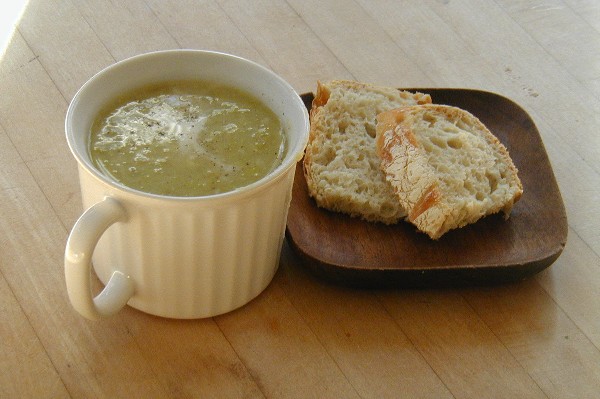 A lovely Advent post by a friend of mine: “A Eucharistic Morning”. May we all welcome Christ as He comes to us in each other as well as my friend does. I would love to come to visit you anytime, Peter!
“Be conscious of your nobility”
Still fighting something like bronchitis, but I want to at least post this excerpt from a meditation from today’s Magnificat by Monsignor Ronald Knox:
“Prepare the way of the Lord, straighten out his paths” . . . All that busy leveling and clearance typify a preparation of the heart which is to be expected in us as we look forward to this year’s Christmas, and beyond that, to the eternal Christmas which will straighten out our world for good.
“Every valley is to be bridged, and every mountain and hill leveled”; the ancients built
their roads, as we our railways, with an eye to avoiding steep gradients–the cutting and the embankment must eliminate rises and dips. That Christmas ought to drive a cutting through our self-conceit goes without saying; for love of us men and for our salvation, God took on himself the nature of a slave. But equally, it must bridge our gulf of self-despair; “Christian,” says Saint Leo, “be conscious of your own nobility, sharing as you do in the divine nature, will you return to your old groveling?” Each of us must sink to child-level before the Crib; each of us, at the same time, must rise to Incarnation-level.
“Without a light to guide”
I apologize again for my spotty posting these days. Lack of power (less than 24 hours!) and a bad cold have been inhibiting. Here’s a bit on St. John of the Cross, whose feast we celebrate today, as Fr. Mark points out: “just one week before the longest night of the year.”
John of the Cross: A Saint for Advent
Saint John of the Cross comes to us in the middle of Advent; he comes to us just one week before the longest night of the year. He comes to us at the very moment when God speaks to us through the mouth of the prophet Isaiah, saying: “I am the Lord, there is no other; I form the light, and create the darkness” (Is 24:6). Saint John comes to guide us through the night; he is familiar with all its secrets.
Blest night of wandering
In secret, where by none might I be spied,
Nor I see anything;
Without a light to guide,
Save that which in my heart burnt in my side.That light did lead me on,
More surely than the shining of noontide,
Where well I knew that One
Did for my coming bide;
Where he abode, might none but he abide.(In an Obscure Night, trans. by Arthur Symons)
Poetry, the best poetry, is born of suffering and forged in the crucible of life. (To read more, go here: Though It Be Night
December
December
 All bright and clear, the starry vault
With golden lights and crisp, clean air,
Allures the soul to rise, nor halt
Till she shall float exultant there.
Earth folds her form in ermine cloak,
Whose glist’ning sheen reflects the stars;
Clear rings the skaters’ rhythmic stroke
From stream held fast in icy bars.
Uprears the sun at morning’s birth,
In glory bathes the wood and plain;
Day’s busy hum awakes the earth
To view the scene of Winter’s reign.
We love the smile of youthful Spring,
There’s gladness in the Summer’s glow,
And rich in Autumn’s harvesting,–
Yet, greater gifts can Winter show,–
Rare gifts, surpassing pearls and gold;
God’s Mother-Maid, Immaculate,
And Christ the King–these, Winter old
Brings down to bless man’s poor estate.
J.A.M.
Advent journey
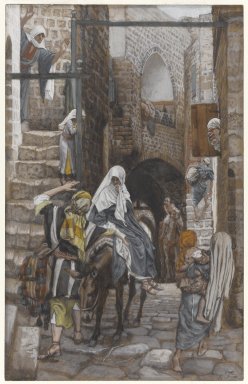 This morning I was meditating on Joseph and Mary’s Advent journey to Bethlehem. So often, I think, we would like our own Advents to be peaceful and calm and balk interiorly–if not exteriorly as well–at inconveniences and grouchy children (and husbands), at interruptions and long lines, etc. And then there are those even more serious situations that we may be facing: the death of a loved one, possible foreclosure on our house, unemployment . . . When we think about what the journey to Bethlehem realistically consisted of, we might do well to join ourselves spiritually to Mary and Joseph in their journey, begging God to give us those same graces.
Here is an excerpt from Come, Lord Jesus–Meditations on the Art of Waiting, by Mother Mary Francis, published posthumously:
We think about our Lady on the way to Bethlehem. Do we really think deeply enough about what she suffered? And about Saint Joseph’s suffering? How do we think he felt to take her off in her condition of expectancy, riding the mule to Bethlehem? Her heart must have been tempted to question, “Why is this?” And surely his heart was tempted to question. Neither was supine; these were real people.
There are struggles asked of us, as were asked of them. And the answer is faith. We will see later on, of course, in the Scriptures, that it says very plainly that she didn’t understand what Jesus said to them after those three days’ loss. And she asked him, “Why did you do that?” Those words, in a sense, sum up her whole relationship with the Son of God, who was the Son of her womb. And he gives her an answer that she doesn’t understand at all. He says to all of us, in a different place in the Scriptures, “What I am doing you cannot understand now, but later you will understand.” That is a precious thought to hold in our hearts. How many times we say, “I just don’t understand this”, and he says, “One day you will understand.”
In the inevitable struggles of life–and the struggles of these special days–we don’t need to understand. We just need to respond, and then to hear him say, “One day you will understand. One day I will explain everything to you–except when that day comes, you won’t need to ask.” (pp. 103-104)
“Just wait a minute”
Well, I’m already having to “practice what I preached” last night. I began last night with this quote from Fr. David May:
“We usually picture a stable around that manger, but in the Byzantine liturgy, they sing of a cave where the splendor of Jesus shines forth.
“’O little Child lying in a manger, by means of a star, heaven has called and led to you the Magi, the first-fruits of the Gentiles, who were astounded to behold, not scepters and thrones, but extreme poverty. What, indeed is lower than a cave? What is more humble than swaddling clothes? And yet the splendor of your divinity shone forth in them resplendently. O Lord, glory to you!’ (Prayer from the Divine Liturgy for Christmas).
“The Child teaches us not to be afraid of the barren winter of our wounded hearts, of our human emptiness. For, by grace, these have become an Advent for us—a time of waiting for the Desired One.
“He encourages us during this season with a Child’s guileless smile. He awaits us there where we are most in need and most afraid: in the dark cave of our poverty.”
The main point I was trying to make was about Christ’s desire to enter into the “dark cave of our poverty.” That is where He decided–and still decides–to be born. If the inn would have not been full, would He have been born there in the inn? I think not. He came–and still comes–to the lowliest and the poorest, to the smelly, messy stables. That is Good News, isn’t it? But we can, just like the innkeeper, say that there’s no room. Or we can say: “Just wait a minute until I get everything fixed up first”–as though we could fix up anything in our souls without Him. We can make so many excuses for His not coming in–at least at this moment.
Anyway, this morning I found myself slipping again into the “Just wait a minute” mode and had to remind myself of what I was talking about last night: the most important thing we can do is be humble and open our hearts to the Christ Child at every moment, not just when we think everything is spic and span and perfect to receive Him.
Advent Prayer
Like foolish folk of old I would not be,
Who had no room that night for Him and thee.
See, Mother Mary, here within my heart
I’ve made a little shrine for Him apart;
Swept it of sin, and cleansed it with all care;
Warmed it with love and scented it with prayer.
So, Mother, when the Christmas anthems start,
Please let me hold your baby–in my heart.
Sr. Maryanna, O.P.
Robert, Cyril. Mary Immaculate: God’s Mother and Mine. New York: Marist Press, 1946.
“And every voice a song”
Last year a few very gifted songwriters from our parish put new music to an old Advent song. It’s become a favorite of mine. The chorus goes: “Hark, the glad sound! The Savior comes, the Savior promised long; let ev’ry heart prepare a throne, and every voice a song.” I’ve been thinking a lot about that last phrase: “and every voice a song,” and asking myself: “What song am I preparing for the Savior’s coming?” I would suggest that you ask yourself the same question. Maybe it’s a simple, secret phrase that you sing silently in your heart: “I am Yours and You are mine.” Or maybe it’s something you want to sing out loud with your whole heart: “I am Yours and You are mine.” (Yes, I know I repeated myself.) May the Holy Spirit open your ears to His still, small voice singing in your heart, that you may sing along with full voice–whether silently or full volume.
 Witnesses to Hope