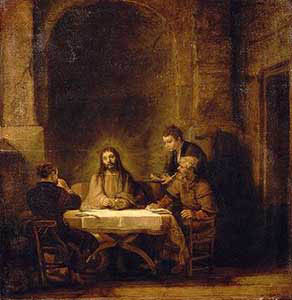
“He was one of us, no stranger . . .”

The poem for this Sunday describes the experience of the two disciples on the road to Emmaus:

Companion

When first He joined us, coming, it seemed from nowhere,
and yet, somehow, as if he had followed us a long, long time,
immediately, He was one of us, no stranger, but
a close companion, speaking softly, familiar with our lives,
these days, the answers to our doubts.

And when we moved Him to at least partake of food,
he stood there at the table, not as guest, but host,
and broke the bread to portions, one for each,
then poured the wine, His dark-marked hands
blessing the wine and us.  Was it that act,

His broken hands raised up against the wooden walls,
the prayer-bowed head, the gently spoken word
or some reflection trembling in the wine,
a thickening of air, a luminosity not of wavering light,
that pierced our hearts with joy,

that filled our mouths with praise?  O praise!
O joy!  Then suddenly the light withdrawn,
no longer form and lifted hands above the bread.
Stumbling, we found the road to town,
knowing that never, never would we walk alone again.

~Marie J. Post (all rights reserved)

With the eyes of faith

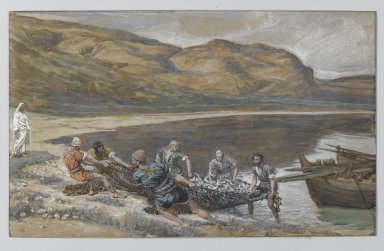
I love pondering the post-Resurrection appearances of Christ.  I guess I feel in good company when those who had spent three solid years with Christ failed to recognize Him.  It’s always a reminder to me of the need to sharpen our eyes of faith, to look for Him in His many disguises.  In today’s Gospel, we see Jesus showing a sense of humor (in my opinion).  He repeats advice that He had given them when He first met them: put the net down on the other side.  How many times does that happen to us, that God comes to us in a familiar way?  Let’s not miss His appearances to us in our every day life.

“It was in every way a hard time for David . . .”

Well, no one has told me that they’re tired of my Amy Carmichael quotes (or maybe you’re all just being nice to me), so I’m going to share a couple more today and tomorrow.   They tie in nicely with yesterday’s post, “Being honest with God.” 

Ps 4.7 Thou hast put gladness in my heart, more than in the time that their corn and their wine increased.

Psalms 3 and 4 were written when David fled from [his son] Absalom [cf. 2 Sam 13ff]; and if, as some think, Psalm 4 was written at the time of the Feast of Tabernacles, the harvest and the vintage were over, and the rich stores of corn and new wine were at Absalom’s disposal, while David had nothing or very little.  It was in every way a hard time for David, and it was not surprising that many said there was “no help for him in God” and “Who will show us any good?”  We all know times of trial when the voices within and without talk like that.  But David’s faith breaks through, and he can honestly say, Though hast put gladness in my heart more than when corn and wine increased.  It is not difficult to have gladness in our hearts when we have what we want–corn and wine may stand for whatever we most enjoy doing or possessing–but God asks for something far more than this.  He wants what David offered Him when he wrote those words more than.
     What David offered to his God was a heart that was utterly satisfied with His will.  There were no private reservations, no little whispered “if”–if only I can be where I want to be, and have what I want to have, then there will be gladness in my heart, O God; he did not say that–he did not even say, By Thy grace I am glad, I am as glad as I should be if I had those stores of corn and wine.  He went further, he flew right out of all the restricting thoughts that might have caged his spirit, up and up into the free air of God, and he said, Thou hast put a new kind of gladness in my heart.  It does not depend on what I have, it is more than that sort of gladness.  It is a joy that is entirely independent of circumstances.

To be continued tomorrow . . .

Why Saturday is Mary’s Day

Saturday is traditionally observed as the day of Our Lady. John Saward explains why.

Rate this:

Lady of ConsolationHave you ever wondered why Saturday is traditionally observed as the day of Our Lady? A few years ago I was reading a book by John Saward (The Beauty of Holiness, the Holiness of Beauty), and, in a section about our Lady, he described Mary’s unfailing faith through the long, terrible day after Christ’s death when she alone kept faith in her Son.   I had never before heard of this mariological foundation for Saturday being traditionally her day:

The yes [her continued yes to the Lord that began with her Annunciation yes] of Our Lady does not end on Good Friday and [Christ’s] yielding of the spirit . . . . The faith and love of Our Lady last into Holy Saturday.  The dead body of the Son of God lies in the tomb, while His soul descends into Sheol, the Limbo of the Fathers.  Jesus goes down into the hideous kingdom of death to proclaim the power of the Cross and the coming victory of the Resurrection and to open Heaven’s gates to Adam and Eve and all the souls of the just.  The Apostles, hopeless and forlorn, know none of this.  “As yet,” St. John tells us, “they did not know the Scripture, that He must rise from the dead” (Jn 20.9).  In all Israel, is there no faith in Jesus?  On this silent Saturday, this terrible Shabbat, while the Jews’ true Messiah sleeps the sleep of death, who burns the lights of hope?  Is there no loyal remnant?  There is, and its name is Mary.  In the fortitude of faith, she keeps the Sabbath candles alight for her Son.  That is why Saturday, the sacred day of her physical brethren, is Our Lady’s weekly festival.  On the first Holy Saturday, in the person of Mary of  Nazareth, Israel now an unblemished bride, faces her hardest trial and, through the fortitude of the Holy Spirit, is triumphant.

And I take great comfort in knowing that Mary always burns the light of hope for me (and you!) as well.

Parable of the Talents (3)

“Everything that happens is for me a message of the excessive love of God for my soul.”

Rate this:

Continuing from The Gift of Faith:

Only a person who has faith is able to be grateful for everything.  This gratitude will be visible on your face as joy; for everything may be changed into good.  This reflection about talents refers to the teaching of St. Paul and to the famous thesis of St. Augustine: ‘For the ones who love God, all things work for good, even sin’ (Rom 8:28).  Therefore, even a fall, which is a great misfortune, can be an opportunity within which is hidden some kind of talent given to you in that situation, from which you can profit.  You only need your faith or your conversion towards such faith which will enable you to look through the eyes of Jesus.

Thinking along these lines can be transformational.  I can’t help but think of a quote of Bl. Elizabeth of the Trinity: “Everything that happens is for me a message of the excessive love of God for my soul.”  And as Amy Carmichael would say: “Everything means everything.”  There’s a lot to be meditated on in just the word “excessive” . . .  I can remember many times when I’ve said this quote out loud to myself in the midst of something that didn’t feel like His excessive love.  Sometimes it’s big things–like being elected superior–but most of the time it’s little things, like those interruptions that I don’t like or changes of plans.  (You can see where my self-centeredness lies . . .)   Yet if I can just remember that my self-centeredness is indeed also a “talent” . . .

Parable of the Talents (2)

Somtimes we do not recognize things such a suffering and family problems as talents that God is giving us to make use of.

Rate this:

Continuing from Gift of Faith:
(Part 1 was posted yesterday . . .)

If certain situations make you feel tense, it means that your talent is hidden within them, as if a diamond were buried beneath the ashes.  What do you do with it?  How do you make use of it?  Everything is meant to serve towards your sanctification.  In this sense, everything is grace.  Suffering, which overwhelms you or other unfavourable circumstances, is a whole mess of talents.  We, however, are often like blind people or like children who understand very little.  It is only when we stand before God that everything will be made clear to us.  Then we will see the ocean of talents in which we have been immersed.
     There are two kinds of talents: those that are less precious and those that are more precious.  If you are successful, if something comes out right for you–this is certainly a talent.  If however, nothings turns out right–this is a more precious talent.  Failures are the priceless treasures given to you in your life. Just like the master in the Gospel who returned from his travels and demanded an account from his servants, God will someday ask you, how did you make use of your personal failures, which He gave you as an opportunity, as a talent.  Sometimes there are many failures in your life–do you make use of them?

     The parable of the talents is an evangelical call to conversion.  You have to start looking at your life differently; you must look at it with the eyes of faith.  Then you will see God’s endless giving of grace; you will see your whole life as a multitude of hidden chances for continual inner transformation.  You will come to know that everything is grace.  It seems that God, granting you difficult graces, is forcing His gifts into your hands, but you resist and do not want to accept them. Yet, difficult graces are the most valuable talents of your life. Sometimes there are many of them because God wants you to have enough talents to make use of.

To be continued . . .

Parable of the Talents (1)

I am rereading Fr. Dajczer’s book, The Gift of Faith–which I cannot recommend highly enough.  When I first read his take on the parable of the talents it caused a major paradigm shift in my thinking, so I thought I would share him with you over the next few days.  He prefaces his comments on the parable with a discussion of the nature of faith: faith is the ability to see everything with God’s eyes–“Every moment of our lives is permeated with the Presence that loves and bestows.  To live in faith means to be able to see this loving and constantly bestowing Presence.” 

So, on to the parable of the talents:

God waits for us to look with the eyes of faith at all the experiences we live through, especially the difficult ones.  In the parable of the talents, Jesus warns us not to close ourselves off from coming to know Him through faith and not to be slothful in using all things which God is continuously giving us. . . . A talent is a gift and material, but at the same time an opportunity.  Christ , in giving you a talent, trusts you and waits for you to take proper advantage of it.  If He has given you certain abilities, then He is not indifferent as to what you do with them.  And if, however, you did not receive these abilities–this is also a talent.  A talent is not only receiving something, but it is also lacking something.
    
In the light of faith, the good health you have is a talent, but bad health is also a talent.  Jesus in each case asks the question.  What are you doing with this talent?  You can equally waste good health, and even more so, you can waste the lack of health. 
    
It is a talent, for example, if you are unable to pray; yet you consider this a misfortune.  It is important what you do with this inability to pray.  Maybe you have buried this talent and you say to yourself: well, I will not pray.  But you can gain so much from it.  The inability to pray should intensify your hunger for God, and thereby it can become a means contributing to your sanctification.
     The same thing applies when you have problems at home, when the family is quarreling, this also is your talent and an opportunity given to you by God.  What can you do with it?  If you break down, and are discouraged, then you bury it in the ground.  It is not possible for a person of faith not to see the deeper meaning of his own experiences.  The very search of the deeper understanding of personal experiences is to profit from the talent.  If you experience fear, for example, you fear suffering or death–this is also an opportunity offered to you. . . .

To be continued . . .