The reason for this blog

Thank you, Pope Francis, for underscoring my hopes for this blog:

945189_257088437762844_1925826626_nPope Francis on Saturday met with the participants of the 26th Plenary Assembly of the Pontifical Council for the Laity, meeting under the theme “Proclaiming Christ in the digital age.”

Pope Francis said the rise and development of the internet raises the question of the relationship between faith and culture.

Looking back to the first centuries of Christianity, the Pope pointed out Christians encountered the “extraordinary legacy” of Greek culture.

“Faced with philosophies of great profundity and educational methods of great value – although steeped in pagan elements, the Fathers did not shut them out, nor on the other hand, did they compromise with ideas contrary to the Faith,” Pope Francis said. “Instead, they learned to recognize and assimilate these higher concepts and transform them in the light of God’s Word, actually implementing what Saint Paul asks: Test all things and hold fast to that which is good.”

He said this also applies to the internet.

“You must test everything, knowing that you will surely find counterfeits, illusions and dangerous traps to avoid,” Pope Francis said. “But, guided by the Holy Spirit, we will discover valuable opportunities to lead people to the luminous face of the Lord. Among the possibilities offered by digital communication, the most important is the proclamation of the Gospel.”

He said it is not enough to acquire technological skills, however important. He said the internet must be used to meet “often hurting or lost” real people and offer them “real reasons for hope.”

“The announcement [of the Gospel] requires authentic human relationships and leads along the path to a personal encounter with the Lord,” he said.

“Therefore, the internet is not enough; technology is not enough,” Pope Francis continued. “This, however, does not mean that the Church’s presence online is useless; on the contrary, it is essential to be present, always in an evangelical way, in what, for many, especially young people, has become a sort of living environment; to awaken the irrepressible questions of the heart about the meaning of existence; and to show the way that leads to Him who is the answer, the Divine Mercy made flesh, the Lord Jesus.”
“Stay with me, Lord.”

11022617009791ee2932f0e1f4

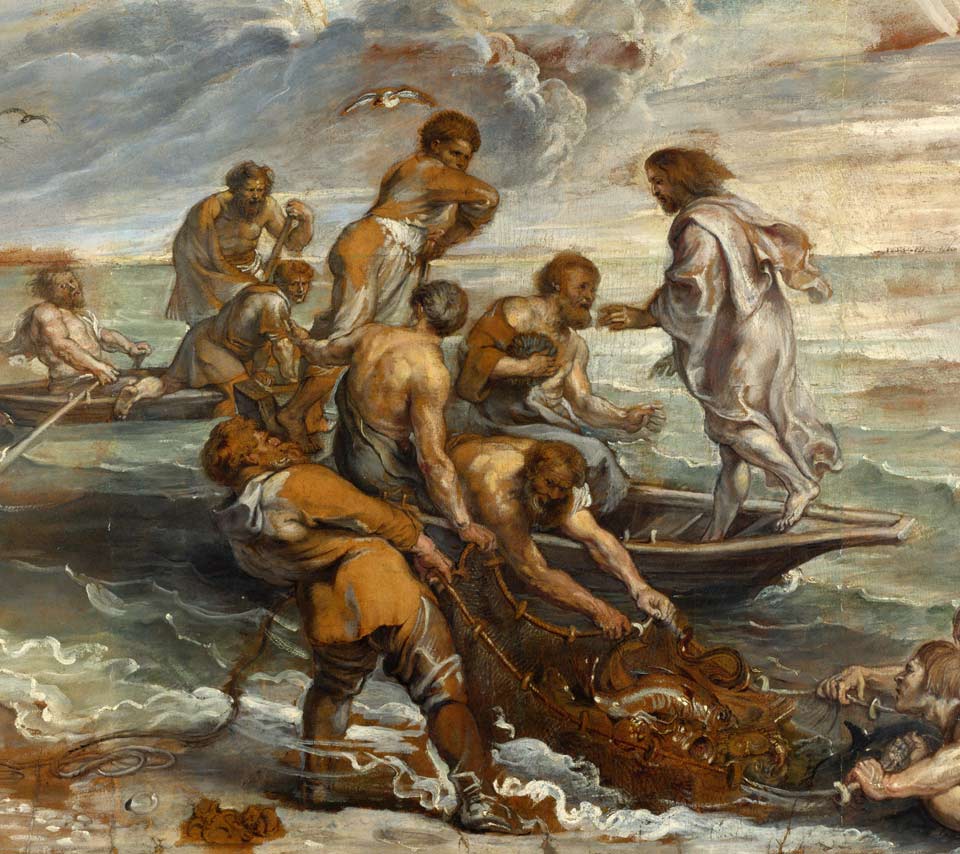
Simon’s heart was racing from effort and emotion, and he gasped for breath as he made his way through the fish to where Jesus was sitting in the stern.  Simon approached this man whose presence had become almost unbearable: they were too different, too distant, too “other.”  And yet it seemed to him that this presence was such an absolute gift to him that only Jesus could reestablish the correct distance between them.

Simon was overtaken by a sense of unworthiness: everything in his life that was petty, false, angry, silly, greedy proud, vile had now become a heavy, nauseating heap.

He was surprised himself by what he cried out in front of everyone: “Depart from me, for I am a sinful man, O Lord” (Lk 5.8).  And he knew that no truer words had ever come from his lips.

Even so, just as his words were disappearing into the noise of the water, the wind, the boat, Simon understood that these words, too, were false.  They were no longer true before that face, before the expression of Jesus, who continued to stare at him in silence.  The words were true inside of Peter himself, in his heart, in his humanity, but they were no longer true before Jesus.  He had not yet finished saying, “Depart from me, Lord,” when his heart began crying in desolation, “No! Stay with me, Lord!  Take me with you!”

~Dom Mauro Giuseppe Lepori, O. Cist.

Hope is a risky virtue

Pope Francis on hope:

Vatican City, October 29, 2013 (Zenit.org) Junno Arocho Esteves

During his morning Mass at Casa Santa Marta today, Pope Francis reflected on the nature of hope, saying that it is not optimism but rather “an eager expectation towards the revelation of the Son of God.” The Holy Father drew his words from the first reading of St. Paul’s Letter to the Romans.

The Pope emphasized that hope does not disappoint, it is secure. However, the Holy Father clarified to have hope does not meant to be optimistic. “Hope is not an optimism, it is not the capacity to see things with a good spirit and go forward. No, that is optimism, it is not hope. Nor is hope a positive attitude in front of things,” the Pope said. “This is good! But it is not hope.”

“It is not easy to understand what is hope. It is said that it is the most humble of the three virtues, because it is hidden in life. Faith is seen, is felt, it is known what it is. Charity can be one, it is known what it is. But what is hope? What is this attitude of hope? To approach this a bit, we can say firstly that hope is a risk, it is a risky virtue, it is a virtue, as Saint Paul says, ‘of an eager expectation towards the revelation of the Son of God.’ It is not an illusion.”

Pope Francis went on to explain that the early Christians depicted hope as an anchor that is fixed on the shore of the afterlife. The goal of a Christian is to walk towards this anchor. The Holy Father then asked those present to contemplate on where are they anchored in there own lives.

“Are we anchored just beyond the shore of that ocean far away or are we anchored in an artificial lagoon, that we have made ourselves, with our rules, our behaviors, our schedules, our clericalism, our ecclesiastical attitudes, not ecclesial? Are we anchored there? All comfortable, all secure That is not hope.”

Another image of this hope the Holy Father said that St. Paul indicates is that of going into labor. Hope, he stressed, is within this “dynamic of giving life.” The fruits of this labor, however, are unseen. The Holy Father compared this image of St. Paul to the life of the Blessed Virgin Mary.

“I think of Mary, a young girl, when after hearing that she was a mother, her attitude changes and she goes, she helps and sings that hymn of praise,” the Pope said.

“When a woman becomes pregnant, she is a woman, but she is never (only) just a woman: she is a mother. And hope is something like this. It changes our attitude: it is us, but we are not ourselves; it is us, looking over there, anchored over there.”

Concluding his homily, Pope Francis addressed a group of Mexican priests who were present at the Mass celebrating their 25th anniversary of priestly ordination. “Ask Our Lady, Mother of hope, that your years be years of hope, to live as priests of hope,” he said to them.

(October 29, 2013) © Innovative Media Inc.

Is the virtue of hope like a Christmas gift?

This is today’s post from Roman Catholic Spiritual Direction, and I just thought it was so apt for this blog.  (If you haven’t discovered  Roman Catholic Spiritual Direction yet, take some time to go over there and browse!)

The Ultimate Christmas Gift: The Gift of Hope!

SEPTEMBER 21, 2013 BY    

Hope is the confident expectation of divine blessing and the beatific vision of God; it is also the fear of offending God’s love and incurring punishment (Catechism of the Catholic Church, paragraph 2090)

Is the virtue of hope like a Christmas gift or divine blessing available to us every day? It can be.  But, do you believe this statement from the Catechism even when you are not faithful to God or you blow it in loving others? Maybe you got snagged by something seemingly urgent and skipped your prayer time or snapped at your kids. You know yourself. Aren’t these the times when we feel less desirable to God, like we might have lost our spiritual luster and his favor? What do you do when you recognize your faults? Do you avoid God, like you do when someone has offended you or do you run to him? The theological virtue of hope, rather than just a set of habits, is a vital energy for the Christian walk. It gives us power to know God personally and to trust him more. When we open ourselves to receive and operate with hope, we let God be God in our lives and find that, rather than being repelled by our weaknesses, God is attracted to us, even when we, ourselves, feel least deserving of his gaze. Rather than ascribing human characteristics to God, the virtue of hope allows us to have an unflappable confidence in God… and not in ourselves.

Servant of God, Archbishop Luis Martinez, Venerable Concepción Cabrera’s last spiritual director, echoes this with: “Your lowliness, not your virtue, attracts God.” While he is not suggesting that we sin in order to attract God, he does suggest a reaction to our own sin that is counter intuitive to us on the human level. When we receive and act with hope, we can experience both contrition for our sins and confidence in God’s love for us at the same time. Martinez elaborates, “We must learn to cast ourselves into the arms of our Savior with our heart torn to pieces…because we feel pain at having offended Him, but we confide in Him because He loves us.” Hope allows us to please our sensitive Savior, because hope gives us the capacity to be available to God when and where he most wants to gift us. Hope helps us receive vital remedies for our hearts from the very heart of God. It anchors us to the very places where the living presence of God wants to meet us. Let us be like ordinary shepherds tending their sheep, but following a luminous star of light, to meet Jesus. What miracles await us when we respond in hope?

In her spiritual classic, Of the Virtues and of the Vices, Venerable Concepción Cabrera (“Conchita”) describes this supernatural gift or virtue of hope as Jesus in action, as “a Star that exists from all eternity that can illuminate the world with the purest experience of the Gospel.” What is this pure experience of the Gospel but a repeat living encounter with Love that reorders us and loves us where we need it the most. The hopeful Christian can approach Jesus openly at every Mass and experience, as Conchita shared that, “The soul that possess this hope, rejoices in it, not for its own good but for the glory to God that it allows.” Hope helps the Christian struggling with the ordinary details of life to center and re-center their lives in God’s love so they can reflect God’s redeeming light to others. Hopeful people are more than just optimistic people. They are people focused with Gospel priorities that nothing ultimately sidetracks, including their own screw-ups. According to Conchita, “When they have hope, they seek after, not the goods of the earth, neither good name, riches nor honor. They set their looks higher and hope for the possession of God himself. This Hope exists on the altars and in each moment [is] waiting for us” reaching out to touch our human wounds. Let us be bold then in naming our sins and setting our sights upon the one crucified out of love for us

Conchita had her hopes set higher. During her daily prayer for several weeks, she heard the gentle words of Christ like a clear whisper in her heart, words meant for all of us to instill hope and faith in Christ’s real presence in the Eucharist. She collated these dialogues with Jesus into I Am: Eucharistic Meditations on the Gospel, which have been reviewed and approved by the Church. While meditating on John 10:25, the Lord told her and us, “But you, if you follow Me, come to look for Me in the Eucharist, tell Me that you belong to Me, that you want to listen to my teachings, that you believe in the mysteries of My Divinity, even though you do not understand them, that all My works witness to you of the love of your magnanimous God who takes pleasure in man’s conversion. Blessed faith and hope makes saints! Open your heart before me because I want to possess it and teach you to look at everything in the light of faith, hope and love.” Let us follow that star of light, Jesus, and become hope-filled saints who arecontrite and confident in God’s love for us!