The recording and handouts for the “Hope in the Midst of the Storms of Life” talk are now uploaded. Go to the “Talks” tab above and click on “Witnesses to Hope talks.”
Category: hope
Where is Christ today?
[A repost from the past]
This is the day when everything is silent. We can go about the day not giving much of a thought to it–just seeing it as the day between Good Friday and Easter Sunday. Yet monumental things were happening in the spiritual realm. Christ descended to hell to set captives free.
This still has meaning for us. So often we think nothing is happening in our own spiritual lives, yet God is about monumental things. Have hope in the Unseen.
Christ descended into “Hell” and is therefore close to those cast into it, transforming their darkness into light. Suffering and torment is still terrible and well-nigh unbearable. Yet the star of hope has risen–the anchor of the heart reaches the very throne of God. Instead of evil becoming unleashed within man, the light shines victorious: suffering–without ceasing to be suffering–becomes, despite everything, a hymn of praise. (Pope Benedict XVI, Spe Salvi)
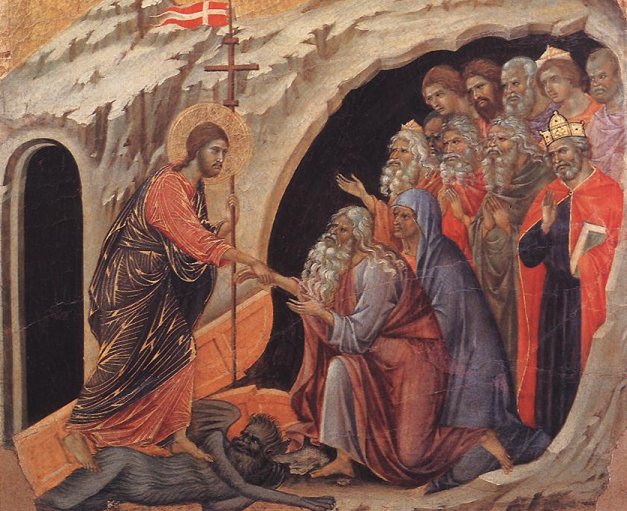
And for those of you who feel that you are living “in darkness and in the shadow of death”, take heart, for you are exactly who he desires to visit. From an ancient homily on Holy Saturday:
Greatly desiring to visit those who live in darkness and in the shadow of death, he has gone to free from sorrow the captives . . .
Choose hope for today . . .

“One thing that helps any relationship”
A guest post from Ann Voskamp for those of you who struggle with a relationship with a family member: “One thing that helps any relationship”
A star of hope
“Just as the presence of the memory of God’s goodness helps us and becomes a star of hope for us in our common, collective history, so also each of us has his own personal history of salvation, and we must truly treasure this history, keeping always in mind the great things He has also done in my life, so that we might trust: His mercy is eternal. And if today I am in the dark night, tomorrow He will free me, for His mercy is eternal.” (Pope Benedict XVI, Wednesday audience, October 19, 2011)
Take a moment today to remember, to remember God’s goodness, to look to that star of hope in your own life.
The strength of hope
Just to underline what Pope Benedict said in his meditation on Ps 136 this past Wednesday: “Remembering becomes the strength of hope. Remembering tells us: God is; God is good, and His mercy is eternal.” This is so important for us to cultivate, this art, this habit of remembering. Life can move too fast, and we fail to remember all that God has done, especially the little things: laughing at the table, the winter sun on the river, bluebirds, St. Therese’s eyes looking at me, my dentist’s generosity, my middle name that means “full of grace.” I would easily have forgotten all of those things except for my list–the list I started 8 months ago–my list of things to be thankful for each day. I’m now on #476. (I really should be farther along than that!) And when I look back over this list, I remember the good things the Lord has done and I have hope for tomorrow. “Remembering becomes the strength of hope. Remembering tells us: God is; God is good, and His mercy is eternal.”
(If you want to learn more about making a list, go here.)
Remembering
From Benedict XVI’s reflection on Psalm 136:
[W]e can say: The liberation from Egypt, the time in the desert, the entrance into the Promised Land and then the other problems are very distant from us; they are not part of our history. But we must be attentive to the fundamental structure of this prayer [of this psalm]. The fundamental structure is that Israel remembers the Lord’s goodness. In its history, there are so many dark valleys, so many passages through difficulty and death, but Israel remembers that God is good, and they can overcome in the dark valley — in the valley of death — because they remember. Israel remembers the Lord’s goodness and His power; that His mercy endures forever.
And this is also important for us: remembering the Lord’s goodness. Remembering becomes the strength of hope. Remembering tells us: God is; God is good, and His mercy is eternal. And thus, remembering opens the road to the future — even in the darkness of a day, of a moment in time, it is the light and star that guides us. Let us, too, remember the good; let us remember God’s eternal, merciful love. Israel’s history is already part of our memory as well, of how God revealed Himself, of how He created for Himself a people to be His own. Then God became man, one of us: he lived with us, suffered with us, died for us. He remains with us in the Blessed Sacrament and in the Word. It is a history, a remembrance of God’s goodness that assures us of His goodness: His love is eternal.
You can read his entire meditation here.
Dull weather
Is it “one of those days”? Here is a little encouragement from Amy Carmichael:
Ps. 76.4 LXX Thou dost wonderfully shine forth from the everlasting mountains.
Sometimes it is dull weather in our soul. Here is a word for such days. Often when it is misty on the plains it is bright on the mountains. ‘Thou art more glorious and excellent than the mountains’ is a lovely word, I think, but this beautiful LXX rendering, which our Lord must often have read, carries us even further. The mist may lie low on the plains, but there is a shining forth from the mountains.
There is nothing in me. I may be as dull as the plains are when the mist is heavy upon them, but what does that matter? ‘Thy mercy, O Lord, is in the heavens; and Thy faithfulness reacheth unto the clouds. Thy righteousness is like the great mountains’ [Ps 36.5-6], and from those everlasting mountains ‘Thou dost wonderfully shine forth’.
In dull weather learn to look up to the mountains. Refuse to look down to the plains.
May you have the grace today to look up to the mountains.
“The brimming river of God’s love”
A commentary by Amy Carmichael on the banner scripture for this blog:
Rom 5.5 And hope does not disappoint us, because God’s love has been poured into our hearts through the Holy Spirit who has been given to us.
This verse seems clearly to mean that love comes first into our hearts. Then because love has come we hope, and that hope “never disappoints,” as Weymouth puts it.
Experience worketh hope, Romans 5.4 tells us. And so it does. But it also worketh fear. If we have had long experience of the weakness of souls, and seen many a time what seemed a great blaze-up of blessing fizzle out, we do become fearful of hoping too much.
And yet the word stands. Here it is Way’s paraphrase (vv.3-5): “I will go further, and say that we actually exult in such afflictions as ours, knowing as we do that affliction develops unflinching endurance; that endurance develops tested strength, and tested strength develops the habit of hope. This hope is no delusive one, as is proved by the fact that the brimming river of God’s love has already overflowed into our hearts, on-drawn by His Holy Spirit, which He has given to us.”
“What He Gives in the Dark”
A story that lifts my heart: “The Importance of Family: What He Gives in the Dark” Have a great day. If you’re in the dark, may you perceive His hand giving to you in the darkness.
 Witnesses to Hope