New every morning

Some mornings it’s just hard.  It’s hard to get up.  It’s hard to pray.  It’s hard to face another day of living for others rather than yourself.   That’s where my thinking was going this morning.  So I did as I usually do when I wake up early, I reached for my Amy Carmichael devotional, Edges of His Ways.  (One of the main reasons I like to read her is because she always draws me deeper into Scripture.  I don’t end up with reading just some nice words, but I end up reading God’s word.)  Today’s entry is entitled “Ps 22.  Title LXX [in the Septuagint] Concerning the Morning Aid”  Well, that obviously struck home.   I stopped reading and grabbed my RSV.  The RSV reads “According to the Hind of the Dawn.”  So I then pulled out my Kidner commentary, in which he said that indeed the more faithful translation according to the Greek is “On the help at daybreak”.   Psalm 22, as you know–and as Amy reminds us–makes us think of the darkness and suffering of Calvary.  I’ll let you read the rest of what she wrote, and may you experience it as I did this morning, as the prophet writes in the Book of Lamentations: “His mercies are new every morning.” 

When we think of Psalm 22, we think most of the darkness and suffering of Calvary.  We know that it was in our Savior’s mind through those most awful hours; He quoted the first verse, He fulfilled all the verses.  Even though there is a burst of triumphant joy in that psalm of pain, it is chiefly the pain that comes to mind when we think of it.  But its title is not about pain, it is a word of beautiful joy: Concerning the Morning Aid. As I pondered this, my thoughts were led on to a familiar New Testament story: “It was now dark and Jesus was not come to them . . . They see Jesus walking on the sea”.  Looking back on that night the most vivid memory must have been, not the darkness or the weariness, not the great wind and the rough sea, but the blessed Morning Aid that came before the morning.
     So let us not make too much of the storm of the night.  “Even the darkness is not dark to Thee” [Ps 139.12]; “And He saw that they were distressed in rowing” [Mk 6.48].  The wind was contrary unto them then, perhaps it is contrary to us now.  But just when things were hardest in that tiredest of all times (between 2 a.m. and 6 a.m.), just then, He came.
      “I will not leave you comfortless: I will come to you” [Jn 14.18], He said, and He does come.  He always will come.  “His coming is as certain as the morning” [Hosea 6.3].  His Morning Aid comes before the morning.  If we do not see Him coming, even so, He is on His way to us.  More truly, He is with us.  “I am with you all the days, and all the day long” [Mt 28.20 Moule].

As I say in my sidebar, I started this blog to share things that have increased my hope during challenging times–those challenging times are not just in the past, but also in my present.  My prayer is that you, especially any of you who are so aware of your need for Him this morning, may know His help at daybreak, and to know that He is coming, and is indeed already with you.
It is no small reason

There is one thing we can put our hope in, and that is no small reason for rejoicing.

Rate this:

As they say in the traffic report, this post is thanks to “tipster” Lupe.  Lupe grabbed me after Mass yesterday and asked me if I had read the Office of Readings for the day–which I hadn’t yet.  (The Office of Readings is part of the Liturgy of the Hours.)  So, of course, I did as soon as I got home.  The readings this time of year, as we close the liturgical year, are mostly about the Lord coming again or about our going to meet Him in death.  The second reading for yesterday, Wednesday of the thirty-third week of Ordinary Time, is from a sermon by St. Augustine.  He preaches about the sure promise we have of seeing the Lord, but now we walk by faith, not by sight. 

We walk by faith, and not by sight.  When will it be by sight? Beloved, says John, we are now the sons of God; what we shall be has not yet been revealed, but we know that when it is revealed we shall be like him, because we shall see him as he is.  When this prophecy is fulfilled, then it will be by sight.

Then Augustine goes on to point out that we have great reason for rejoicing–and the reason for our rejoicing is that this promise will be fulfilled:

Nevertheless, even now, before that vision comes to us, or before we come to that vision, let us rejoice in the Lord; for it is no small reason for rejoicing to have a hope that will some day be fulfilled.

This got me thinking about the many things we put our hope in, and how often we are then disappointed when they are not fulfilled.  That can lead us to discouragement and to an attitude of “Why hope?”  It is true that we will face many disappointments in life–but this one thing we can–and must–put our hope in: that we shall see Him as He is.  This is a hope that will one day be fullfilled.  We–you–will see Him as He is.  And that is no small reason for rejoicing.

The Reality of Hope

I would like to refer you to an excellent article I read yesterday at First Things, entitled “The Reality of Hope.”  It’s written by Amy Julia Becker who lost her mother-in-law to cancer six years ago.  She writes about what the word “hope” really means as you live through the experience of losing someone you dearly love. 

After she died, it was as if I had broken my arm. A part of me ached all the time, and something that had been functional was now useless, and everything about my daily routine needed to be navigated differently. It was difficult, for instance, to stand in line at the post office or buy groceries or make dinner. Nothing seemed to matter anymore.

I had spent much of the final six months of her life with her, my mother-in-law, my friend: Penny. And once she was gone, I missed her. I missed the Penny I knew when she was healthy—the woman who had enjoyed kick-boxing, who loved ice cream and didn’t like cilantro, who had hand-addressed our wedding invitations. I missed the Penny I came to know in the midst of her battle against cancer, who, after surgery, laughed so hard in response to a get-well card that staples holding her wound together were dislodged, who walked around the block in sneakers and a nightgown just to get outside, who held my hand as she slept, who said, “thank you” even at the very end.

You can read the rest here.

God’s choice of building materials

Saturday I posted about the “defects of Jesus”.  Here’s another example, posed by G.K. Chesterton, of God doing something exactly the opposite of how you would expect–that is, until you really get to know Him. 

When Christ at a symbolic moment was establishing His great society, He chose for its cornerstone neither the brilliant Paul nor the mystic John, but a stutterer, a snob, a coward–in a word, a man.  And upon this rock He has built His Church, and the gates of Hell have not prevailed against it.  All the empires and the kingdoms have failed, because of this inherent and continual weakness, that they were founded by strong men and upon strong men.  But this one thing, the historic Christian Church, was founded on a weak man, and for that reason it is indestructible.  For no chain is stronger than its weakest link.  (Heretics, Collected Works 1:70)

God desires to build something beautiful on your weakness, if you’ll just give it to him today.

I start again

Periodically I feel a need to post something I posted back in June, a quote from St. Andrew of Crete: “Every day I start again.”  What a great grace from God that He gives us a new day every 24 hours.  He gives us a new start every time we go to Confession.  A song I sing frequently is:  “The steadfast love of the Lord never ceases, his mercies never come to an end; they are new every morning; great is thy faithfulness” (Lam 3.22)  Today I start again.  And I feel I should add–the starting again isn’t so much what we do, or what we strive for . . . the starting again should be starting again to abandon ourselves to the mercies of God that never come to an end, starting again to surrender our lives to His love and mercy for us, starting again to lower our hands that would push Him away because we’ve failed once again.  Today I start again to let Him love me.

When the doors were shut

Have you ever been in a funk–one of those times when you’ve been walking along fine, experiencing great hope in the Lord about something, but all of a sudden that hope just disappears?  (Rhetorical question) Your thoughts just swirl around you.  You’re not able to concentrate on the truth.  Your thinking at the moment is not helpful, to say the least?


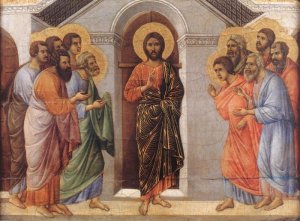
Christ Appears to the Apostles Behind Closed Doors (Duccio)

   Often our thoughts are like a crowd of people talking together in a room whose doors are shut, and because of the setting of some hope that had a bright sunrise, it is a sorrowful time.
     There may be love, understanding love, all around us, and yet we may be needing some word of life in our own soul, something that would do what only the Divine can do.  “Lord, to whom shall we go?  You have the words of eternal life” (Jn 6.68).
     One day lately, when feeling like this, I took my New Testament, and it opened of itself at John 20, and the first words I read were these: “The same day at evening . . . when the doors were shut . . . Jesus came and stood in their midst, and said . . . Peace be with you.  And when He had said this, he showed them His hands and His side.”  It is all there–the shut doors (for we cannot say aloud all that fills our mind), the dreary evening, then the risen Lord, and peace.   (Amy Carmichael, Edges of His Ways, pp. 131-2)

My prayer for you today is that the Lord may enter through any of your shut doors . . .

Little words (3)

Today’s little word from those circled in my bible comes from Ps 102, verse 12: “but”.  The previous verses are a litany of personal suffering.  As Derek Kidner describes it: “The cry of one whose sufferings are unexplained.”  When one’s suffering is unexplained, it makes the suffering even more intense.  The psalmist pours forth his woe: “My heart is smitten like grass, and withered; I forget to eat my bread.  Because of my loud groaning, my bones cleave to my flesh. . . I lie awake, I am like a lonely bird on the housetop . . .  for you have taken me up and thrown me away.”  These are dire cries from a forsaken soul. 
       Yet, out of this heartfelt suffering rises the little word, “but”–and that word makes all the difference: “BUT you, O Lord, are enthroned forever; your name endures to all generations.  You will arise and have pity on Zion.”  Etc.  An incredible act of trust and courage.  This is indeed heroic hope.  A hope and trust placed not in one’s circumstances but in Someone who can be trusted because of Who He is and Whose word never fails. 
       May this little word encourage each of us.  May we pray for the grace to use it in the midst of our own litanies, that we, too, may say: “BUT you, O Lord, are the lover of my soul.  Your steadfast love endures forever.  Your mercies are new every morning.  Great is your faithfulness.”

More than conquerors

“So let us all take courage; not one of us is too weak to be made more than a conqueror.” (Amy Carmichael)

Rate this:

It’s Monday, so I’m going to rely on my good friend, Amy Carmichael, this morning.  She’s always got something good to think about.  And this is a good word for a Monday:

Rom 8.37  More than conquerors.
James 1.2  Count it all joy . . . when you meet various trials.

Sometimes when we read the words of those who have been more than conquerors, we feel almost despondent.  “I shall never be like that,” we feel.  But they won through, step by step; by little acts of will, little denials of self, little inward victories, by faithfulness in very little things, they became what they are.  No one sees these little hidden steps, they only see the accomplishment; but even so, those small steps were taken.  There is no sudden triumph, no spiritual maturity that is the work of a moment.  So let us all take courage; not one of us is too weak to be made more than a conqueror.

As a “bonus” today, I’m adding another short homily to the “Talks” tab above, under “Other Talks.”  This one is by Fr. Ken McKenna, an Oblate of St. Francis de Sales and a good friend of our community.  He is an excellent homilist, short and to the point.  He gave this homily this past Saturday on “Blessed are those who hear the word of God and observe it.”  Some of his examples are more pertinent to us, but I thought you would all benefit from–and enjoy–his homily.  Click here. (It’s only 7 minutes long.)

The God of hope

“The God of Hope” hopes for us, even for us. (Amy Carmichael)

Rate this:

I guess it’s obvious if you look at my “Category Cloud”–scroll down the sidebar on the right–that Amy Carmichael is indeed a present and favorite author of mine.  She has been consistently present in my life for many years.  When I pause to consider why, the reason is simply because reading her has always fostered great hope in me.  She helps me to be a witness to hope.  And so I quote her often in my blog in the hopes that she will also foster hope in you.

Rom 15:13 says: May the God of hope fill you with all joy and peace in believing, so that by the power of the Holy Spirit you may abound in hope.

Amy begins her reflections on this verse first by looking at some other verses in Scripture, verses that seem contradictory and surprising: In Lk 22.28,  Jesus says: You are those who have continued with me in my trials.   Yet, just a few hours later, he says: Could you not watch with me one hour?  And then (Mt 26.56): Then all the disciples forsook him and fled.
    
Another set of conflicting verses:  In Jn 17.6, Jesus says to His Father: They have kept Your word.  Yet we know differently–as is so evident in Lk 22.24, describing their activity right after the institution of the Eucharist (!) (but who am I to judge?!): A dispute arose among them, which of them was to be regarded as the greatest.
    
And so Amy wonders: How could Jesus say: They have kept Your word.

     How could He say it?  What does it mean to us?  Just this: Our Lord of Love, our blessed Lord Jesus, looks upon us with such loving eyes that He sees us as we are in our deepest, lowliest, holiest moments, in those hours when, like John, we lean upon His bosom, and He speaks to us, and we all but see His face.
     He knows, as no one else can know, how far we fall. “Not as though I had already attained”–He knows that; but “I press on”–He knows that, too.
     The love of the Father has the same golden quality of hope.  “The God of Hope” hopes for us, even for us.  He never loses hope.  He accepted the word of His beloved Son: “They have kept [intently observed] Thy word”, in spite of times when they had seemed most grievously to disregard it–when for example at our Lord’s own table they strove about the dreadful matter of pre-eminence.  The God of Hope saw what they wished to be, what they yet would be.  And He looks at us like that.  Is there not something in this that touches us to the quick?  How grieve a love like that?  And is there not encouragement, too, for the strengthening of our souls?
                   (Edges of His Ways, p. 145)

The age-long minute

If you feel like Jesus may pass you by, have hope–He is coming to you.

Rate this:

The title of this post comes from a meditation by Amy Carmichael on Ps 107.29-30: He made the storm be still, and the waves of the sea were hushed.  Then they were glad because they had quiet, and he brought them to their desired haven.  I have to say that my first thought after reading Then they were glad because they had quiet, were: “This verse must mean a lot to parents of toddlers and teenagers!”  Amy’s reflection was other–and deeper–than mine 🙂

jesus-walking-on-the-water“Then they were glad because they had quiet;” the words were music to me.  Then in reading the different stories of the Lord calming the sea, I found this: “He came to them . . . and meant to pass by them” [Mk 6.48].  The more literal the translation the more startling it is.  As I pondered the matter I saw that this “age-long minute” was part of the spiritual preparation of these men for a life that at that time was unimagined by them–a life of dauntless faith and witness in the absence of any manifestation of the power of the Lord; and it must be the same today.  Such minutes must be in our lives, unless our training is to be unlike that of ever saint and warrior who ever lived.  Our “minute” may seem endless–“How long wilt Thou forget me,” cried David out of the depths of his–but perhaps looking back we shall in such an experience a great and shining opportunity.  Words are spoken then that are spoken at no other time . . .  We have a chance to prove our glorious God, to prove that His joy is strength and that His peace passeth all understanding, and to know the love of Christ that passeth knowledge.
     And the “minute” always ends in one way, there is no other ending recorded anywhere: “But immediately he spoke to them, and said, ‘Take heart, it is I; have no fear” . . . and the wind ceased” [Mk 6.50].   
     “Then they were glad because they had quiet; and he brought them to their desired haven.”
                                                  (Edges of His Ways, pp. 143-44)

If you feel that you are in “an age-long minute”, have hope–He is coming to you and will bring you to your desired haven.