One less kiss

You did not give me a kiss

Following up on yesterday’s gospel which is one of my very favorite readings:  I did a study once on all the New Testament scriptures that talk about women at the feet of Jesus.  I usually meditate on various of them this time of year because most of them occurred near and at the time of the Lord’s Passion (like yesterday’s reading).  Luke 7 recounts a story similar to yesterday’s Gospel, but in a different context, and in it, it is said that the woman “covered his feet with kisses” (Lk 7:38).  Jesus himself remarks on this to Simon (at whose house he was) and actually upbraids him for not welcoming Him in the same fashion. “You did not give me a kiss . . . ”  Let not the same be said of us.  Let us then not hold back our kisses for His sacred feet.  Mother Teresa once said something to the effect that if we don’t put our drop in the ocean, the ocean is one drop less.  The same can be said for kissing the feet of Jesus: if we don’t give Him our kiss, He has received one less kiss . . . and it will be missed by Him.  And note . . . for those of you who hold back because of your faults and failings . . . it was the kiss of a sinful woman that He valued.

One’s little pot of oinment

Today’s Gospel as we begin Holy Week is the story of Mary of Bethany anointing Jesus’ feet.  A meditation from Amy Carmichael to ponder when we think we have broken our “little pot of ointment” in vain.

Things to remember quietly when one’s little pot of ointment seems to have been broken in vain.  Of Thine own have we given Thee, for love is of God.  The love, then, was His, and to Him first of all it was offered–to the human dear one not first but second.  No pot of ointment was ever broken at His feet wihtout given Him some little quick sense of pleasure. So it was not all in vain.  Then if it seemed to miss what we meant it to do for the one we love down here, it may be only for the moment.  The remembrance may return and be very sweet, like a fragrance.

The more loving the heart is, the more it looks forward to giving a pleasure to the one it loves, the keener therefore the pang of disappointment when it fails, and the fiercer the inrush of depression.  The heart is grieved and cannot rise to be glad.  At such times it does help to know that love cannot be as water spilt on the ground.  For it is of God.  The fragrance of the ointment will yet fill the house.  The one to whom we wanted to bring comfort will in the end find that which we brought.  But the sweet and immediate comfort is-–‘Of Thine own have we given Thee.’  Dear Lord, did it comfort Thee?

How to receive the One who comes in the name of the Lord

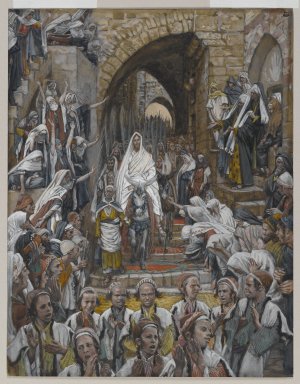
It’s hard to find a lovelier description of our response to this day that that in today’s Office of Readings:

Let us run to accompany him as he hastens toward his passion, and imitate those who met him then, not by covering his path with garments, olive branches or palms, but by doing all we can to prostrate ourselves before him by being humble and by trying to live as he would wish.  Then we shall be able to receive the Word at his coming, and God whom no limits can contain, will be within us.  (St. Andrew of Crete)

Royalty

Today’s Sunday-poem is by Luci Shaw:

Royalty

He was a plain man
and learned no latin.

Having left all gold behind
he dealt out peace
to all us wild ones
and the weather.

He ate fish, bread,
country wine and God’s will.

Dust sandaled his feet.

He wore purple only once
and that was an irony.

Smiling during Lent

A “guest post” from Fr. Pat McNulty from Madonna House:

Did Jesus Laugh?

by Fr. Pat McNulty.

When you fast do not put on a gloomy face like the hypocrites do (Mt. 6:16).

It was the loudest doorbell I had ever heard. And when I pushed the little black button a second time, I was certain that every monk turned toward the door in monastic desperation as if to say, “What? Don’t you know this is a monastery!”

Yet when the door opened, there stood a monk with a smile that was put together with his whole face. It was so delightful I didn’t even notice his almost-shaven head and his foot-long beard.

There is something very special about smiling. So much so that science continues its desperate attempt to explain the phenomenon. Some explanations seem fair and some foolish.

One says that smiling, like exercise, releases powerful natural body elements (endorphins) into our system making it possible for us to tolerate pain more easily. That would make most people I know smile more.

But how about this one: smiling constricts the facial muscles and thus reduces the amount of blood flowing to the brain and temporarily cools it down. The cooler the brain, the happier we are. I guess polar bears must be really happy, huh!

But one thing that is generally agreed on is that there are two kinds of smiles. One involves only the lips and the cheek muscles, and the other involves both these and the eye muscles.

They say you can smile with the cheek and lip muscles even when you are not happy or in agreement with someone else, and most people will never know for sure if it’s a real smile or one put on for the occasion.

But once the eyes are involved the person who is smiled upon can tell exactly what we really mean: it’s there in our eyes.

The cheeks and lips may seem to say, “hello” or “have a nice day,” but the eyes express the real message: “Get a life,” or “Get a job,” or “Don’t bother me, I’m busy.”

I didn’t need any scientific explanation to know immediately, from his eyes, which smile this monk was showering upon me when he opened that monastery door. “Come in, little friend,” he said, “What can I do for you today?” And he meant it.

It didn’t surprise me to learn, not too long after, that I had been staring into the face of Fr. Solanus Casey, who is now up for canonization.

Nor did it surprise me to discover over the years that there were lots more like him in my hometown monastery, monks who would never become famous but whose smiles did.

It was in the eyes, and almost all of them had it.

People often ask, “Did Jesus laugh? I mean, you know, a good ol’ belly laugh?”—as if we might finally find something in common with him if he had.

Well, at least we know that he told us not to be gloomy. When you fast do not put on a gloomy face like the hypocrites do (Mt. 6:16). Gloomy means “dismal, grim, dark, long faced, without laughter.” These are all things you can hide with smiling lips and face muscles but not with the eyes.

You can fast for forty days and forty nights from visiting the mall, from TV, from beer, from coffee, gossip, and eating between meals. You can spend ten hours a day in church on your knees, and then smile like the Cheshire Cat from Alice in Wonderland. But in the end the truth is in the eyes.

So this year it comes to me that maybe a good Lenten discipline which would help me not look gloomy when I fast could be that of simply looking into the mirror every day. Every day I could smile and then look into my own eyes and see what message I find. Do I merely “muscle” my way past other people all day, or does my heart join in the festivities?

I might even go a little further with this Lenten fast from gloom and mention a specific name each day as I look in the mirror and try to smile on that person with my eyes. That ought to crack a mirror or two.

But what if it seems hopeless? What if the mirror on the wall tells me that I am not the fairest of them all, that my smile is just my lips and cheeks? Maybe I could ask Jesus to help me want people to see beyond my own pain and sin into a heart that knows Him anyway and wants them to know Him better, too.

Yes, a Lenten fast from gloom could make Lent go very fast indeed—especially for everyone else around me.

But P. S. you didn’t answer the question: Did Jesus ever laugh?

I would say that if Jesus ever laughed, it was intimately connected to his smiling. And his smile could not have been a polite smile like when you hold a door for someone, or a nodding smile when you pass and greet someone in public, or even the kind of smile you give when someone smiles at you and you return the smile.

Jesus’ smile must have opened up his very heart to those who looked into his eyes. When that happened between him and someone else, I imagine they suddenly smiled “out loud” together. And thus was born, I think, a new kind of laughter.

It must have been something like what happened that day at the monastery door when Fr. Solanus smiled at me: we both started laughing. It was not nervous laugher, and it was not polite laughter.

The laughter flowed through the smile, from the heart, and was visible in the eyes. Suddenly we were smiling together “out loud.”

I remember it with Catherine Doherty, too. Her smile was so profound you knew she was looking into your very soul. At first it was a fearful thing, but then one day you realized she was letting you look into her soul, too, and the fear was gone. And after that, every now and then, unexpectedly, eye-to-eye, you smiled together “out loud.”

Perhaps when Jesus tells us not to be gloomy during our Lenten fast, he is trying to teach us how to smile from the heart so that we notice less and less the other person’s physical condition, social or economic status, woundedness, or personal sins or our memories of the same.

Then perhaps by Easter, we will rise from the gloom-tomb again and suddenly find ourselves smiling together with Jesus “out loud” the laughter of Resurrection.


Mirror, mirror on the wall, what does my smile say to them all?

We are all beggars

If you read my blog, you know that I enjoy reading Fr. Pat McNulty from Madonna House.  In a very recent article, he talks about experiencing poverty during Lent, discovering how poor we really are.  An excerpt:

Since that first Lent, much has changed in my life: there has been growth, healing, and conversion. But in some deep, deep place in my heart, I know that the real change hasn’t taken final hold yet. And it’s down there in those depths that I need to discover how poor I really am and how to beg for God’s mercy and for the ability to embrace this poverty with new hope and joy.

For I am insufficient unto myself. I, along with all of mankind, am on a restless pilgrimage, a pilgrimage in search of a final fulfillment which those who are truly poor know is theirs only in the kingdom of heaven.

We are all beggars! It’s nothing to be ashamed of. The Son of God was the poorest beggar of all, and it didn’t bother him a bit. It was, he said, his food to do the will of his Father!

But so many of us do not recognize our own poverty and thus cannot figure out why we are always so spiritually hungry.

Poverty?

I don’t love my spouse anymore. That’s poverty.

My child just died without warning in an accident. Why? Why? That’s poverty.

He’s a lousy preacher, but we’re stuck with him. That’s poverty.

My kids don’t have anything to do with God anymore. That’s poverty.

I don’t like this senior citizen dwelling I’m in. That’s poverty.

Why do you not heal me of this sickness, Lord? That’s poverty.

I spent a fortune on my education, and I can’t find a job commensurate with it anywhere. That’s poverty.

I’ve lost my job and I can’t find another one of any kind. That’s poverty.

I don’t want to grow old. That’s poverty.

I can’t stand my neighbour. That’s poverty.

I have no friends. That’s poverty.

Nobody understands me. That’s poverty.

Our poverty is all around us. We are all beggars. And The Beggar we follow has been there, done that, and wears the scars of those wounds. He knows exactly how to teach us to embrace our poverty as he embraced his. Even our need to be taught is our poverty!

Our desire to learn is our begging. And his response is the food that gives us new life.

Lent is a perfect desert-time for us to own our poverty, great or small, to put real words on it, to cry it out, to yell it out, to beg it out, and finally to embrace it as it is, whatever it is, and wrap it up in his mercy.

Then by Easter, after we’ve looked again with Jesus deep into our own personal poverty, the Risen Lord can show us how to reach out even more to one another—whether we are rich or poor.

If you want to read the whole article, just click here.

Good news for dust and ashes

I guess I’m still catching up with Lent.  .  .  .  Because of our dear friend’s death and her family still being in town and all of our grief and exhaustion, Ash Wednesday remains a blur–except for the oh-so-real words: “Remember, man, that you are dust and to dust you shall return.”  Here is an article by Fr. Pat McNulty from Madonna House on this very topic:

Good News for Dust and Ashes

by Fr. Pat McNulty.

One Ash Wednesday, the ashes on Fr. Pat’s forehead began a change in a young woman’s heart.

“No thanks, I only smoke filters,” she said as I offered her a cigarette. She was smoking filtered Kools. Yuck! I was smoking a real cigarette—Camels.

We found ourselves on the same train. She had boarded in Chicago and I in Ft. Wayne, Indiana. I took one of the few remaining seats in that car, the one next to her.

As I sat down, she politely whispered, “Excuse me, but you’ve got something all over your forehead.”

That “something” was ashes from the Ash Wednesday Mass I had just come from. They became the stimulus for a very nice ride together on Amtrack.

We eventually ended up in the dining car for coffee and a cigarette, and we talked about the weather, politics, the latest movies, the Chicago Bears, and finally, ashes and God.

My “Kool friend” was in her late twenties, a beautiful and intelligent young lady. She had the job of her dreams and the man of her dreams too—though, as I found out later, he was already married and had a family.

“I used to be a Christian,” she said, “but it never really took, I guess.”

“Oh, it always takes,” I said. “We just have to catch up to it.”

“I guess so. I don’t know much about your Catholic faith, but I have always been intrigued by your Ash Wednesday thing. How does it go?”

“Remember, thou art dust and unto dust thou shalt return.”

“Yes. That. Don’t you think it is a bit of bad news to be talking about God and dust? Isn’t religion supposed to be good news?”

“Well, if we don’t begin with the truth, if we filter it all out to suit our own purposes, then it’s not real news anymore, is it, let alone “good news?’”

“Yes, but…”

“Many people don’t believe in the extent of their own mortality until they see it with their own eyes. They do not believe they are totally involved with and dependant on a God who could return them all to dust forever in a flash and leave them there if he wanted to.”

“That doesn’t sound like good news to me.”

“The extent of our own mortality—dust thou art—and God’s loving presence mixed in with all the ashes, through Jesus Christ, is the Good News!”

“Meaning?”

I think we were both surprised when the conductor called her Ohio stop, because the time had passed so rapidly. We returned to our primary seats and, as she gathered her things together, I quickly wrote out my phone number and address on a book of matches I had taken from the dining car and gave it to her in case she wanted to talk more.

The train stopped. I helped her with some small luggage. She thanked me. I smiled and said to her, “Excuse me, but you’ve got something all over your forehead.” She quickly brushed it, looked at her hand, then at me. She was still laughing as she made her way up the aisle.

I’m sure people in the car wondered why the man with the Roman collar and the smudge mark on his forehead was waving to the young lady through the window as the train pulled away from the station. But I knew her repentance had begun.

It was almost two years later when I heard from her again, though I had not forgotten the incident. In fact, she had come to mind on the Ash Wednesday after that.

Her father had died since we had met, and because his long battle with cancer had left his body in such an appalling physical state, her mother had had him cremated. This had deprived her and her siblings of that final closure with their dad, which body-funerals can provide.

When they gathered for the scattering of the ashes into the winds over the Atlantic Ocean, she was devastated. He had been her best friend, and now he was just ashes thrown to the wind. “Why would God do that?” she asked.

We wrote to each other a few times off and on over the next year or so. She eventually returned to the Christian faith, met a young man at church, and they had set the wedding date. (Now why did that not surprise me?)

I was unable to be present for the wedding, but I sent her a special gift, my favorite crucifix, and I attached a piece of palm to it. I wanted her to have them.

And I reminded her that from such a simple Palm Sunday “thing” comes that powerful Ash Wednesday “thing” that had pointed her ever so gently toward repentance. “Excuse me, but you’ve got something all over your forehead.”

To this day when I receive ashes on Ash Wednesday, I cannot help but wonder how our chat would have turned out if I had taken my cue from the more cool, filtered Ash Wednesday blessing, “Repent,” etc. etc. vs. the real one, “Remember, thou art dust and unto dust thou shalt return.”

I don’t think the filtered version would have done it for this young lady. What she needed was the shock of real ashes leading to repentance.

And I believed it then as I believe it now: if you don’t get the “unto dust” part of Ash Wednesday first, you’ll never really get the “repent” part either.

P.S. She stopped smoking because her father had died from smoking-related causes. I asked her to pray that I could stop too. And if I knew where my “Kool” friend was today, I could let her know that this old “Camel” finally made it.

After frolicking with death by smoking for about forty years, I was finally able to stop about ten years ago. Till then I guess I imagined I was ready to return to dust anytime God wanted. But on second thought, I think I realized I needed more time to repent. Actually a lot more time!

What to give up for Lent

I realize that Lent is well underway and numbers of you have already pondered this question: “What should I give up for Lent?”  and well on your way into Lent, giving that thing up as you decided. At the same time, there are probably some of you that are either behind in answering it . . . or perhaps you had an answer, but are not really doing what you set out to do.  Any of those is a good excuse for me to share my favorite answer to that perennial question–and probably one of the most important answers.  It comes from a Magnificat article written by Fr. Peter John Cameron a few years ago.  I do not have time to quote the whole article (which is always dangerous because what you read will be edited), but I hope–especially those of you who despair of ever giving up what he suggests we give up–that you will find some hope in what he says:

Here’s what to give this Lent: the doubt that goes, “I can never get closer to God because I’m too sinful, too flawed, too weak.”  This is a lethal attitude, for it based on the false presumption that we can possess something of our own–that does not come from God–by which we can please God.  Nothing could be farther from the truth.  Only what is from God can please God.  But as long as such error persists, we estrange ourselves from God.  Lent is not about lamenting our inadequacy.  Rather, it is a graced moment to receive from God what he is eager to give us so that we can live the friendship with him that he desires. . . .

He goes on to describe how often we try to substitute self-sufficiency for the lack that we find in ourselves–and this usually leads to an experience of darkness in our lives–“we may even wonder if God hates us.”  He allows the darkness in order to draw us back to him.  “The most reasonable thing we can do when that feeling strikes is “to renew our act of love and confidence in God’s love for us.  The Lord allows the darkness precisely to move us to unite ourselves all the more closely to him who alone is the Truth.”

Still–we panic!  We feel as if we are obliged to do for God what we know we are unable to do.  But the point of the pressure is to convince us to receive everything from God.  We can be sure that God himself is the one who, in his mercy, moves us to do what is not within our power.  This is the Father’s way of opening us a little more to himself by making us a little more in the likeness of his crucified Son.

For nothing glorifies God like the confidence in his mercy that we display when we feel indicted by our frailty and inability.  The experience of our hopelessness is a heaven-sent chance to exercise supremely confident trust.  God delights in giving us the grace to trust him.

Sadly, for those who refuse God’s gift of confidence, the darkness can turn to despair.  Yet even in despair the miracle of mercy is at work.  Father Jean-Baptiste Henri Lacordaire, the nineteenth-century Dominican priest who was responsible for the revival of the Order of Preachers in France after the French Revolution, makes this astonishing remark: “There is in despair a remnant of human greatness, because it includes a contempt for all created things, and consequently an indication of the incomparable capacity of our being.”  In our darkness, the incomparable capacity of our being will settle for nothing less than the embrace of the Infinite.  Like nothing else, our helplessness moves us to cry out for that embrace in confidence and trust.  The cry of forsakenness that Jesus emits from the cross is just this.

Saint Paul wrote, “We were left to feel like men condemned to death so that we might trust, not in ourselves, but in God who raises from the dead” (2 Cor 1.9, NAB).  That’s the point.  That’s the challenge of Lent.  God wants us to have the strength to believe in his love so much that we confidently beg for his mercy no matter how much we feel the horror of death in ourselves. . . .

Let us this Lent, in the face of all ours sins, our limitations, and our weakness cry out with Jesus, “My God, why have you forsaken me?”  And let us do so with certainty–not doubt or desperation–because our union with Christ crucified has given us the Way to approach reality.  In our asking we hold the Answer.

Pushing God aside

“At the heart of all temptations is the act of pushing God aside because we perceive him as secondary, if not actually superfluous and annoying, in comparison with all the apparently far more urgent matters that fill our lives.” (Pope Benedict XVI)

And why do we do this?  Is it not because we forget who God truly is?  For if we remembered, we would never push Him aside, would we?  This is, in fact, my biggest temptation these days.  I have brought this to confession numerous times these past months.  For me, I push Him aside not so much because of the urgency of other matters–although that has been a big factor this past week–but because I am one of “little faith”, diminishing God to my idea of who I think He is, reducing His love to my narrow ideas of it.  Over and over again, I have had to decide to trust Him, to put my trust in who He says He is, rather than in my apparent experience at the moment—to let Him lead me out into the “wilderness” and there speak tenderly to my heart . . .  (Cf. Hosea 2.14)

and Angels danced

A wonderful poem about the joy of the angels when any of us repents of our sin:

Choreography for Angels

I say to you, that there is joy among the angels in heaven upon one sinner doing penance . . . (Luke 15.10)

Who spun these Angels into dance
When wars are needing artillery
Of spirits’ cannonading.  Armistice
Wants first the over-powering wings, and they
Are occupied with pirouettes!  Who did this?

Gone penitent, I caused it.  I confess it.

Who tilted flames of Seraphim
In arabesques of pure delightedness?
Is not the cosmic crisis begging fire
For full destruction of hate’s hazarding?
Why Seraphs swirling flames on floors of heaven?

I lit the heavens, when I bent my head.

Who lined mystic corps-de-ballet
Of Cherubim?  Who set in pas-de-deux
This Power with this Principality?
Why these Archangels not on mission sent
Today, but waltzing on stars, and singing?

I am the one who did this.  I confess it.
I smote my errant heart, and Angels danced.

~Mother Mary Francis (Summon Spirit’s Cry)