If today

“If today you hear His voice, harden not your hearts.”

We have been praying that verse several times every morning during Lent.  In essence, it is a plea to not turn away when the Lord convicts us of sin.  But yesterday morning, the Lord broke into my thoughts as if to say: “What I most speak to you is My love.  Don’t harden your heart to it.”  When we think of the true meaning of sin, it is a breaking of our relationship with God–which, in fact, weakens our ability to know His love.  He only convicts in order to restore the relationship.  He so longs for full union with us, for each of us to know His love in its fullness.

So today, when the Lord nudges you with His love, don’t harden your heart.  Open it wide.

Put yourself in this woman’s place

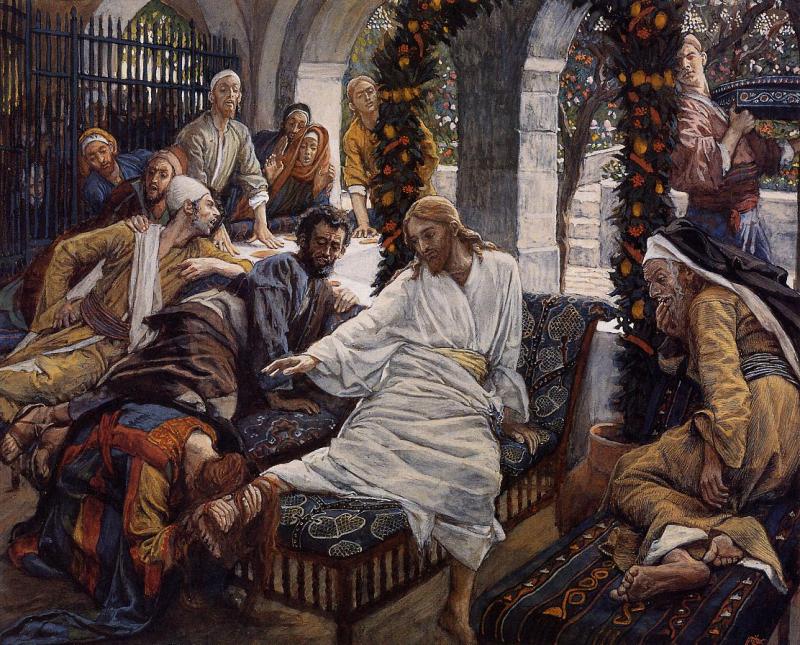
Jesus does not want our sins, our weaknesses and faults, to keep us from coming to Him, to keep us from intimacy with Him.  I post again this painting by James Tissot.  Put yourself in this woman’s place, a great sinner.  Touch His feet, kiss His feet.  And see the Lord reaching out to you in His tender love.

He said to Simon the Pharisee, “You gave me no kiss . . . ” (Lk 7.45).  The Lord of Love will miss your kiss if you don’t draw near to Him . . .

At the top of the stairs

On those days when I think, “This is never going to change in me”, the Holy Spirit often reminds me of these words of St. Thérèse:

“At the top of the stairs He is looking at your lovingly.  Soon conquered by your vain efforts, He will come down Himself, and taking you in His arms, will carry you forever into His kingdom where you will not leave Him again.  But if you stop lifting your little foot, He will leave you on earth for a long time.”

“God desired a harlot . . .”

As some of you know, I have a little book of art pictures and quotes that I periodically use for meditation.  I have been pondering the picture below of the sinful woman anointing Jesus’ feet (James Tissot).  And below it is a beautiful quote from John Chrysostom describing the love of God for us, each of whom is indeed the sinful woman.

“God desired a harlot, and how does He act?  He does not send to her any of His servants.  He does not send any angels or archangels, cherubim or seraphim.  No, He Himself draws near to the one He loves, and He does not take her to Heaven, for He could not bring a harlot to Heaven, and therefore He Himself comes down to earth, to the harlot, and is not ashamed.  He comes to her secret dwelling place and beholds her in her drunkenness.  And how does He come?  Not in the bare essence of His original nature, but in the guise of one whom the harlot is seeking, in order that she might not be afraid when she sees Him, and will not run away, and escape Him. He comes to the harlot as a man.  And how does He become this?  He is conceived in the womb, He grows little by little, as we do, and has intercourse with human nature.  And He finds this harlot thick with sores and oppressed by devils.  How does He act?  He draws nigh to her.  She sees Him and flees away.  He calls the wise man, saying, ‘Why are you afraid?  I am not a judge, but a physician.  I come not to judge the world, but to save the world.’  Straightway He calls the wise men, for are not the wise man the immediate first fruits of His coming?  They come and worship Him, and then the harlot herself comes and is transformed into a maiden.  The Canaanite woman comes and partakes of His love.  And how does He act?  He takes the sinner and espouses her to Himself, and gives her the signet ring of the Holy Spirit as a seal between them.” (John Chrysostom)

What wondrous love is this!

“It was because a man lay on the road . . .”

A painting or a song can be so powerful.  The picture below can be found on the cover of the first volume of Fire of Mercy by Erasmo Leiva-Merikakis, a Trappist monk.  I have been meditating on it this Lent.  I know I have posted about this picture before, but can’t help sharing it with you again.

Good Samaritan

This is how the back of the book describes this picture:

The book’s cover portrays Christ as the Good Samaritan in an illumination taken from the mid sixth-century Syrian Codex Rossanensis. The fire of God’s mercy, poured out without reserve by the Father into the Heart of his incarnate Word, impels the Son’s eager gaze earthwards.  Christ Jesus, Son of God and Son of Mary, the living ‘image of the invisible God’ in whom ‘the whole fullness of divinity dwells bodily’ (Colossians 1:15, 2:9), bends down his sun-like nimbus—the very splendor of his glory, inscribed with the cross of his suffering—in a full ninety-degree angle, to show the perfection of His descent among us.  The eternal Lord of the ages thus moves into position to nurse with divine tenderness the green body of decaying humanity, prostrate with festering wounds: ‘Through the tender mercy of our God, the Dawn from on high has visited us, to give knowledge of salvation to those who sit in darkness and the shadow of death’ (Luke 2:78f).  For his part, the dazzling angel has found a new mode of praise: to stand by his Master, marveling and ministering as he holds the gold bowl of grace and compassion, awestruck at the depth of the Word’s condescension.  What even angelic hands cannot touch unveiled, that Christ lavishes with open gesture upon the flesh and soul of his beloved brother, sin-wounded man.

Sometimes I just sit and meditate on how I am that green man lying in the road and try to imagine Christ standing over me pouring out His mercy–that even the angels cannot touch–upon me.  Peguy says: “It was because a man lay on the road that a Samaritan picked him up.”  It is because we lay on the road that Christ picks us up . . .

What should I give up for Lent?

I have the answer for you!  I’d like to share a short article I wrote for The Catholic Times last year:

“So . . . what are you giving up for Lent?”  The best all-time answer I’ve ever heard to that question comes from Fr. John Peter Cameron, editor of Magnificat: “Here’s what to give up for Lent: the doubt that goes, ‘I can never get closer to God because I’m too sinful, too flawed, too weak.’”  Lent really is not about giving up, but about receiving. Fr. John goes on to say: “Lent is not about lamenting our inadequacy.  Rather, it is a graced moment to receive from God what he is eager to give us so that we can live the friendship with him that he desires. . . .”

This approach requires a major change of attitude on most of our parts.  We are so geared up for what we should do for God, when what is uppermost in the Lord’s mind is his desire to draw near to us, to give himself to us.  If what we decide to give up would, in fact, encourage greater friendship with him, that would be one thing, but for many of us, we fall too readily into the following two categories. Either we succeed in doing what we’ve set out to do and just grow stronger in our pride and self-sufficiency, and in a real sense, further from God.  Or we fail and  grow less confident in God’s mercy.  “How could I expect him to show me mercy after I fail to do one simple thing like giving up chocolate for Lent? I mean, how hard is that?”

Of course, I’m not saying that self-discipline isn’t important or that chocolate in someone’s life may not indeed be a stumbling block in his relationship with God, but for so many of us, the main obstacle we face is our lack of confidence in God’s goodness and his love for us.  We hide from him, as Adam & Eve did after they sinned.  We think that we can’t come to him unless we’ve got everything together.  But notice God’s first words to them after their fall.  They were not: “What have you done?!” but “Where are you?” (Gen. 3:9)After listening to the serpent, Adam and Eve doubted his goodness rather than placing their trust in his unbounded mercy.  Otherwise, they would have run to him like the prodigal son to his father.  His first concern was the restoration of relationship with them.
St. Thérèse encourages us along these lines of trust: “Sanctity does not consist in this or that practice, it consists in a disposition of heart which makes us humble and little in the eyes of God, conscious of our weakness but boldly confident in his goodness as Father.” (emphasis added)

Again, I am not minimizing the seriousness of sin.  What I am saying is that the first step, and the most important one, is dealing with mistrust in the goodness of God toward us.

So this Lent, you might reconsider what you should give up.  Perhaps it should be mistrust or doubt of the Lord’s goodness towards you. Look at the obstacles in the way you think about your relationship with Him. Listen to the Father calling out to you: “Where are you?” If you’re hiding because of lack of confidence in His goodness, try just taking one small step toward Him.  Come out from behind the bushes of doubt. Put aside the sin of mistrust and you might be surprised to see Him running toward you with arms wide open.

A personal feast day

We all have personal feast days, days that we celebrate for different reasons, usually because of a saint we’re named after or one to whom we have great devotion. Over the last few years I have come to look at Holy Saturday as a personal feast day.  Ever since my brother, Tim, died, it has taken on great meaning: this day during which it looks like nothing is happening, when, in fact, great and “terrible” things are happening.  Jesus is setting the captives free. Christ has descended into our loneliness,  into our grief, into those spaces in our lives–and of those we love–where darkness seems to reign. And that is Good News.  We are no longer alone.  He is, indeed, God-with-us.  That is the wonder and consolation of this day.  That was so true for me as I walked through those dark days after Tim took his life.  Christ gave me such an assurance of His being with my brother during those dark, dark moments in his life. . . and an assurance of the same for myself.  “Though I walk through the shadow of death, I fear no evil, for you are with me.” (Ps 23.4)

Christ is there with us, whether we perceive Him or not.

Holy Saturday is the day of the ‘death of God,’ the day which expresses the unparalleled experience of our age, anticipating the fact that God is simply absent, that the grave hides him, that he no longer awakes, no longer speaks, so that one no longer needs to gainsay him but can simply overlook him . . . Christ strode through the gate of our final lonelienss; in his passion he went down into the abyss of our abandonment.  Where no voice can reach us any longer, there is he.  Hell is thereby overcome, or, to be more accurate, death, which was previously hell, is hell no longer.  Neither is the same any longer because there is life in the midst of death, because love dwells in it.

Christ descended into “Hell” and is therefore close to those cast into it, transforming their darkness into light.  Suffering and torment is still terrible and well-nigh unbearable.  Yet the star of hope has risen–the anchor of the heart reaches the very throne of God.  Instead of evil being unleashed within man, the light shines victorious: suffering–without ceasing to be suffering–becomes, despite everything, a hymn of praise.  (Benedict XVI, Spes Salvi)

For further reading on the significance of this day, see these posts: “Where is Christ today?” and “Why Saturday is Mary’s Day”

Trauma Unit

Trauma Unit

It was never meant
to burst from the body
so fiercely, to pour unchanneled
from the five wounds
and the unbandaged brow,
drowning the dark wood,
staining the stones
and the gravel below,
clotting in the air
dark with God’s absence.

It was created for
a closed system–the unbroken
rhythms of human blood
binding the body of God,
circulating hot, brilliant,
saline, without interruption
between heart, lungs,
and all cells.

But because he was once
emptied, I am each day refilled;
my spirit-arteries
pulse with the vital red
of love; poured out,
it is his life
that now pumps through
my own heart’s core.  He bled and died
and I have been transfused.

~Luci Shaw