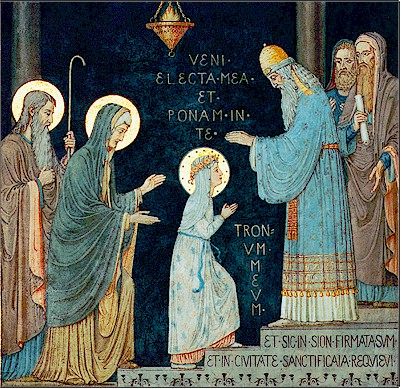
“It is ours to be gazed upon . . .”

“This is a story told of a mother and her little daughter in Trinidad.  They are the poor of the earth, and the mother takes great care each evening to launder the one well-worn dress that her daughter wears to school day after day.  Each morning, as the little girl leaves the front door to set off for class, her mother asks her to stop and turn toward her for a moment.  ‘Just stand there.  I love to look at you.’

“Contemplation is a way of looking, a way of seeing.  The more I see, the more I love.  And the more I love, the more I see.  Seeing by loving; loving by seeing.  But the one caught up in contemplation knows that it is not only I who look and gaze and behold; it is the Other, whose name above all naming is Love, who gazes upon me.  A beloved child hears the word of a mother: ‘Just stand there.  I love to look at you.’  It is ours to be gazed upon . . . even while gazing.”  (Michael Downey, The Heart of Hope)

“Behold, God’s love for you!”

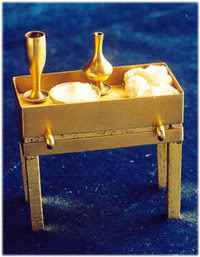
I am reading a fascinating book on the Eucharist by Dr. Brant Pitre, Jesus and the Jewish Roots of the Eucharist.  In one section of the book, Dr. Pitre illustrates the connection between the Eucharist and the Bread of the Presence  from the Temple.  God had commanded the Israelites to keep twelve loaves of bread on a golden table in the Holy Place. “And you shall make a table of acacia wood . . . You shall overlay it with pure gold, and make a molding of gold around it.  And you shall make its plates and dishes for incense, and its flagons and bowls with which to pour libations; of pure gold you shall make them.  And you shall set the Bread of the Presence on the table before me always.” (Ex 25:23-24)

Later in the chapter, Dr. Pitre explains the custom of the priests bringing this table out from the Holy Place three times a year (the feasts of Passover, Pentecost, and Tabernacles) so that the pilgrims might see it:  “They [the priests] used to lift it [the Golden Table] up and exhibit the Bread of the Presence on it to those who came up for the festivals, saying to them, “Behold, God’s Love for you!”

What an amazing foreshadowing of God’s love made manifest in the Eucharist. . . .

Another footnote

[Note: the first time I tried to post this this morning, it crashed.  I’ve never had that happen with Word Press.  Makes me wonder how important this post may be for one of you . . .]

I recently posted about a footnote that had grabbed me.  The other night–the eve of Divine Mercy Sunday–some of us were talking about another footnote–no. 52 to be exact, in Blessed (!) John Paul II’s encyclical, Rich in Mercy–and its impact on each of us.  I remember exactly where I was when I first read it and how profound I found it.  May his insights into the Old Testament use of the words for mercy shape your minds and hearts:

“In describing mercy, the books of the Old Testament use two expressions in particular, each having a different semantic nuance. First there is the term hesed, which indicates a profound attitude of “goodness.” When this is established between two individuals, they do not just wish each other well; they are also faithful to each other by virtue of an interior commitment, and therefore also by virtue of a faithfulness to themselves. Since hesed also means “grace” or “love,” this occurs precisely on the basis of this fidelity. The fact that the commitment in question has not only a moral character but almost a juridical one makes no difference. When in the Old Testament the word hesed is used of the Lord, this always occurs in connection with the covenant that God established with Israel. This covenant was, on God’s part, a gift and a grace for Israel. Nevertheless, since, in harmony with the covenant entered into, God had made a commitment to respect it, hesed also acquired in a certain sense a legal content. The juridical commitment on God’s part ceased to oblige whenever Israel broke the covenant and did not respect its conditions. But precisely at this point, hesed, in ceasing to be a juridical obligation, revealed its deeper aspect: it showed itself as what it was at the beginning, that is, as love that gives, love more powerful than betrayal, grace stronger than sin.

This fidelity vis-a-vis the unfaithful “daughter of my people”(cf. Lam. 4:3, 6) is, in brief, on God’s part, fidelity to Himself. This becomes obvious in the frequent recurrence together of the two terms hesed we’e met (= grace and fidelity), which could be considered a case of hendiadys (cf. e.g. Ex. 34:6; 2 Sm. 2:6; 15:20; Ps. 25[24]:10; 40[39]:11-12; 85[84]:11; 138[137]:2; Mi. 7:20). “It is not for your sake, O house of Israel, that I am about to act, but for the sake of my holy name” (Ez. 36:22). Therefore Israel, although burdened with guilt for having broken the covenant, cannot lay claim to God’s hesed on the basis of (legal) justice; yet it can and must go on hoping and trusting to obtain it, since the God of the covenant is really “responsible for his love.” The fruits of this love are forgiveness and restoration to grace, the reestablishment of the interior covenant.

“The second word which in the terminology of the Old Testament serves to define mercy is rahamim. This has a different nuance from that of hesed. While hesed highlights the marks of fidelity to self and of “responsibility for one’s own love” (which are in a certain sense masculine characteristics), rahamim, in its very root, denotes the love of a mother (rehem = mother’s womb). From the deep and original bond-indeed the unity-that links a mother to her child there springs a particular relationship to the child, a particular love. Of this love one can say that it is completely gratuitous, not merited, and that in this aspect it constitutes an interior necessity: an exigency of the heart. It is, as it were, a “feminine” variation of the masculine fidelity to self expressed by hesed. Against this psychological background, rahamim generates a whole range of feelings, including goodness and tenderness, patience and understanding, that is, readiness to forgive.

The Old Testament attributes to the Lord precisely these characteristics when it uses the term rahamim in speaking of Him. We read in Isaiah: “Can a woman forget her suckling child, that she should have no compassion on the son of her womb? Even these may forget, yet I will not forget you” (Is. 49:15). This love, faithful and invincible thanks to the mysterious power of motherhood, is expressed in the Old Testament texts in various ways: as salvation from dangers, especially from enemies; also as forgiveness of sins-of individuals and also of the whole of Israel; and finally in readiness to fulfill the (eschatological) promise and hope, in spite of human infidelity, as we read in Hosea: “I will heal their faithlessness, I will love them freely” (Hos. 14:5).

“In the terminology of the Old Testament we also find other expressions, referring in different ways to the same basic content. But the two terms mentioned above deserve special attention. They clearly show their original anthropomorphic aspect: in describing God’s mercy, the biblical authors use terms that correspond to the consciousness and experience of their contemporaries. The Greek terminology in the Septuagint translation does not show as great a wealth as the Hebrew: therefore it does not offer all the semantic nuances proper to the original text. At any rate, the New Testament builds upon the wealth and depth that already marked the Old.

In this way, we have inherited from the Old Testament-as it were in a special synthesis-not only the wealth of expressions used by those books in order to define God’s mercy, but also a specific and obviously anthropomorphic “psychology” of God: the image of His anxious love, which in contact with evil, and in particular with the sin of the individual and of the people, is manifested as mercy. This image is made up not only of the rather general content of the verb hanan but also of the content of hesed and rahamim. The term hanan expresses a wider concept: it means in fact the manifestation of grace, which involves, so to speak, a constant predisposition to be generous, benevolent and merciful.

“In addition to these basic semantic elements, the Old Testament concept of mercy is also made up of what is included in the verb hamal, which literally means “to spare” (a defeated enemy) but also “to show mercy and compassion,” and in consequence forgiveness and remission of guilt. There is also the term hus, which expresses pity and compassion, but especially in the affective sense. These terms appear more rarely in the biblical texts to denote mercy. In addition, one must note the word ‘emet already mentioned: it means primarily “solidity, security” (in the Greek of the Septuagint: “truth”) and then “fidelity,” land in this way it seems to link up with the semantic content proper to the term hesed.”
Do not lose heart, O soul

This is the week of penance services.  Along with that can come the temptation–yes, it is a temptation–to overdwell on our sins, on how we have offended God to the point that we never really return to the arms of our loving Father.  We stay in the pig sty rather than running with confidence to the God who comes to meet us.  May this selection from St. Ephrem the Syrian enable you to “leave the city that starves you.”

Do not lose heart, O soul, do not grieve; pronounce not over yourself a final judgment for the multitude of your sins; do not commit yourself to fire; do not say: The Lord has cast me from his face.

Such words are not pleasing to God.  Can it be that he who has fallen cannot get up?  Can it be that he who has turned away cannot turn back again?  Do you not hear how kind the Father is to a prodigal?

Do not be ashamed to turn back and say boldly: I will arise and go to my Father.  Arise and go!

He will accept you and will not reproach you, but rather rejoice at your return.  He awaits you; just do not be ashamed and do not hide from the face of God as did Adam.

It was for your sake that Christ was crucified; so will he cast you aside?  He knows who oppresses us.  He knows that we have no other help but him alone.

Christ knows that man is miserable.  Do not give yourself up to despair and apathy, assuming that you have been prepared for the fire.  Christ derives no consolation from thrusting us into the fire; he gains nothing if he sends us into the abyss to be tormented.

Imitate the prodigal son: leave the city that starves you.  Come and beseech him and you shall behold the glory of God.  Your face shall be enlightened and you will rejoice in the sweetness of paradise.  Glory to the Lord and Lover of mankind who saves us.

The love of God

I have been reading and re-reading one of the homilies that Fr. Cantalamessa gave this Lent to the Roman Curia.  Here are the beginning paragraphs, followed by the link to the whole homily.  In it he stresses–as I have highlighted below–the importance, the necessity, of our being permeated by the knowledge of God’s love for us before we can bring that love to others.  I  find in my own life, and in the lives of many of the women to whom I give spiritual direction, that the most challenging thing can very often be believing in the love of God for me personally.   Sounds so easy, but so hard to do.

The first and essential proclamation that the Church is charged to take to the world and that the world awaits from the Church is that of the love of God. However, for the evangelizers to be able to transmit this certainty, it is necessary that they themselves be profoundly permeated by it, that it be the light of their life. The present meditation should serve this purpose at least in a small part.

The expression “love of God” has two very different meanings: one in which God is object and the other in which God is subject; one which indicates our love for God and the other which indicates God’s love for us. The human person, who is more inclined to be active than passive, to be a creditor rather than a debtor, has always given precedent to the first meaning, to that which we do for God. Even Christian preaching has followed this line, speaking almost exclusively in certain epochs of the “duty” to love God (“De Deo diligere”).

However, biblical revelation gives precedence to the second meaning: to the love “of” God, not to the love “for” God. Aristotle said that God moves the world “in so far as he is loved,” that is, in so far as he is object of love and final cause of all creatures.[1] But the Bible says exactly the contrary, namely, that God creates and moves the world in as much as he loves the world.

The most important thing, in speaking of the love of God, is not, therefore, that man loves God, but that God loves man and that he loved him “first”: “In this is love, not that we loved God but that he loved us” (1 John 4:10). From this all the rest depends, including our own possibility of loving God: “We love, because he first loved us” (1 John 4:19).  (emphasis added)

You can read the whole thing here.

It’s really all about you

I was going to start out this post by reminding you–and me, of course–that Lent is not all about you; it’s all about Christ.  It’s so easy to get focused on what we’re doing for Lent, etc. But then I got to thinking and realized again that actually it is all about us.  The love of the Father is always about us, about drawing us to Himself, about manifesting His love to us through His Son.  These 40 days of retreat are meant to draw us into a deeper knowledge of that love.

The Bridegroom

“Whatever he did, whatever he said on earth, even the insults, even the spitting, the buffeting, even the Cross and the tomb, were nothing but yourself [Father] speaking in the Son, appealing to us by your love, stirring up our love for you.”

~William of St. Thierry

When “a hundred or a million are suffering”

Sorry for not posting in awhile.  God’s will was manifest in my life in unexpected events.  . .

In praying for the people in Japan, I was reminded of this pertinent perspective from Caryll Houselander:

It struck me last night that many people are increasing their fear by thinking in crowds, i.e. they think of hundreds and thousands suffering etc., whilst the fact is, God is thinking of each one of us separately, and when–say–a hundred or a million are suffering, it is God who has each one separately in His own hands and is Himself measuring what each one can take, and to each one He is giving His illimitable love.  This thought, though obvious, consoles me a lot . . .

Loved by Christ

In this Monday’s Office of Readings (for the Feast of the Conversion of St. Paul), John Chrysostom wrote, describing St. Paul: “The most important thing of all to him, however, was that he knew himself to be loved by Christ.”

How many of us can say that about ourselves, that the most important thing of all to each of us is that we know ourselves to be loved by Christ?  That reminds me of a quote I’ve shared before, but think it apt to share it with you again:

Not long ago I received in the mail a postcard from a friend that had on it only six words, “I am the one Jesus loves.” . . . When I called him, he told me the slogan came from the author and speaker Brennan Manning.  At a seminar, Manning referred to Jesus’ closest friend on earth, the disciple named John, identified in the Gospels as “the one Jesus loved.”  Manning said, “If John were to be asked, ‘What is your primary identity in life?’ he would not reply, ‘I am a disciple, an apostle, an evangelist, an author of one of the four Gospels,’ but rather, ‘I am the one Jesus loves.’”  What would it mean, I ask myself, if I too came to the place where I saw my primary identity in life as “the one Jesus loves”?   (Philip Yancey)

May the Holy Spirit, the love of Christ that has been poured out into our hearts, bring us more and more to this point.

The greater the reason we have to trust in God

One more from Francis de Sales:

The more miserable we are, the more we ought to trust in God’s goodness and mercy.  Had God not created man, God would always have been good, but he would not have been actually merciful, since he would not have shown mercy to anyone; for to whom can mercy be shown except to the wretched?

You see, then, that the more we recognize ourselves as miserable, the greater the reason we have to trust in God, since there is absolutely nothing in us in which we could put our confidence.

“To make visible the marvels wrought by God”

Yesterday, November 21, is usually observed as the Feast of the Presentation of Mary in the Temple.  (This year it was superseded by the Feast of Christ the King.)  The Presentation of Mary is always a special day for consecrated religious.  Fr. Peter John Cameron, in his book Mysteries of the Virgin Mary,  explains it this way:

The Presentation of Mary in the temple is an act of consecration.  This feast hold special significance for those persons called to consecrated life in the Church; at the same time it moves all people to reflect on the meaning of consecrated life for the Church.

He goes on to cite a quote from John Paul II that I have also found very encouraging for myself, as one called to consecrated life:

What Pope John Paul II says about consecrated life in his apostolic exhortation Vita Consecrata is revealed first and foremost in the life of the Blessed Virgin Mary, especially as Our Lady is presented in the temple:

The first duty of the consecrated life is to make visible the marvels wrought by God in the frail humanity of those who are called.  They bear witness to these marvels not so much in words as by the eloquent language of a transfigured life, capable of amazing the world.  To people’s astonishment they respond by proclaiming the wonders of grace accomplished by the Lord in those whom he loves . . . . It is the duty of consecrated life to show that the Incarnate Son of God is . . . the infinite beauty which alone can fully satisfy the human heart.

Please pray for us that we may fulfill this duty wholeheartedly, that God’s marvels may be manifest “in the frail humanity of those [of us] who are called”.