But if not

Facing another day of high heat today made me think of the three young men in the fiery furnace.  Now that you’re smiling, I actually did meditate on that passage from Daniel today.  The attitude of those men in the midst of a life-threatening situation–much more serious than this heat crisis :-)– is amazing.  I just want to share a few thoughts:

  1. When Nebuchadnezzar announces that he will throw them into the fiery furnace if they do not worship his gods, they respond: “If it be so, our God whom we serve is able to deliver us from the burning fiery furnace; and he will deliver us out of your hand, O king.  But if not, be it known to you, O king, that we will not serve your gods or worship the golden image which you have set up.” (Daniel 3.17-18 emphasis added)  Amy Carmichael did a little meditation on these verses, highlighting the “but if not.”  If things do not turn out the way we prefer, will we keep abandoning ourselves to Him, trusting wholeheartedly in His love?
  2. This verse really struck home: And they walked about in the midst of the flames, singing hymns to God and blessing the Lord. This verse always makes me think of Isaiah 43.2b: When you walk through fire you shall not be burned, and the flame shall not consume you. No grumbling allowed for me when it’s hot, hot, hot.  Only singing hymns and blessing the Lord.  (If you’re like me, it’s easier to handle the big “heats” in life than the small ones. . .)
  3. And most importantly, a fourth man was seen walking in the midst of the fire with the three.  Jesus is always with us in the midst of our own fires.

So bless the Lord, O my soul . . .  He saves us from the eternal fire, which is the most important.
Where the pressure lies

I am reading a new biography of J. Hudson Taylor, It is not Death to Die.  Taylor was a missionary to China in the early 20th century.  In my estimation, he was one of the greatest Protestant missionaries to have ever lived, and, along with Amy Carmichael, has had a profound effect on my life.  I always recommend reading his life.  Yesterday as some of our Sisters were sharing about the stresses they’re encountering in life, I could not help but remember this quote from Taylor and would like to pass it along to the rest of you as well:

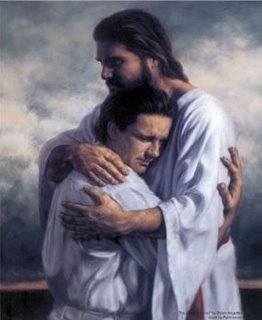
It does not matter, really, how great the pressure is.  It only matters where the pressure lies.  See that it never comes between you and the Lord–then, the greater the pressure, the more it presses you to His breast.

May whatever is pressing in on you this day only serve to press you closer to His breast.

Bowing down before the Lord

The whole story of the Canaanite woman who implored Jesus to heal her daughter (cf. Mt. 15.21 ff) is absolutely fascinating to me.  Jesus seems to rebuff her more than once, yet she tenaciously perseveres in her request.  What particularly moves me is her response after 1) he first seemingly ignores her and 2) says that His mission is to the lost sheep of the House of Israel (of which she is not a part).  She responds by coming to Him, kneeling at His feet and worshiping (15.25).

Worship is an act of bowing before the Lordship of God and completely surrendering to His will.  How often is our response one of worship when we experience silence and non-answers from the Lord?  May the Spirit of the Lord prompt us to turn our disappointments into occasions of worship of our God who is only and always Love.

Red Sea Rule 8

Jumping ahead in the book I referred to yesterday, Rule #8 is “Trust God to deliver in His own unique way.”

God will deliver His children from every evil work, from every peril and problem, from tribulation, even from death itself.  But there are no cookie cutters in heaven.  God doesn’t have standardized, same-size-fits-all solutions to our various problems.  He treats every situation as singular and special, and He designs a unique, tailor-made deliverance to every trial and trouble.

He goes on to write about how God can indeed deliver in miraculous ways and does, but other times, in His providence, He works in mysterious ways that we cannot always understand.

When God does not deliver overtly (through a miracle) or covertly (through providence), He will deliver mysteriously, with a deeper level of intervention than we can discern; in the end it will be better for us, though for a time we may be perplexed.

When Vance Havner, the wry North Carolina evangelist, lost his wife to disease, he was disconsolate.  But out of the experience he later wrote:

When before the throne we stand in Him complete, all the riddles that puzzle us here will fall into place and we shall know in fulfillment what we now believe in faith–that all things work together for good in His eternal purpose.  No longer will we cry “My God, why?”  Instead, “alas” will become “Alleluia,” all question marks will be straightened into exclamation points, sorrow will change to singing, and pain will be lost in praise.

“What I am doing you do not know now, but afterward you will understand.” (Jn 13.7)

The voice of Pharaoh

Following on yesterday’s post (and Tesa’s excellent comment!), I thought I would share another reflection by Amy Carmichael on the same topic: listening–or rather the importance of not listening–to the voice of the Enemy.

Exodus 14.3  Pharaoh will say . . . They are entangled in the land; the wilderness has shut them in.

Sometimes when problems come up and we see no way through, or when souls we love seem entangled, we are tempted to think of what Pharaoh will say.  There can be no entanglement, the wilderness cannot possibly shut in anyone whom God is leading Home.  It has been said, “What we see as problems, God sees as solutions”; and what we have to do through the age-long minute* before we see is to wait in peace and refuse to be hustled.  “Fear not, stand still,” and sooner or later, you shall “see the salvation of the Lord” (v. 13).  There will be no entanglement.

And is it not comforting that the Lord Jesus knows beforehand what Pharaoh will say? So we need not pay the slightest attention to him, even if he does make discouraging remarks.  The last word is never with Pharaoh.  What is he but a “noise” (Jer 46.17)?  So let us trust and not be afraid.

(Edges of His Ways, p. 40)

*Amy is referring here to the “age-long minute” between when the storm on the sea began for the disciples and when Jesus came to them walking on the water and calmed the sea.

The Hill Mizar

Did you ever wonder about Mizar in Ps 42–where it was and what was its significance?  (Maybe you didn’t, but have I piqued your curiosity?)  Here’s Amy Carmichael’s take on it:

Ps 42.6  The Hill Mizar

Did you ever feel that you had nothing great enough to be called a trouble, and yet you very much needed help?  I have been finding much encouragement in the hill Mizar.  For Mizar means littleness–the little hill.  The land of Jordan was a place where great floods (the swelling of Jordan) might terrify the soul, and the land of the Hermonites was a place of lions and leopards [FYI: these are the places mentioned in this verse]; but Mizar was only a little hill: and yet the word is, I will “remember You from . . .  the hill Mizar”, from the little hill.

So just where we are, from the place of our little trial, little pain, little difficulty, little temptation (if temptation can ever be little), let us remember our God.  Relief will surely come, and victory and peace; for “the Lord will command His lovingkindness” (v. 8), even to us in our little hill.

Leaning upon your Beloved

From Amy Carmichael:

I want to give you a word that helped me all yesterday and will help me today.  It is the “through” of Psalm 84.6 [“As they go through the bitter valley, they make it a place of springs”] and of Isaiah 43.2 [“When you pass through the waters I will be with you; and through the rivers, they shall not overwhelm you”], taken with Song of Songs 8.5 [“Who is that coming up from the wilderness, leaning upon her beloved?”].

We are never staying in the valley or the rough waters; we are always only passing through them, just as the bride in the Song of Songs is seen coming up from the wilderness leaning upon her Beloved.

So whatever the valley is, or however rough the waters are, we won’t fear.  Leaning upon our Beloved we shall come up from the wilderness and, as Psalm 84.6 says, even use the valley as a well, make it a well.  We shall find the living waters there and drink of them.

While it is still dark

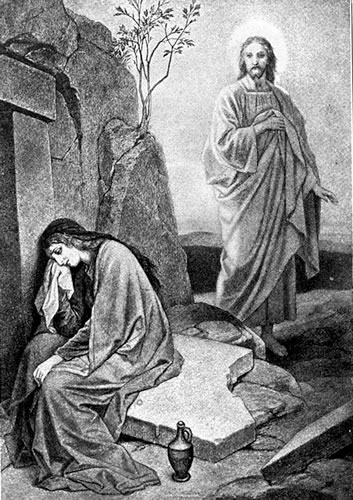
Some of us can wake up on Easter morning or Easter Monday or any other morning, for that matter, and wonder where the risen Christ is.  For one reason or another, we may feel like Mary Magdalene weeping outside the tomb wondering where they have taken Him.  I wrote this a few years back on Easter morning and thought I might share it with you:

“Now on the first day of the week Mary Magdalene came to the tomb early, while it was still dark . . . “ (Jn 20:1)

While it was still dark she came. She did not wait at home. She did not wait for Him or for others to come to her. And she expected to find what? Surely the stone still blocking her from Him. And yet she came. In the darkness. In her grief. She sought Him out even if only to lean her head and heart upon that stone that separated Him from her. In the darkness, in her grief she came.

And what did she find? The stone rolled away—but He was not there. He was not there. “I sought him, but found him not. I called him, but he gave no answer” (Song of Songs 5:6b). “Where have they laid him? They have taken away my Lord, and I do not know where they have laid him” (Jn 20:13b).

Her sorrow is now greater, yet she does not return home. She stands there weeping. And seeking. While it was still dark.

And no one else can solace her. Not angels. Not gardeners . . . She still seeks Him. While it is still dark. And that seeking, that longing of her soul, that anguish at His absence is the latch Christ uses to open her heart when He says her name: “Mary.” While it was still dark.

So go to Him. While it is still dark. While you are still weeping. Even when you cannot find Him. Stand there weeping and seeking Him. And listen for your name. Even now He is saying it.

While it is still dark.

“Blessed are those who have not seen and yet believe.”

Let it be done unto me

One of the best prayers my spiritual director ever taught me to say was Mary’s “Let it be done unto me according to your word.”  A very simple prayer, but absolutely life-changing.  The part that he particularly focussed on with me was the “Let it be done” part.  All I had to do was give God permission to do what He wanted to do, to let Him do it in me.  There are many, many times when I simply do not understand what He is about in my life.  (Now is one of them.)  I like to understand what God is about in my life.  The reality, however, is that I seldom have a real clue. With this prayer, I don’t need to understand.  I simply need to surrender to what He is about.   As long as He knows, that’s really all that is necessary.  He will guide me, even in hidden ways.

With the Feast of the Annunciation approaching, it’s a good time to remember the example Mary set for us in her response to what, certainly, was not something she fully understood.

God is holding on to you

Do you have times when you feel that no matter how well-intentioned you are, you still blow it?  Here are St. Francis de Sales’ thoughts on the matter:

You should be like a little child who while it knows that its mother is holding its sleeve walks boldly and runs all round without being distressed at a little fall or stumble; after all, it is a s yet rather unsteady on its legs.  In the same way, as long as you realize that God is holding on to you by your will and resolution to serve him, go on boldly and do not be upset by your little set-backs and falls; there is no need to be put out by this provided you throw yourselves into his arms from time to time and kiss him with the kiss of charity.  Go on joyfully and with your heart as open and widely trustful as possible, and if you cannot always be joyful, at least by brave and confident.  (Sellected Letters)

For a related post, see “Punishing with a kiss”