I would like to share with you today an excerpt from St. John of the Cross’s “Romances”. In this poem, John reveals the Heart of God behind the Annunciation and the Incarnation:
7. The Incarnation
Now that the time had come
when it would be good
to ransom the bride
serving under the hard yoke
of that law
which Moses had given her,
the Father, with tender love,
spoke in this way:
“Now you see, Son, that your bride
was made in your image,
and so far as she is like you
she will suit you well;
yet she is different, in her flesh,
which your simple being does not have.
In perfect love
this law holds:
that the lover become
like the one he loves;
for the greater their likeness
the greater their delight.
Surely your bride’s delight
would greatly increase
were she to see you like her, in…
One of the things I love about the week after Easter is that the Church relates to each day of the octave as though it is Easter Day. In the Preface of Easter I, the priest is directed to pray during the octave: “We praise you with greater joy than ever on this Easter day when Christ became our paschal sacrifice.” (Unfortunately most of the priests where I attend daily Mass pray “in this Easter season.”) In the Liturgy of the Hours, we pray Morning, Evening, and Night Prayer of Easter Day all week. To me this is a foretaste of heaven when each day will be as the first. “This is the day the Lord has made. Let us be glad and rejoice in it!”
In the hour of darkness the moon had hid her face,
And all the world was sleeping, save one who wept.
He left the meager comfort of well-meaning friends,
Charging them, Watch; and into the garden crept,
And heard the lie of the world;
That the darkness here is a fell and final thing:
And flesh will crumble for aye in the valley of bones,
And tongues that are parched will never find voice to sing.
And this is our hope: that he whose sweat was blood,
As the heavy droplets fell and his spirits sank,
Lifted his eyes and murmured Thy will be done;
Lifted cracked lips to the Father’s cup; and drank.
An excellent Holy Week suggestion from Fr. Peter John Cameron (editor of Magnificat):
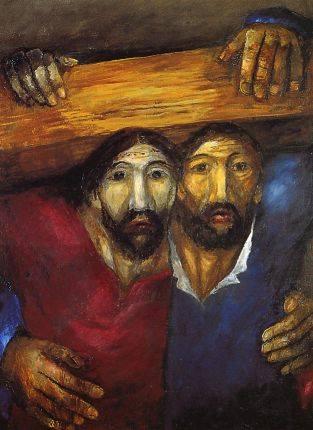
One way to approach Holy Week to live it like no other of the year is to unite yourself with one of the holy people who accompany Jesus in his Passion. So perhaps you might identify with one of the disciples sent to prepare the Upper Room, looking at everything in your life in the light of the Eucharist . . . or the woman who anoints Jesus in Bethany, begging for the grace of special compassion . . . or Simon Peter, weeping with true repentance over your sins . . . or Simon of Cyrene, eager to take up Christ’s cross no matter how it may appear . . . or the Good Thief, bursting with hope that Jesus wants us to be with him in paradise . . . or John, daring to remain with Jesus on Calvary and accepting the gift of Mary to be our Mother . . . or the centurion, letting our profession of faith transform our life for ever: This man is the Son of God!
And for those of you who are walking your own way of the Cross, my advice is that you approach Holy Week pondering how Jesus is accompanying you in your passion, helping you to carry your cross, washing your feet and kissing them . . .
One of my favorite meditations this time of year. So utterly profound.
Jesus is sweet in the bowing of His head and in death, sweet in the stretching out of His arms, sweet in the nailing together of His feet with one nail.
Sweet in the bowing of His head; for bending down His head form the cross He seems to say to His loved one: ‘Oh My beloved, how often hast thou desired to enjoy the kiss of My mouth, declaring to Me through thy comrades, “Let Him kiss me with the kiss of His mouth.” I am ready, I bow My head, I offer My mouth to be kissed as much as thou wilt. And say not in your heart, “I seek not such a kiss which is without beauty and loveliness, but I seek a glorious kiss which the angelic citizens of heaven seek ever to enjoy.” Be not thus mistaken, for unless you kiss that first mouth you will never reach to that other. Kiss therefore the mouth that I now offer to you, for though it be without beauty or loveliness it is not without grace.’
Sweet in the stretching out of His arms; for in extending His arms He reveals how He desires our embraces, and seems to say: ‘O all you that labor and are heavy burdened, come and be refreshed within My arms. See how I am ready to gather you all within My arms; then come all. Let no one fear to be repulsed, for I desire not the death of the sinner but that he be converted and live. My delights are to be with the children of men.’
Sweet in the opening of His side; for that opening reveals to us the riches of His goodness and the charity of His Heart towards us.
Sweet in the nailing of His feet with one nail; for by that He says to us: ‘Lo, if you think that I must flee from you, and so are slow to come to Me, knowing that I am swift as the hart, see that My feet are fixed by a nail, so that I can in no wise flee from you, for mercy has me bound fast. I cannot flee from you as your sins deserve, for My hands are fixed with nails.’
Good Jesus, humble Lord, dear Lord, sweet in mouth, sweet in ear, unknowable and untellably pleasant, kind and merciful, mighty, wise, benign, generous but not rash, exceedingly sweet and gentle! Thou alone art the highest good, beautiful above the sons of men, fair and comely, the chosen of thousands and all-desirable! Fair things become the fair. O my Lord, now my whole desires Thine arms and Thy kiss. I desire nought but Thee, as though no reward were promised. If hell and heaven were not, yet would I long for Thee, for Thy sweet good and for Thyself. Thou art my constant meditation, my word, my work. Amen.”
A wonderful poem about the joy of the angels when any of us repents of our sin:
Choreography for Angels
I say to you, that there is joy among the angels in heaven upon one sinner doing penance . . . (Luke 15.10)
Who spun these Angels into dance
When wars are needing artillery
Of spirits’ cannonading. Armistice
Wants first the over-powering wings, and they
Are occupied with pirouettes! Who did this?
Gone penitent, I caused it. I confess it.
Who tilted flames of Seraphim
In arabesques of pure delightedness?
Is not the cosmic crisis begging fire
For full destruction of hate’s hazarding?
Why Seraphs swirling flames on floors of heaven?
I lit the heavens, when I bent my head.
Who lined mystic corps-de-ballet
Of Cherubim? Who set in pas-de-deux
This Power with this Principality?
Why these Archangels not on mission sent
Today, but waltzing on stars, and singing?
Christians . . . should strive in all things and ought not to pass judgment of any kind on anyone, neither on the prostitute nor on sinners nor on disorderly persons. But they should look upon all persons with a single mind and a pure eye, so that it may be for such a person almost a natural and fixed attitude never to despise or judge or abhor anyone or to divide people according to categories. If you see a man with one eye, do not make any judgment in your heart, but regard him as though he were whole. If someone has a maimed hand, see him not as maimed. See the crippled as straight, the paralytic as healthy. For this is purity of heart, that, when you see the sinners and the weak, you have compassion and show mercy toward them. (Pseudo Macarius)
And I would add: “If you see yourself with one eye, do not make any judgment in your heart . . . and so on.”

 His arms, sweet in the nailing together of His feet with one nail.
 Witnesses to Hope