Cardinal Dolan on littleness, click here.
Mary words
Friday: from the archives
Blaspheming
Be prepared for a “punch to the solar plexus” as you read the quote below. At least, that’s what I experienced when I read it. A good punch, though.
You would be very ashamed if you knew what the experiences you call setbacks, upheavals, pointless disturbances, and tedious annoyances really are. You would realize that your complaints about them are nothing more nor less than blasphemies–thought that never occurs to you. Nothing happens to you except by the will of God, and yet [God’s] beloved children curse it because they do not know it for what it is. ~Jeanne-Pierre de Caussade
This quote implies the need to grow in the ability to see through what is going on to the hand of God at work, which of course is something only the Holy Spirit can do in us. Let’s beg Him again to help us to see with His eyes rather than our own, which are blinded so much of the time.
First step towards holiness
“The recognition of God’s overwhelming love for you, completely unmerited, totally undeserved, is a great first step towards holiness.” (Cardinal Timothy Dolan)
When Life Hurts
From Ann Voskamp: Three Things to Hold Onto When Life Hurts
“You shall have grace sufficient . . . “
Last week, in his Wednesday audience, Pope Benedict spoke of St. Paul and his ability to find the strength of God in his weakness. Commenting on Paul’s petition to be delivered from the thorn in his flesh, Pope Benedict said:
Let us reflect a moment more on this event, which occurred during the years when St. Paul lived in silence and contemplation before commencing his journeys across the West to proclaim Christ, for this attitude of profound humility and trust before God’s self-revelation is also fundamental for our prayer and for our lives, for the way we relate to God and to our own weakness.
First, what is the weakness of which St. Paul speaks? What is this “thorn” in his flesh? We don’t know, and he doesn’t say, but his attitude makes us understand that all the difficulties we meet in following Christ and witnessing to his Gospel can be overcome by opening ourselves in faith to the Lord’s action. St. Paul is well aware of being a “useless servant” (2 Corinthians 4:7) in whom God places the riches and power of his grace. In this moment of intense contemplative prayer, St. Paul understands clearly how to face and live every event, especially suffering, difficulty and persecution: when he experiences his own weakness, the power of God is manifested, which neither abandons us nor leaves us alone but which becomes our support and strength.
Certainly, Paul would have preferred to be delivered from this “thorn”, from this suffering; but God says: “No, this is necessary for you. You shall have grace sufficient to resist and to do what must be done”. This is true also for us. The Lord may not deliver us from evil, but he helps us to mature through suffering, difficulty and persecution. Faith, then, tells us that if we remain in God, “though our outer nature is wasting away, our inner nature is being renewed every day” (cf. Verse 16). The Apostle communicates to the Christians of Corinth and also to us that “this slight momentary affliction is preparing for us an eternal weight of glory beyond all comparison” (Verse 17). In reality, humanly speaking, the weight of difficulty was not light, it was exceedingly heavy; but compared with God’s love, with the grandeur of being loved by God, it seemed light in knowing that the weight of glory will be without measure.
Therefore, as our union with the Lord grows and our prayer intensifies, we too come to focus on the essential, and we understand that it is not through the power of our resources, our virtue, or our abilities that the Kingdom of God shall come; rather, it is God who works marvels precisely through our weakness, through our inadequacy for the task at hand. We must therefore have the humility not to trust in ourselves alone but to work — with the Lord’s help — in the Lord’s vineyard, entrusting ourselves to Him as fragile “earthen vessels”.
These are words for us all and should give us each hope. You can read his entire address here.
Same as yesterday
Today I am still recommending Fr. Eric’s homily from yesterday’s post. (I’ve edited the long section at the beginning where he was fixing his mike. 😉 You’ll be glad that you listened to it. (It’s only 5 minutes long.)
Where do you most need to know love?
A short and powerful homily by Fr. Eric Weber that answers that question and what to do about it: click here.
Mary words
“When your heart is anxious, turn to Mary and say, ‘Mary, put my heart at peace.’ When your mind is too busy, look to Mary and pray, ‘Mary, settle down my mind.’ When you want to grow and deepen you life, look to Mary and beg, ‘Mary, just as you helped Jesus grow in wisdom and grace, help me also to advance on the spiritual path which God has laid out for me.'” (Fr. Alfred McBride)
Friday: from the archives
“Since He Love Us All”
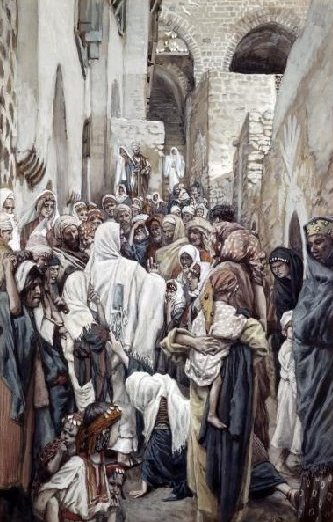
I must re-post my favorite picture for this Feast of the Sacred Heart. This is by James Tissot. (And don’t miss the quote at the end. It’s just for you.)
We are all in the Heart of Jesus Christ, since He loves us all, for the way of love is for the lover to lodge the beloved in his heart. (Fr. Timothée de Raynier)