First, we must cry out

Here’s a comforting take on the story of the road to Emmaus by Fr. David May from Madonna House:

The Gospel is the story of the two disciples on the road to Emmaus.  They are discussing the events of the Lord’s passion and death when suddenly Jesus comes up and joins them on the way.  They take him for a stranger and are astonished that he seems unaware of what has happened.

Have you ever had that experience?  When it seems that Jesus Christ is the only one who doesn’t know what is happening down here!

“What things?” he asks. “What things?!

In his wisdom, the Lord wants to draw out of his disciples all the pain and sorrow they are carrying.  It seems that the Lord has more respect and understanding of our human nature than we do ourselves.

He knows our grief; he understands all our suffering.  But he also knows that first we must speak our pain to him.  First, we must cry out.

For how will we be able to hear what he has to offer until we do so?  And he has far more to offer us than mere sympathy for our plight.

Fr. David goes on to speak of what Jesus offers to these disciples in pain, and what He offers as well to us:

He offers them more than sympathy because as the Risen Lord, he can offer them a hope they had not dared to imagine.  He offers them a victory that comes only through suffering and death: Resurrection from the dead.

He will surely come:

In an instant, in the twinkling of an eye, the Lord can reveal himself, and after that, everything is transformed.  In a second, at the breaking of the bread, he is recognizable to his disciples in Emmaus.  And then he vanishes from sight!

This, too, is part of his mystery, of his unfathomable ways.
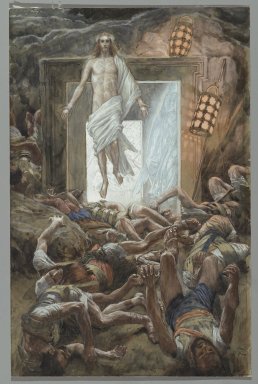
A personal feast day

We all have personal feast days, days that we celebrate for different reasons, usually because of a saint we’re named after or one to whom we have great devotion. Over the last few years I have come to look at Holy Saturday as a personal feast day.  Ever since my brother, Tim, died, it has taken on great meaning: this day during which it looks like nothing is happening, when, in fact, great and “terrible” things are happening.  Jesus is setting the captives free. Christ has descended into our loneliness,  into our grief, into those spaces in our lives–and of those we love–where darkness seems to reign. And that is Good News.  We are no longer alone.  He is, indeed, God-with-us.  That is the wonder and consolation of this day.  That was so true for me as I walked through those dark days after Tim took his life.  Christ gave me such an assurance of His being with my brother during those dark, dark moments in his life. . . and an assurance of the same for myself.  “Though I walk through the shadow of death, I fear no evil, for you are with me.” (Ps 23.4)

Christ is there with us, whether we perceive Him or not.

Holy Saturday is the day of the ‘death of God,’ the day which expresses the unparalleled experience of our age, anticipating the fact that God is simply absent, that the grave hides him, that he no longer awakes, no longer speaks, so that one no longer needs to gainsay him but can simply overlook him . . . Christ strode through the gate of our final lonelienss; in his passion he went down into the abyss of our abandonment.  Where no voice can reach us any longer, there is he.  Hell is thereby overcome, or, to be more accurate, death, which was previously hell, is hell no longer.  Neither is the same any longer because there is life in the midst of death, because love dwells in it.

Christ descended into “Hell” and is therefore close to those cast into it, transforming their darkness into light.  Suffering and torment is still terrible and well-nigh unbearable.  Yet the star of hope has risen–the anchor of the heart reaches the very throne of God.  Instead of evil being unleashed within man, the light shines victorious: suffering–without ceasing to be suffering–becomes, despite everything, a hymn of praise.  (Benedict XVI, Spes Salvi)

For further reading on the significance of this day, see these posts: “Where is Christ today?” and “Why Saturday is Mary’s Day”

Trauma Unit

Trauma Unit

It was never meant
to burst from the body
so fiercely, to pour unchanneled
from the five wounds
and the unbandaged brow,
drowning the dark wood,
staining the stones
and the gravel below,
clotting in the air
dark with God’s absence.

It was created for
a closed system–the unbroken
rhythms of human blood
binding the body of God,
circulating hot, brilliant,
saline, without interruption
between heart, lungs,
and all cells.

But because he was once
emptied, I am each day refilled;
my spirit-arteries
pulse with the vital red
of love; poured out,
it is his life
that now pumps through
my own heart’s core.  He bled and died
and I have been transfused.

~Luci Shaw

“The King of glory took as his spouse our souls . . .”

from Venerable Louis of Granada:

Indeed the greatest proof of Christ’s love for his disciples at the Last Supper was the institution of the Blessed Sacrament . . .  O great mystery which is deserving of being impressed on the very core of our hearts!  If a prince were to love a slave and take her as his bride and make her queen of all that he possessed, we would acknowledge that such a love is indeed great.  And if, after marriage, the slave’s love were to grow cold, and the prince were to go in search of something to re-awaken her love, this would be proof that his love is exceedingly great.  So also, the King of glory took as his spouse our souls, which were slaves of the devil, and seeing how cold they were in love, he gave them this mysterious food which has the power to transform souls into himself which has the power to transform souls into himself and make them burn with the living flames of love.  Nothing so manifests love as the desire to be loved, and he so desired our love that he invented this wonderful means of arousing it.

The Bridegroom had to absent himself from his spouse and since love will not tolerate a separation nor the absence of the beloved, he wished to depart from his spouse in such a way that he would not be separated from her completely; to leave her and yet somehow remain with her.  He could no longer remain with her.  He could no longer remain with her and she could not as yet accompany him, but although he was to go and she would remain, they would never henceforth be separated, thanks to this great Sacrament.

A footnote

I was grabbed by a footnote in a book I’m reading.  The author was commenting on the blessing it is for us that the book of Job has survived through the years.  It is a blessing that “God has willed that this great cry of scandal before the ways of Providence should survive until our days.”  He footnotes this statement with:

God has also willed that the only words gathered by the two oldest evangelists from the lips of the dying Jesus were, “My God, my God, why have you forsaken me?” (Mt 27.46; Mk 15.34, so that believers in a state of confusion should never feel that they were intruding, but always find a place to lay down their head in the paradise of Scripture.  (Fr. Dominique Barthélemy)

Keeping Him company

Following up on yesterday’s post, here is another quote from St. Paul of the Cross along the same lines:

I will try with all my strength to follow the footsteps of Jesus.  If I am afflicted, abandoned, desolate, I will keep him company in the Garden.  If I am despised and injured, I will keep him company in the Praetorium.  If I am depressed and afflicted in the agonies of suffering, I will keep him company faithfully on the Mount, and in a generous spirit I will keep him company on the Cross with a lance in my heart.

Fill in the blanks for yourself: “If I’m _________, I will keep him company in the __________________” He is looking for you to be with Him during these days . . .

What is your suffering?

What is your suffering?  Whatever it is, whatever its cause (including your own personal weaknesses), it can be joined to the sufferings of Christ this week.  St. Paul of the Cross was a big advocate of this.  Don’t let your personal sufferings separate you from Christ this week.  Dealing with your tendencies to irritability or depression or anger is a real suffering.  Let it draw you to Christ this week.

Paul connects all sufferings with the Passion, not only pain and distress but everything we do not naturally like.  To make this connection, Paul looked at the different sufferings that Jesus not only endured, but accepted during his Passion: inner anguish, terrible fear and depression, abandonment by his friends, betrayal, deprivation of his freedom, injustice, lies told about him, excommunication, rejection by authority, especially by religious authority, bodily pain, utter fatigue, misunderstanding, helplessness, a sense of failure, the feeling of being abandoned by his Father, and finally death itself.   (Spiritual Direction According to St. Paul of the Cross)