The Difficult Love (3)

(Continuing on from the last couple of days . . . )

And, as we know, the Lord calls us to not just put up with the people around us, those who are difficult to love, but to love them as He loves them.  “To love one whom others despise is to demonstrate God’s love for that person, for one who is more precious than the whole world.  It is perhaps to save that person from self-hatred.” (Clément, p. 283)

The spiritual person hides the faults of others, as God protects the world, as Christ washes our sins in his blood, as the Mother of God stretches the veil of her tears over the human race. “It was said of Abba Macarius the Great that he became, according to the writings, a god on earth, because in the way God protects the world, so Abba Macarius would hide the faults he saw as though he had not seen them, and the faults he heard about as though he had not heard of them.” (ibid., p. 284)

Isaac of Nineveh said: “Spread your cloak over anyone who falls into sin and shield him.  And if you cannot take his fault on yourself and accept punishment in his place, do not destroy his character.”

More on all this tomorrow, but think on this today: this is how Christ loves you.
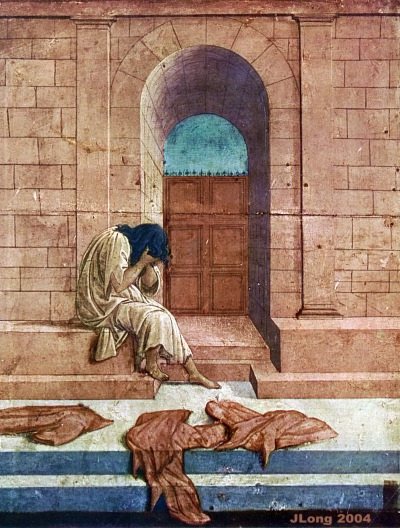
The Difficult Love (2)

What really stopped me in my tracks while reading this chapter (see yesterday’s post) was this that he wrote:

For the person who has begun to tread the spiritual path, nothing is more important than the Gospel command: ‘Do not judge.’ Greed and vanity are passions that belong to those who are novices on the way or who have only just begun to advance along it.  But for the more advanced, the breakdown always comes from judgment pronounced on others. . . . according to spiritual teachers, the whole of virtue is comprised in the refusal to despise. (p. 281)

I guess, in reading this, I felt it was kind of a back-handed compliment.  I struggle with judgmental thinking so much.  Somehow that means I’m further along on the spiritual path?

Then he goes on to quote from John Climacus and a desert father:

John Climacus: : “The failures of beginners result almost always from greed. In those who are making progress the failures come also from too high an opinion of themselves.  In those nearing perfection they come solely from judging their neighbor.”

Abba Theodore of Pherme said, “There is no other virtue than that of not despising anyone.”

And back to Clement: “To justify ourselves by condemning others is our permanent tendency, in private as in public life.”

So is there hope for us who struggle with this?  Of course, but more on all of this tomorrow.

The Difficult Love (1)

So this morning I have been thinking about a chapter in the book, The Roots of Christian Mysticism (Fr. Olivier Clement), entitled “The Difficult Love” which I read a few years ago.  I ended up re-reading it a few times, and I would like to blog about it for a couple of days (at least).   The first sentence in the chapter gave me pause: “Spiritual progress has no other test in the end, nor any better expression, than our ability to love.”  And so went the rest of the chapter.  Interestingly enough, the chapter is situated in a section entitled: “Approaches to Contemplation.”  It is also the last chapter in the book, which says something in itself.  Clement laces the chapter with quotes from many and various ancient writers.  Here is a sampling:

Pseudo Macarius: “Those who have been judged worthy to become children of God and to be born from on high of the Holy Spirit. . .not infrequently weep and distress themselves for the whole human race; they pray for the ‘whole Adam’ with tears, inflamed as they are with spiritual love for all humanity.  At times also their spirit is kindled with such joy and such love that, if it were possible, they would take every human being into their heart without distinguishing between good and bad.  Sometimes too in humility of spirit they so humble themselves before every human being that they consider themselves to be the last and least important of all.  After which the Spirit makes them live afresh in ineffable joy.”

St. Isaac of Syria: “This shall be for you a luminous sign of the serenity of your soul: when, on examining yourself, you find yourself full of compassion for all humanity, and your heart is afflicted with pity for them, burning as though with fire, without making distinction between one person and another.”

Okay.  So far so good, but more on this tomorrow.  (If you don’t want to wait, I did give a talk on this in 2005 which is available here with a handout.)

Little words (7)

In October I did a series of posts on “little words” in Scripture that are really “big” words.  I wanted to share another with you today.  

Psalm 73.26: But God

These words have been like strong hands lifting up, bearing up, countless thousands of souls. “My flesh and my heart faileth: but God is the strength of my heart and my portion for ever.”  Many who will read this note are well and strong and joyful in their work, thank God for that.  Sooner or later, however, to most who follow the Crucified, there comes a time when flesh and heart fail, and if it were not for that “But God”, we should go under. . . .   (Amy Carmichael, Edges of His Ways, p. 12)

It’s evident to me what it means to have your flesh fail, but I have been pondering what it may mean to have your heart fail: sorrow, doubts, hopelessness, discouragement, etc.  It comforts me to hear those words: but God even in the midst of those failings.  He will be for us all times–another very important little word.  🙂

(For the other “little words” posts, go to the first one here and move on from there.)

The Second Giving

God is always giving.  This insightful poem by Jessica Powers underlines the fact that God gives most to those who are needy and empty, yet bold in their cry for more.

     The Second Giving

The second giving of God is the great giving
out of the portions of the seraphim,
abundances with which the soul is laden
once it has given up all things for Him.

The second growth of God is the rich growing,
with fruits no constant gathering can remove,
the flourishing of those who by God’s mercy
have cut themselves down to the roots of love.

God seeks a heart with bold and boundless hungers
that sees itself and earth as paltry stuff;
God loves a soul that cast down all He gave it
and stands and cries that it was not enough.

Hymns of light and chants of darkness

I have been pondering this selection ever since I read it in Abandonment to Divine Providence last night. 

Souls who walk in light sing the hymns of light; those who walk in the shadows chant the hymns of darkness.  Each must be allowed to sing through to the end the words and melody which God has given him.  Nothing must be changed in what he has composed.  Every drop of distress, bitter as gall though it may be, must be allowed to flow, no matter what its effect on us.  It was the same for Jeremiah and Ezekiel.  They found consolation only in continuing their laments.  Had their tears been halted, we should have lost the loveliest passages in Scripture.

I have felt for many years that God has had me walking in the shadows rather than walking in the light.  This is a very thought-provoking passage for me.  He is not talking about a hopeless type of lament, but true lament, sung in God and to God.  Michael Card, in his book Sacred Sorrow, talks about this very thing, the importance of lament.  (I have more to say about this, but not the time today.  More later.  But I’m interested in your thoughts.)

“A word for the year”

Yesterday I came across this blog post about having a “word for the year”.  I have a very good friend who always takes time at the end of the year to do just this thing: seek the Lord about a word or phrase that He might have for her to focus on for the coming new year.  I find myself doing the same just because of my friendship with her.  (She’s another of the “lighted coals” in my life.)  Sometimes the phrase carries over for a longer time.  “Blessed is he who takes no offense at Me” is one that continues to form my life after coming across it four years ago.  If you asked me about this year, I would probably say it has something to do with keeping my lamp filled with oil and lit at close to midnight–it’s dark and I wonder if He’s ever going to come . . . 

Do you have a word for your year?  I’m sure we would all love to hear you share about it.

John must have wondered . . .

I have a number of “lighted coals” in my life.  One of them is Amy Carmichael whom I have quoted quite often in this blog.  She never fails to “rekindle” me.   And one of my favorite things is to introduce my good friends to one another.  Here is another gem from her:

I have been reading Luke 1.  “With God nothing shall be impossible” [Luke 1.37].   Then I read Acts 12.  James was killed in prison; Peter was set free.  God, with whom nothing is impossible, did not answer the prayers of those who loved James in the same way as He answered prayers of those who loved Peter.  He could have done so, but He did not.  “And blessed is he who takes no offense at Me” [Luke 7.43].  The words seem to me to be written across Acts 12.  John must have wondered why the angel was not sent to James, or at least have been tempted to wonder.  Again and again in Acts the Lord Jesus seems to say those words under His breath, as it were.  Let us turn all our puzzles, all our temptations to wonder why, into opportunities to receive the blessing of the unoffended.
     And now all the grief of those days has been utterly forgotten by those who loved James; they have all been together with him in the Presence of the Lord for 1900 years, and the one thing that matters now is how they lived through those days when their faith was tried to the uttermost.
     So it will be with any who are longing to see the answer to their prayers for those who are in affliction, or any other adversity.  In a few years–how few we do not know, but few at most–we shall all be together in joy.  So with us, too, all that matters is how we live through these days while we are trusted to trust.   (Thou Givest . . . They Gather, p. 76)

The same day that my good friend, Deb, was in her bad car accident, I heard of another person who spun out on the expressway, hit a truck, ended up facing the right direction, and was able to drive off without injury.  I, too, have wondered, but I also know only too well: “Blessed is he who takes no offense at Me.”

A lighted coal

“A friend comes to the rescue in time of need, and if he is aware of the truth of friendship, he directs his friend just as if her were himself and puts his own members at his disposal if he has lost his . . . A friend is a lighted coal, and if placed beside it, it can rekindle a dead one.” (Bl Simon Fidati of Casica)

“God loves to light little lights”

When I found out that St. Peter’s keeps their Christmas tree and crèche up in the square until February 2, I decided we would keep our crèche in the chapel and all our Christmas lights up until then as well.   I always felt gypped that there were not 40 days to celebrate after Christmas as there are after Easter.  Then I discovered that February 2, the Presentation of the Lord (Candlemas), is indeed 40 days after Christmas.  So, to me, it makes total sense to keep those Christmas lights lit.  If you drive past our house right now, you will still see our candle lights in the windows. I personally love clusters of little white lights. When we begin the Salve Regina at the end of night prayer, the guitarist dims all the lights in our chapel.  During this season, that leaves only the Christmas lights and the sole candle lit before the icon of the Mother of God. Yet the chapel still seems bright.

In the beginning of his Christmas message, Pope Benedict spoke of how God “loves to light little lights.”  I found that particularly encouraging as I thought of all of us who are desiring to be God’s witnesses to hope.  May it encourage you as well, and may you call it to mind whenever you see Christmas lights and candles:


The liturgy of the Mass at Dawn reminded us that the night is now past, the day has begun; the light radiating from the cave of Bethlehem shines upon us. . . .
At first, beside the manger in Bethlehem, that “us” was almost imperceptible to human eyes.  As the Gospel of St. Luke recounts, it included, in addition to Mary and Joseph, a few lowly shepherds who came to the cave after hearing the message of the Angels. The light of that first Christmas was like a fire kindled in the night.  All about there was darkness, while in the cave there shone the true light “that enlightens every man” (Jn 1.9).  And yet all this took place in simplicity and hiddenness, in the way that God works in all of salvation history.  God loves to light little lights, so as then to illuminate vast spaces.

May we allow God to light each of us, little lights in this darkened world.