“And the Philistines yet again made a raid in the valley.” (1 Chron. 14:13) How many of you feel that you are in a sort of valley at the moment–at least in some area of your life: kids, finances, some relationship, prayer, whatever? And then the Philistines make a raid on you as well? Two thoughts about the real reality (I know that’s redundant) of the situation:
Two verses later in 1 Chronicles: “God has gone out before you.” God has gone out before you. He is before you, not just with you. He knows the way in which you walk.
And secondly, so well known to us: “Even though I walk through the valley of the shadow of death, I fear no evil, for you are with me.” Even in the valley of the shadow of death–where many of us have walked–I fear no evil, for He is with us.
Today on my way home from dropping one of our sisters at the Ypsi Emmanuel House, I tuned in to Fr. John Riccardo on WDEO. He mentioned that the most used phrase in the Bible, both Old and New Testaments, is “Be not afraid!” He also pointed out that it was said when the recipients were in pretty scary situations. Yet, that is the most common thing the Lord says to us. And, need I say, the most common thing our beloved John Paul II said to us. So, let’s pursue this a bit–why should we not be afraid in a situation that is obviously fear-provoking?
Here’s a little bit of an exercise for you:
Look up one or two of these passages: Luke 1:8-13; Luke 1:26-30; Luke 2:8-11; Isaiah 43:1-5; Matthew 14: 22-27; Matthew 17:1-7; Revelation 1:12-18
Think about the situations which cause you fear.
Based on what God reveals in the passage(s) you read, ponder and write down why you should not be afraid. Let me point out that it’s natural for us to be afraid in many situations, but why does God tell us to notbe afraid?
Feel free to let me (us) know what you find out. (Leave a comment.)
If you’ve got a concordance, look up more passages.
On the occasion of my 25th anniversary of my Final Profession, I had the opportunity of choosing the music for the Mass of celebration. For the closing hymn, I chose the following song. It’s an anonymous poem put to music by one of our sisters. The language is a little quaint, but the message is so true for each of us–and yet we forget it all too often. All of our life is but a response to Someone who has always loved us first.
I sought the Lord, and afterward I knew
he moved my soul to seek Him, seeking me.
It was not I that found, O Savior true.
No, I was found, found by Thee.
Thou didst reach forth Thy hand and mine enfold.
I walked and sank not on the stormy sea.
‘Twas not so much that I on Thee took hold,
as Thou, dear Lord, on me.
I find, I walk, I love, but O the whole
of love is but my answer, Lord, to Thee!
For Thou were long beforehand with my soul.
Always Thou lovedst me.
This is a follow-up on “God is the One at the end of the line” (posted 7/5/09). This quote from Amy Carmichael caused a paradigm shift in my thinking when I first read it, and I continue to come back to it periodically. She’s commenting on how St. Paul called himself a “prisoner for the Lord” numerous times. “Do not be ashamed of testifying to our Lord, nor of me his prisoner” (2 Tim 1:8) :
It takes all the sting out of a disappointment if we see it as Paul did. Isn’t it interesting that never once does he call himself Nero’s prisoner, though he was chained by Nero’s chain and in Nero’s cell? This has been a great comfort to me. We don’t admit the domination of Nero–no, not for an hour. We have to do only with the sovereignship of Christ.
And that brought to mind this same orientation from St. Paul of the Cross, this time in reference to Jesus. “[Jesus] said to Peter, as Peter was wielding his sword against the soldiers who had come to take Jesus, ‘Put your sword into its scabbard. Am I not to drink the cup the Father has given me?’ (Jn 18:11)”
It is significant that Jesus did not say, “Am I not to drink the cup that these soldiers are giving me?” or “the cup that Annas or Pilate is giving me?” Jesus saw everything as coming from the hand of his Father and did not take the cup from those whom St. Paul of the Cross calls “intermediaries”. Jesus took it directly from the hand of his Father.
Can we say the same about the difficulties in our own lives?
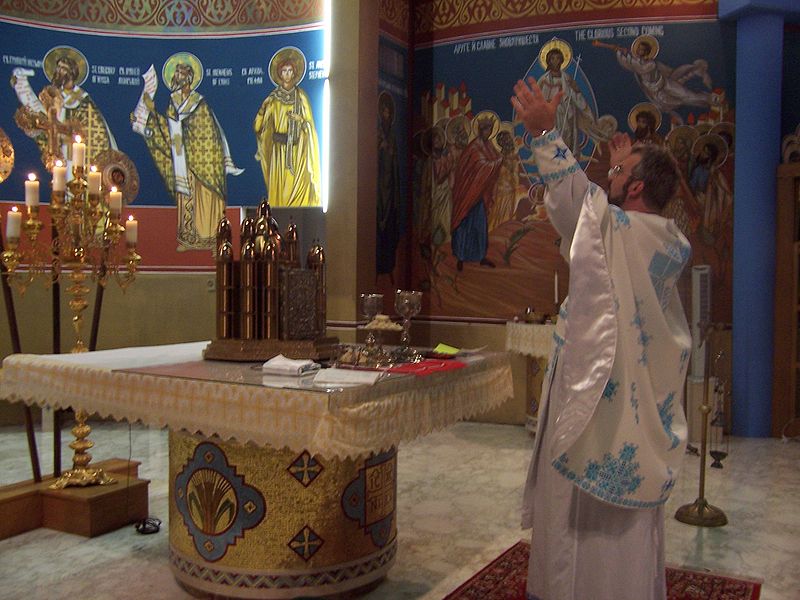
Yesterday I took our two postulants to the Divine Liturgy at Sacred Heart Byzantine Catholic Church in Livonia. We’re in the middle of a series of talks on ecumenism, which includes a bit about the Eastern Catholic Churches in communion with Rome. This was their field trip. 🙂
Ukrainian Catholic Liturgy
I’ve been to this church numerous times and love the beauty, the icons, the incense, the prayers of the Eastern Liturgies. I have to pinch myself when I’m there to remind myself that this is our Church. I always remember how John Paul II stressed the need for both lungs in the Church–referring to the Eastern and Western (That’s us–the Latin Church) Churches. It calls to mind this story:
In the 10th century, the Prince of Kiev [present day Ukraine] sent ambassadors out throughout the world in search of the best religion: to the Muslims, to the Jews, the Latins, and the Greeks. When the ambassadors that had gone to Constantinople returned and shared about their experience, the story goes that Prince Vladimir decided without any hesitation for Christianity. The ambassadors said, “We knew not whether we were in heaven or on earth, for assuredly on earth such beauty cannot be found anywhere else. So we do not know what we ought to tell you; but one thing we know well: there God dwells among men who celebrate His glory in such a manner that no other religion on this earth could equal. It is impossible for us to forget such splendorous beauty.”
There may be many of you who aren’t even aware that the Catholic Church is made up of more than just one church. There are, I believe, 22 Eastern Churches that are in communion with Rome: the Melkite, the Maronite, etc. Each has its own liturgy, but we can all participate in each other’s. This is indeed part of the wonder of the Catholic Church.
If you ever, ever have a chance to take your family to an Eastern Catholic liturgy, do so! The one in Livonia is in English–which is, of course, a great help. And the pastor there used to be a Latin Catholic so he’s sensitive to us not knowing what we’re doing at their liturgy.
I give spiritual direction to quite a few women, and we frequently wrestle with what to do with hard situations and how they fit into God’s will. Perhaps one of the hardest is children who have strayed from the faith. I am currently reading Peter Kreeft’s Jesus-Shock and came across this section in one of his “7 beginnings”, in the seventh to be exact. I think it proposes a very true and helpful perspective:
Christ is not, ultimately, our solution. (Is your lover your “solution”?) He is our divine Lover and Lord. All the “problems” of our life are part of His marriage to us, His lovemaking, His foreplay. As Francis Thompson wrote in his classic poem “The Hound of Heaven,” “Is my gloom, after all, shade of His hand outstretched caressingly?”
All things in life must be that, becasue He is not relative to them, they are relative to Him. Everything is, for He is God, and God is the absolute.
He is not the solution to our problems; He is the giver of our problems. Our problems are His tasks and our opportunities, His teaching and our education, His will and our sanctification. Whether they are as small as a dropped earring or as large as a death or (worse) a divorce, everything is somewhere on that love-line that runs from Him to us. He is our Universal Other, the One we are always in dialog with, the One pulling at the other end of the line. Whether we see it or not, whether we believe it or not, we always struggle with Him, not with our problems, our lives, our deaths, our friends, or our families. They are on the line with us; He is the One at the end of the line. Do you have a child who is dead, or who has done something awful, or who is in terrible trouble? (No problem, no “locked door,” can be bigger than that for a parent.) Christ is not a mere means to the end of solving your problem and relieving your sorrow. Your problem, however big it is (or however small), is His wise and loving will to you, even though it may not look wise or loving. It is His deliberate permissive will. And your response to it is your response to Him.
I encourage you to read through that again and to linger on “He is our divine Lover” . . .
Well, as I think about it, I realize that the Lord leads me by fire also–not the kind of brilliant, clear fire ahead of me–or by Fourth of July fireworks either–but by a purifying internal fire, a fire that purges and causes great longing for Him and Him alone. It’s not a fire that makes one “feel good” necessarily, but, nonetheless, it is a fire that leads, and leads us to places that we cannot go on our own. It is the very fire of His Holy Spirit making us ready to see Him as He is.
And that reminds me of something a good friend of mine, Cecilia, told me years ago when I was going through the fire: “Gold is gold before it goes through the fire.” A good thing for us all to remember–we are already gold. Amy Carmichael illustrates this point somewhere in her writings where she tells the story of a goldsmith who keeps pulling his work out of the fire and checking it. When asked what he was doing, he replied that he was waiting for it to be pure enough to see his face in it. So also does Christ want to see His face reflected in us, and that is the beautiful purpose of the fire in our lives.
“The Lord went before them . . . in cloud and fire.” (Exodus 13.21)
I don’t know about you but most of my prayer times seem to be in the cloud rather than the fire. It’s comforting to know that God leads by a cloud as well as by a pillar of fire. And it’s also strengthening to remember that God spoke to Moses out of the cloud.
From Amy Carmichael:
When Moses went up, a cloud enfolded him. In that cool darkness he heard words which afterwards he spoke to the people in the heat and glaring light of the plain. So, day by day, as we look forward into the hours which seem to rush upon us, we see not clearness but a cloud. Then a Voice that we know calls softly, Come up to Me, and be here; the Cloud of the Unknown becomes for us then the very over-shadowing of the wings of the Lord; we sit down under His shadow with great delight, and His fruit is sweet to our taste [Song of Songs 2.3]. And this fruit, tasted first in the dark alone with Him, will be ours for others. “What I tell you in darkness,” He says to us still, “speak that in the light.” [Matt. 10.27]
Amy Carmichael has a slim book called Figures of the True. It is a collection of meditations on some photos that someone sent her in her illness. Each picture, she says, is a “Figures of the True”: “For surely they are not only lovely pictures of fragments of a lovely creation, they are patterns of things we all know if we have ever really lived: they are Figures of the True.” Everything in God’s creation points to Him if only we have the eyes to see.
Fairy Door
Today I am going over to our “baby house” to help our little girls, Anna and Renee, make some fairy doors. Ann Arbor has a set of these around town, delightful little doors through which one can peek and see the little world of fairies. I’ve always loved looking through them. The girls recently took a tour of them and want to make their own. I started thinking about how they, too, are a Figure of the True. Most of these doors around town require one to stoop down to look through them. It’s only then that you can see into the little room created behind the door. In the spiritual life, humility is often referred to as the low door through which one must enter the kingdom of heaven. And the world one enters through that door is far more delightful and beautiful than that behind any fairy door . . . Let’s not hesitate to stoop and enter by the door of humility as it presents itself daily in our lives.
Another thing that can cause me discouragement sometimes is dealing with besetting sin–you know that thing you keep taking back to confession over and over. One of mine is critical thinking. A few years ago I read Sr. Ruth Burrow’s autobiography, and in it she spoke about this being one of her ongoing faults as well. However, she found what I think is a very clever way to deal with it:
Perceptive, quick to see the flaws in another, I was prone to criticism, finding a certain satisfaction in seeing another at fault as though this, in some way, raised me up. I knew that no fault would so displease our Lord or stop his grace as this harsh judgment on his children. I realized I had the mentality of a pharisee but, I thought to myself, if a pharisee had turned to our Lord and admitted his hardness of heart, his crabbed, mean spirit and asked for help, our Lord would have helped him. So I did the same. The pharisee became the publican. I came to realize that temptations to pride, the sin of the pharisee, could make one a publican. The stone which the builders rejected could become head of the corner. I tried to use these bad tendencies to grow in humility.