A lovely little poem by Anne Porter.
A Short Prayer
Mary, in you
We see the flowering
Of our human beauty
And hear
The songs of God.
And in your heart the lost
Rejected and abandoned ones
Are held in honor
Stay with us now
And always.
A lovely little poem by Anne Porter.
A Short Prayer
Mary, in you
We see the flowering
Of our human beauty
And hear
The songs of God.
And in your heart the lost
Rejected and abandoned ones
Are held in honor
Stay with us now
And always.
Last night we lit the last of the Twelve Days candles. Most folks I know are done with Christmas, but not in our house. We will soon take down most of the decorations, but we leave our lights up until February 2–40 days after Christmas. Every year I reblog the post below to remind you why I think it’s such a good idea. Join us!

When I found out that St. Peter’s keeps their Christmas tree and crèche up in the square until February 2, I decided we would keep our crèche in the chapel and all our Christmas lights up until then as well. I always felt gypped that there were not 40 days to celebrate after Christmas as there are after Easter. Then I discovered that February 2, the Presentation of the Lord (Candlemas), is indeed 40 days after Christmas. So, to me, it makes total sense to keep those Christmas lights lit. If you drive past our house right now, you will still see our candle lights in the windows. I personally love clusters of little white lights. When we begin the Salve Regina at the end of night prayer, the guitarist dims all the lights in our chapel. During this season, that leaves only the Christmas lights and the sole candle lit before the icon of the Mother of God. Yet the chapel still seems bright.
In the beginning of his Christmas message, Pope Benedict spoke of how God “loves to light little lights.” I found that particularly encouraging as I thought of all of us who are desiring to be God’s witnesses to hope. May it encourage you as well, and may you call it to mind whenever you see Christmas lights and candles:

May we allow God to light each of us,

For a long time the threat of a new year brought with it an onslaught of more darkness, more enervating melancholy, more long, gray days ahead to suffer through. It was nothing to celebrate.
At the end of one of those especially difficult years I met Alece Ronzino online. She too had experienced a year (or more!) like that, punctuated by loss and betrayal and hopelessness. In 2009 she decided to find one word to focus on in the new year, instead of a list of resolutions that were quickly and quietly abandoned. One Word 365was born.
One word can change everything. Forget New Year’s Resolutions. Scrap the long list of goals that you won’t remember three weeks from now anyway. Choose just one word. One word that sums up who you want to be or how you want to live or what you want to achieve by the end of 2016. One word. 365 days. A changed life. ~Alece Ronzino
The last four years I’ve participated brought some incredible changes to my life. I became more focused, more hopeful, more inspired to hold fast, keep going, and expect good things. I’ve been challenged to be fearless. I have committed to believing. I have thrown myself into creativity. Most recently, I have spent a year contemplating possibility and what that looks like fleshed out in real life, and right now it looks like The Mudroom. I doubted it was possible a year ago, yet giving space for possibility to bloom made it a reality.
I’ve been brought low and robbed of energy by chronic pain. I’ve spiraled into dark depression. Anxiety has left me dizzy and breathless. I’ve been facing childhood sexual abuse head on and I have the bruises and scars to show for it. I’ve been humbled by my own darkness, my secret sins that cast a shadow over my heart and steal the light from my eyes. I’ve staggered under the weight of loneliness and grief and fear and despaired of ever feeling strong again.
My One Word for 2016 is restore.

The locusts have ravaged me, leaving me bereft. I hardly know what plenty, abundance, fullness feels like. I find myself returning to that field of devastation, the locusts leaving nothing of worth behind. But there is a promise and I am claiming it.
25 I will restore to you the years
that the swarming locust has eaten,
the hopper, the destroyer, and the cutter,my great army, which I sent among you.
26 “You shall eat in plenty and be satisfied,
and praise the name of the Lord your God,
who has dealt wondrously with you.
And my people shall never again be put to shame.
27 You shall know that I am in the midst of Israel,
and that I am the Lord your God and there is none else.
In these verses God is not telling his people to buck up, man up, cowgirl up, grow up, deal with it, get over it, or pull yourself together. He is acknowledging that this is a straight-up disaster, a full-on calamity. He sees and validates the wreckage and the ruin that has devastated his people, who have been left desolate. He tells them that it was his great army, obeying his command, meting out justice, which caused this cataclysm.
But God.
God is a God of restoration, redemption, healing, and deliverance. He is a God of double portions and spacious places. He removes shame and exchanges it for radiance.
Jeremiah 30:17
For I will restore health to you, and your wounds I will heal, declares the Lord
Isaiah 61:7
Instead of your shame there shall be a double portion
Hosea 6:1
“Come, let us return to the Lord; for he has torn us, that he may heal us; he has struck us down, and he will bind us up.”
He will not leave us as orphans. He will not treat us as our sins deserve. He will not ignore our cries for mercy. There is no shadow of turning in him.
In Life Together, Dietrich Bohoeffer penned a paragraph that all of us should write on our mirrors. He was referring to the morning, but I have replaced day with year.
For Christians the beginning of the [year] should not be burdened and oppressed by besetting concerns for the [year’s] work. At the threshold of the new [year] stands the Lord who made it. All the darkness and distraction of the dreams of night retreat before the clear light of Jesus Christ and his wakening Word. All unrest, all impurity, all care and anxiety flee before him. Therefore, at the beginning of the [year] let all distraction and empty talk be silenced and let the first thought and the first word belong to him whom our whole life belongs.
My proclamation for 2016 is to not be oppressed by the besetting concerns for this year’s work, but to face it with excitement and expectation. I will remember that God stands at the threshold of this year, like a sentry, offering protection but also reminding me that every day is a battle, but one I don’t fight in vain or alone. Darkness and distraction are no match for the light of Jesus and his wakening Word. Restlessness, impurity, worry, and fear have no place in this year. My first thought and first word of this year, and every morning in it, belong to God who has “destroyed death and has brought life and immortality to light through the gospel.”
The onset of a new year isn’t a threat to me anymore. It doesn’t hold the same bleakness and grim prospects as it did previously. I’m determined to wrestle until I’m limping. I’m done with ashes and mourning and shadows and death. I’ve had enough of despondency and gloom. I’m aching for the light.
Who’s aching with me?
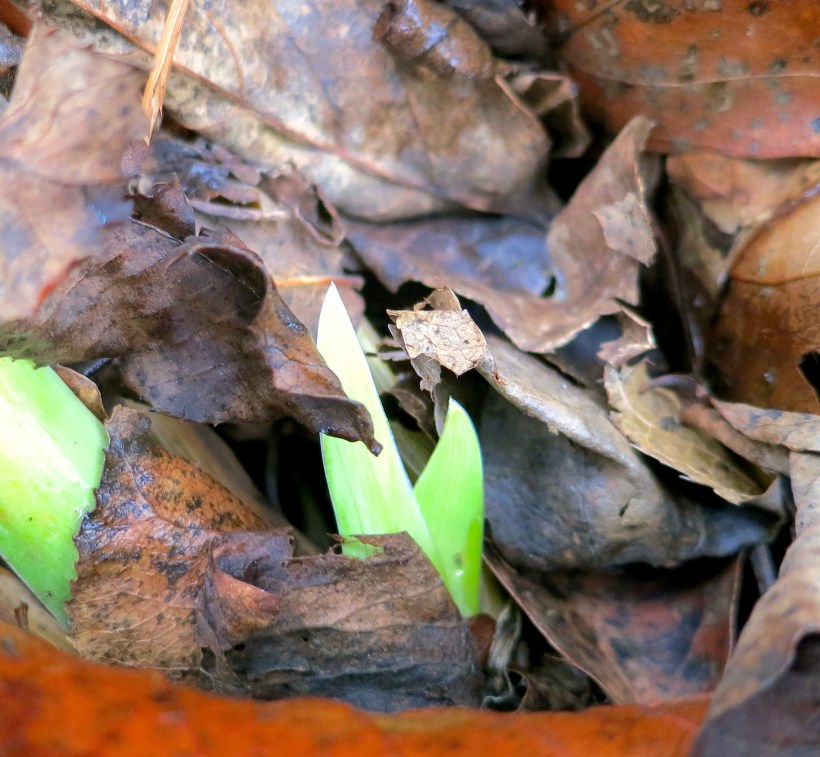
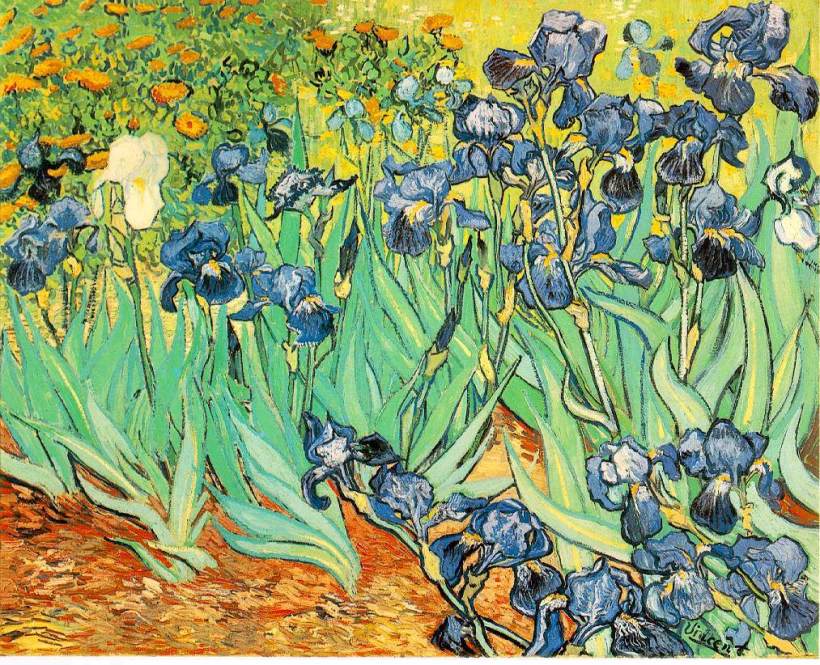 Van Gogh’s Irises
I have a small grain of hope–
one small crystal that gleams
clear colors out of transparency.
I need more.
I break off a fragment
to send you.
Please take
this grain of a grain of hope
so that mine won’t shrink.
Please share your fragment
so that yours will grow.
Only so, by division,
will hope increase,
like a clump of irises, which will cease to flower
unless you distribute
the clustered roots, unlikely source–
clumsy and earth-covered–
of grace.
~Denise Levertov “For the New Year, 1981”
Years ago, my newly widowed sister-in-law was trying to bring order to her late husband’s large yard and flower garden which had become overgrown following his sudden cardiac death in his mid-fifties. In her ongoing ebb and flow with her grief, she brought to us several paper bags full of iris roots resting solemnly in clumps of dirt–dry misshapened…
View original post 337 more words
A blessed Christmas to you all . . .

“When we give each other our Christmas presents in his name, let us remember that he has given us the sun and the moon and the stars, the earth with its forests and mountains and oceans and all that lives and moves upon them. He has given us all green things and everything that blossoms and bears fruit and all that we have misused–and to save us from our own foolishness and from all our sins, he came down to earth and gave us Himself. Venite adoremus Dominum.” (Sigrid Undset)
” . . . that things are not so ill with you and me as they might have been, is half owing to the number who lived faithfully a hidden life, and rest in unvisited tombs.”
~George Eliot, Middlemarch
Friday: from the archives
I don’t usually post Christmas music videos before Christmas. (Trying to keep Advent Advent.) But this one is special. And it’s for all of you who are having a hard time during this Advent season, finding it hard to be joyful like all of those around you. This one’s for you (from Steven Curtis Chapman).
And here’s his story behind the song.
Now, go back and listen to the song again, written just for you.
A sister of one of our Sisters recently broke her leg severely and is basically off her feet for months. I thought I would share one of her posts. I’m sure you will be as inspired as I have been by God’s care for her.
I find myself mentally setting up my week with the goal of coping till the weekend when my family is all around me, to help, love and support me.
Week day mornings are a rush to get all my “assisted” tasks done before my children catch the bus for school…they closely follow a list to ensure I have everything within an arm’s reach so I can manage my world from the mossy green motorized lift chair.
Most mornings prior to my accident I would leisurely walk out to my kitchen and prepare coffee while marveling at the birds gathered around the feeder outside my window. The familiar sound of my favourite couple, The Cardinals, calling back and forth, one protectively watching the surroundings as the other fed taking turns to spell each other off. God’s morning gift of greeting me through nature, as I poured the rich aromatic dark roast coffee from the bodum to my mystic monk pottery mug, never ceased to bring a grand smile of thanksgiving to my face.
I am a creature of habit, with little rewards built into my everyday routine…a decadent coffee here, pastry there, thick fluffy towels and luxurious lotion after a shower…by no means do I possess wealth, but reflecting now, I managed to physically reward myself after every spiritual exercise of obedience. Oh boy did I have things backwards.
Friday I felt stuck… dark… alone… all of the creature comforts I used to cling to have vanished, I need aid to do them all and guilt prohibits me from asking a personal support worker to grind beans for a gourmet coffee – it’s so minuscule in the grand scheme of what they do. The walls feel like they are closing in and perseverance just out of reach. Reflection on the week brings me back to our study of the sacraments, the outward sign containing God’s grace… God’s grace… I feel empty. Last week Fr. Brian didn’t come by for my weekly confession and with many funerals this week in addition to his weekly masses I hesitated to bother him for a home-visit for reconciliation. My sister reminded me that Fr. Mooney, a retired priest that lives in a nursing home a few miles west of our home had his number in the bulletin for emergencies. Is this an emergency? I just knew that my heart was in its darkest place since my accident.
Nervously I picked up the phone, I prayed ahead that God would prepare Father’s heart for my call and I wouldn’t be disturbing him. Father picked up on the 3rd ring, his soft frail “hello?” producing a lump in my throat, as if I had connected somehow with much needed light in my darkness. “Father Mooney?” I choked through tears… and explained my circumstance. “Well… let me check my book” with a few words he ripped open a spiritual oppression that had been hanging over me for days “tomorrow afternoon I will visit and hear your confession” in a whisper it was gone – the walls, the shadows, the monotony of my days – uncertainty uprooted and HOPE was firmly planted.
When I got off the phone the dam holding all of my anxiety washed away and I wept in gratitude for Fr. Mooney. I emptied my heart and lifted it to God, thanking Him for sending me a super hero – literally, a super hero… because there is NO earthly person, except a priest, who can administer reconciliation. Father Mooney, in his sunset years of mid-eighties, will pull a chair up to mine… he will garb himself in the priestly purple stole symbolizing penance and a portal will open… between time and a place outside of time. I will be joined, through Father as the veil, with my Saviour and healing will happen…the broken made whole… my GPS set straight… the gifts of The Holy Spirit watered and nurtured.
Of all the people in the world, pro-athletes, music giants, movie stars, motivational speakers, fashion designers, models and a plethora of other multi-millionaires who claim to have the answers to joy, love and success…there is a tiny white haired man whose humble life belongings line the dressers and walls in one room of a nursing home. This afternoon he will pull a worn camel coloured cardigan over his black dress shirt and white collar. He will shoulder an overcoat past the aches and pains of his eighty year old body and cover his head with an ancient fedora to keep today’s misty rain out of his downy locks. Gazing at the back of an envelope where he scribbled my address in pencil, he will find my home… and walk in the front door – his spiritual cape invisible to everyone but me.
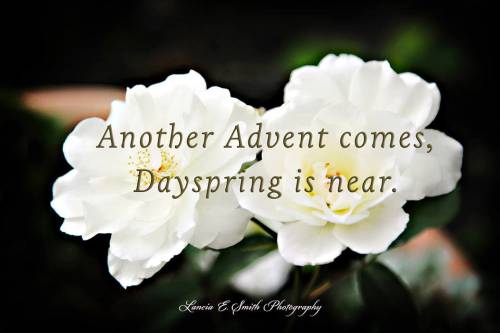 https://lanciaesmith.com/image-for-the-day-advent/
December 13th is St. Lucy’s day and the poem I have chosen in my Advent Anthology from Canterbury Press Waiting on the Word, is ‘Launde Abbey on St. Lucy’s Day’. I wrote this poem whilst leading an Advent retreat at Launde Abbey, a beautiful place hidden away in the soft folds of Leicestershire. This morning, on Saint Lucy’s day, whose brief brightness is dedicated to the martyr saint who found the true dayspring and whose name means light, I walked in the abbey grounds. As I watched the bright low winter sun rise dazzling through the bare bleak leafless trees and light at last the Abbey’s sunken rose garden this sonnet came to me.You can hear me read this poem by clicking on the title or the play button. the image above, takes up the poems opening proclamation, was created by Lancia Smith. you can see this and more on her…
View original post 172 more words
reblogged from The Mudroom


 Witnesses to Hope