“Is the doorbell ringing?”

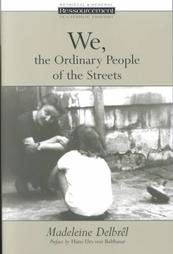
If you have clicked on the “What I’m Reading” tab, you know that one of the books I’m currently reading is We, the Ordinary People of the Streets, the writings of Madeleine Delbrêl, a French woman who lived from 1904-1964.  Similar to Dorothy Day, she converted from atheism to Catholicism which “led her to a life of social work in the atheistic, Communist-dominated city of Ivry-sur-Seine, France.”  Many of her insights are applicable to us who live in a secular-dominated world.  Here’s some of what I read this morning:

We, the ordinary people of the streets, are certain we can love God as much as he might desire to be loved by us.
We don’t regard love as something extraordinary but as something that consumes.  We believe that doing little things for God is as much a way of loving him as doing great deeds.  Besides, we’re not very well informed about the greatness of our acts.  There are nevertheless two things we know for sure: first, whatever we do can’t help but be small; and second, whatever God does is great.
And so we go about our activities with a sense of great peace.
. . . .
Each tiny act is an extraordinary event, in which heaven is given to us, in which we are able to give heaven to others.
It makes no difference what we do, whether we take in hand a broom or a pen.  Whether we speak or keep silent.  Whether we are sewing or holding a meeting, caring for a sick person or tapping away at a typewriter.
Whatever it is, it’s just the outer shell of an amazing inner reality: the soul’s encounter, renewed at each moment, in which, at each moment, the soul grows in grace and becomes ever more beautiful for her God.
Is the doorbell ringing?  Quick, open the door!  It’s God coming to love us.  Is someone asking us to do something?  Here you are!  . . . it’s God coming to love us.  Is it time to sit down for lunch?  Let’s go–it’s God coming to love us!

Let’s let him.

God is holding on to you

Do you have times when you feel that no matter how well-intentioned you are, you still blow it?  Here are St. Francis de Sales’ thoughts on the matter:

You should be like a little child who while it knows that its mother is holding its sleeve walks boldly and runs all round without being distressed at a little fall or stumble; after all, it is a s yet rather unsteady on its legs.  In the same way, as long as you realize that God is holding on to you by your will and resolution to serve him, go on boldly and do not be upset by your little set-backs and falls; there is no need to be put out by this provided you throw yourselves into his arms from time to time and kiss him with the kiss of charity.  Go on joyfully and with your heart as open and widely trustful as possible, and if you cannot always be joyful, at least by brave and confident.  (Sellected Letters)

For a related post, see “Punishing with a kiss”

Passing through the midst of them

In last Sunday’s gospel, Luke recounts the story of Jesus escaping those who were furious enough with him to want to throw him headlong off the brow of a hill.  Luke simply states: “But Jesus passed through the midst of them and went away (Lk 4.30)”.  An astonishing thing.  Amy Carmichael applies this verse to our own lives:

Our new month will bring us joys, for the Lord of joy is with us; it will also bring us sorrows, for sorrows are part of life.  It may bring things which would “throw us down” if they could.  But they need not ever do that, for it is possible for us to do just what our Master did when, passing through the midst of them, He went His way.
As, by His grace, we go on in quietness, we shall find those words we know so well come true: “My Presence will go with you, and I will give you rest” (Ex 33.14).  (Edges of His Ways, p. 18)

How bright our souls should be

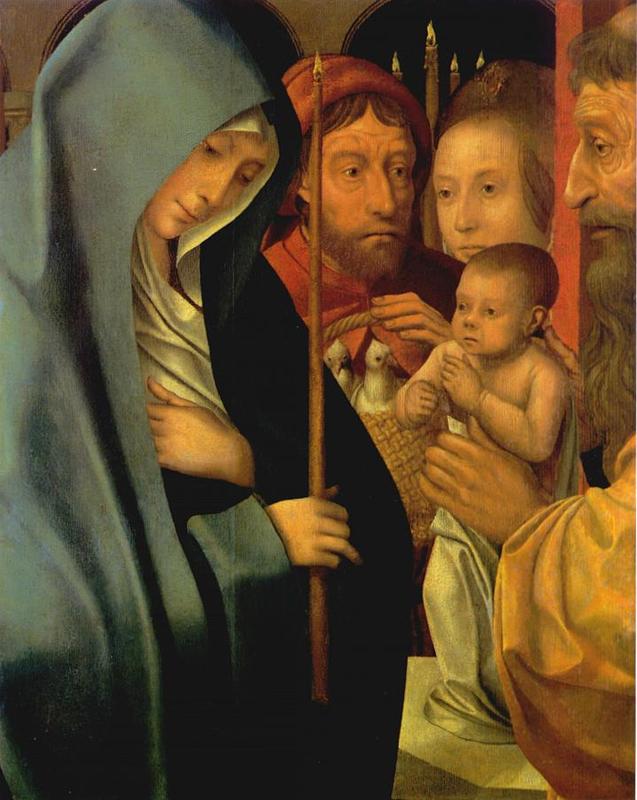
A few weeks ago I wrote about the custom we have in our house of leaving our Christmas lights up until today, the Presentation of the Lord (Candlemas), and the reasons for doing so. (See “God loves to light little lights”)  Well, today is the last day of our Christmas lights.  Even as I write this, I am facing two candles alit in my office windows that won’t be there tomorrow.  I was bemoaning all this to myself this morning until I read the Second Reading for the Office of Readings for today and realized anew that you and I are and will be the ongoing Christmas lights in this world, in season and out of season. (Note: the Eastern Church refers to this feast as The Meeting of the Lord.)

In honor of the divine mystery that we celebrate today, let us all hasten to meet Christ.  Everyone should be eager to join the procession and to carry a light.
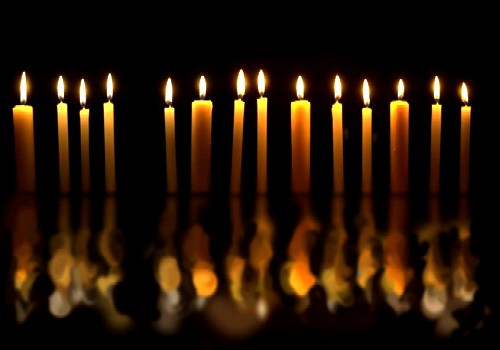
Our lighted candles are a sign of the divine splendor of the one who comes to expel the dark shadows of evil and to make the whole universe radiant with the brilliance of his eternal light.  Our candles also show how bright our souls should be when we go to meet Christ.
The Mother of God, the most pure Virgin, carried the true light in her arms and brought him to those who lay in darkness.  We too should carry a light for all to see and  reflect the radiance of the true light as we hasten to meet him.
The light has come and has shone upon a world enveloped in shadows; the Dayspring from on high has visited us and given light to those who lived in darkness.  This, then, is our feast, and we join in procession with lighted candles to reveal the light that has shone upon us and the glory that is yet to come to us through him.  So let us hasten all together to meet our God.
The true light has come, the light that enlightens every man who is born into this world. Let all of us, brethren, be enlightened and made radiant by this light.  Let all of us share in its splendor, and be so filled with it that no one remains in the darkness.  Let us be shining ourselves as we go together to meet and to receive with the aged Simeon the light whose brilliance is eternal.  (From a sermon by Saint Sophronius, bishop)

This evening we will begin Mass in our chapel with a procession, each of us carrying a lit candle.  I’m praying it will remind me of the true Light that dwells in me.  Tomorrow evening at Night Prayer when the lights are dimmed in our chapel for the singing of the Salve Regina, there will be only one lit candle (besides the sanctuary lamp) and that will be the one before the icon of the Mother of God.  “The Mother of God, the most pure Virgin, carried the true light in her arms and brought him to those who lay in darkness.  We too should carry a light for all to see and  reflect the radiance of the true light as we hasten to meet him.”  O sweet Mother of God, help us to do so.

God saw that it was beautiful

When God created the world, Genesis says He “saw that it was good” which also means “beautiful.”

Rate this:

I’m back pondering “beauty”–partly because I’m reading an excellent article, “Tolkien and St. Thomas on Beauty” from the current issue of StAR.  Lots to ponder there.  Then this morning I stumbled on this post from Conversion Diary about music and beauty.  Seems to be a theme for my day today.  Actually, the upshot of my pondering this morning was to ask God for more of His eyes, to be able to see the beauty in every soul I encounter today (including my own).  When God created the world, Genesis says He “saw that it was good” which also means “beautiful.”  This is how God sees us:

The Creator, like a divine poet, in bringing the world into being out of nothingness, composed his “Symphony in Six Days,” the Hexameron. After each one of his creative acts, he “saw that it was beautiful.”  The Greek text of the biblical story uses the word kalon–beautiful–and not agathon–good; the Hebrew word carries both meanings at the same time.  (Paul Evdokimov, The Art of the Icon: a Theology of Beauty, p. 2)