Entering Holy Week

Entering Holy Week

by Catherine Doherty.

This is the hour of faith. We are going to need faith, because Holy Week, in a manner of speaking, will show us the reign of the prince of darkness, who rejoiced on Good Friday because he killed God, or so he thought.

One picture has haunted me throughout the years. It is Christ hanging on the cross while many who have benefited by his goodness—the halt, the lame, and the blind—are saying to him, “If you are who you say you are, come down from that cross and we shall believe you.”

How many miracles have happened to us, individually?

This is the week for meditating on how much we are loved. If there is anyone who thinks that he or she is not loved, let him follow the Holy Week liturgies, and he will know with what love we are all loved.

For those of us who do know a little of that love, let this week be a week of loving others, for no one can receive the infinite love of God without passing it on. God meant it to be that way. If we kept it for ourselves, it would break us.

It seems that each of us is always to have empty hands—to have our sinner’s heart with all its hostility, pain, and sin—yet a heart that is always turned to God. He who loves sinners has to come into our hearts again and again and constantly give us the mercy of his love.

Let us acknowledge this and let us share this love, emptying it onto the other, whoever he might be. It is immaterial who, for when one is loved by God, one loves everybody, because God lets the rain fall on the just and the unjust.

God’s love pouring into us is poured out to the other, and then another Niagara of his love comes in. It never stops.

When I think I have nothing to give, lo and behold, the cascade of God’s love passes through me and I am renewed. I can give again, because God became man, dispossessing himself.

When you fall in love with God, the desire for dispossession becomes like a fire in your heart, because when one falls in love, one wants to identify with the beloved. It has always been thus and still is.

The Gift of Tears

Russians say that this is the week of the gift of tears. We believe that there is a gift of tears that comes from the Holy Spirit. We say that it washes away our sins and the sins of mankind. Silence and tears and a contrite heart God will not reject.

This is the week of confession and also the week of overcoming sins, because it is one week in the year when we know that, while we can’t overcome our sins, Christ can.

As one of our MH priests has said, “During most of this holy season of Lent, you have to work at living Lent, but then comes the time when you no longer have to carry Lent. The liturgy is so strong, so powerful, that it just carries you. The strength and power at work in the Church carries us all through Holy Week.”

When you think of this holy week, it’s like a shiver passing through you. It is the mercy of God and his love for you. And because you are caught up in it, held by it, immersed in it, your soul opens up and you cease to be afraid. The God-man has erased your fear.

In this Holy Week, let us join hands in deep forgiveness of one another. Let us reconcile ourselves to whomever we are not reconciled. Let us each enlarge the circle of love in our hearts so that it can encompass the humanity that flows near us. Such is the love of God: mercy flows from it. Forgiveness is part of it. Humility sings a song to it. This truly is a week that is holy!

Let all of this sink into you, for God is with us every moment. He is present right now. Let his love, his simplicity, his ordinariness, and his extraordinariness—all of him—enter your heart, and then you will know why this week is called holy.

— Adapted from Season of Mercy, pp. 79-81, available from MH Publications.

“The Blessing of Poverty”

A very honest and inspiring personal testimony from one of the priests of Madonna House about his own personal poverty and weakness:

The Blessing of Poverty

by Fr. Denis Lemieux.

Blessed are you poor, for the kingdom of heaven is yours (Lk 6:20).

I have learned that there is only one place where I grow in faith, one place where I encounter the living God. That is the place of my own personal poverty.

I am going to reflect on my spiritual journey and on different ways in which I have encountered my own poverty, at least a little bit. At least enough that I am beginning, I hope, to know the blessedness of poverty.

I’m 45 years old now, and I’ve been a staff worker of Madonna House for twenty years and a priest for seven. I was nineteen the first time I came to Madonna House and twenty-five when I made my first promises.

When I arrived at Madonna House in 1986, for various personal and familial reasons, I was fairly “bruised and broken.” I don’t mean physically.

You can read the rest here.

If today

“If today you hear His voice, harden not your hearts.”

We have been praying that verse several times every morning during Lent.  In essence, it is a plea to not turn away when the Lord convicts us of sin.  But yesterday morning, the Lord broke into my thoughts as if to say: “What I most speak to you is My love.  Don’t harden your heart to it.”  When we think of the true meaning of sin, it is a breaking of our relationship with God–which, in fact, weakens our ability to know His love.  He only convicts in order to restore the relationship.  He so longs for full union with us, for each of us to know His love in its fullness.

So today, when the Lord nudges you with His love, don’t harden your heart.  Open it wide.

When God is silent

What sense can we make of those times when God is silent?  Does that mean that He is absenting Himself from our lives?  Pope Benedict profoundly reflected on this a couple of weeks ago during his Wednesday audience:

“Often in our prayer, we find ourselves before the silence of God; we experience a sense of abandonment; it seems to us that God is not listening and that He does not respond.  But this silence of God–as Jesus also experienced–is not a sign of His absence.  The Christian knows well that the Lord is present and that he is listening, even in the darkness of suffering, rejection and solitude.  . . . God knows us intimately, more deeply than we know ourselves, and He loves us: and knowing this should suffice.  In the Bible, Job’s experience is particularly significant in this regard.  This man quickly loses everything: family, wealth, friends, health; it seems that God’s attitude towards him is precisely one of abandonment, of total silence.  And yet Job, in his relationship with God, speaks with God, cries out to God; in his prayer, despite everything, he preserves his faith intact and, in the end, he discovers the value of his experience and of God’s silence.  And thus, in the end, turning to his Creator, he is able to conclude: ‘I had heard of thee by the hearing of the ear, but now my eye sees thee’ (Job 42.5): nearly all of us know God only through hearsay, and the more we are open to His silence and to our silence, the more we begin to know Him truly.  This supreme confidence, which opens way to a profound encounter with God, matures in silence.  St. Francis Severio prayed, saying to the Lord: I love you, not because you can give me heaven or condemn me to hell, but because You are my God.  I love You because You are You.”

And God says in turn to each of us: “I love you because you are you.”

Gold on glass

Makoto Fujimura is a Christian contemporary artist.  He studied under Matazo Kayama.  One of Kayama-sensei’s lessons teach us a lot about the spiritual life, about God’s wonderful work in our souls.  Fujimura reflects on one lesson:

“When he gathered us students to teach us how to use gold, he had one of his assistants bring a clear piece of glass.  He then proceeded to glue the gold right onto the glass.  Lifting the glass, he showed us that the most pure gold is nearly transparent as it casts a bluish light and halo.  I mentally pictured the new Jerusalem ‘coming down out of heaven from God, prepared as a bride beautifully dressed for her husband’ (Rev. 21.2).  The transparency of gold that Kayama-sensei was displaying overlapped with John’s vision.  For the new Jerusalem is a ‘city of pure gold, as pure as glass’ (Rev. 21.18).”  (Makoto Fujimura, Refractions)

“There is nothing brighter than the eyes of God”

Romano Guardini wrote this beautiful meditation on what it means that God sees us.  I think you’ll find it very hope-filled.

“There is nothing brighter than the eyes of God, nor is there anything more comforting.  They are unyielding, but they are the source of hope.

“To be seen by him does not mean to be exposed to a merciless gaze, but to be enfolded in the deepest care.  Human seeing often destroys the mystery of the other.  God’s seeing creates it.

“We can do nothing better than to press on into the sight of God.  The more deeply we understand what God is, the more fervently we shall want to be seen by him.  We are seen by him whether we want to be or not.  The difference is whether we try to elude his sight, or strive to enter it, understanding the meaning of his gaze, coming to terms  with it, and desiring that his will be done.

“We can do nothing better than place ourselves and all that we have in God’s sight: ‘Behold me!’  Let us put away the fear that prevents us.  Let us abandon the sloth, the pretense of independence, and the pride.  ‘Look at the good!  Look at the shortcomings!  The ugly, the unjust, the evil, the wicked, everything—look at it, O God!’

“Sometimes it is impossible to alter something or another.  But let him see it at any rate.  Sometimes one cannot honestly repent.  But let him see that we cannot yet repent.  None of the shortcomings and evil in our lives are fatal as long as they confront his gaze.  The very act of placing ourselves in his sight is the beginning of renewal.  Everything is possible so long as we begin with God.  But everything is in danger once we refuse to place ourselves and our lives in his sight.”  (Romano Guardini, The Living God, Sophia Institute Press, 1997)

“How are you doing?”

Yesterday was the sixth anniversary of my brother Tim’s death.  He would have been 60 this year.  As many of you know, he took his own life and the impact on all of us who loved him was devastating.  What I want to share here is a set of e-mails between me and my spiritual director from three years ago at this time of year.  Fr. Dan, remembering that Tim’s anniversary was coming up, had sent me a short e-mail, simply asking “How are you doing?”  My response is very frank.  I share this with you for a few reasons.

One: it means so much for people to remember, to remember anniversaries.  Every year since she found out, a friend always shows up on my brother’s anniversary with a plant.  I, of course, do not expect her to do that every year for the rest of my life, but she obviously knows enough about the pain of a suicide to know how much this touches me.  Just saying those four words: “How are you doing?” can make a world of differences.  Even if my answer is “I’m really doing fine,”  I am still so touched that you have remembered.

Two: Losing someone to suicide is a grief that never goes away and is very paimnful for years.  It is unlike any other grief.

Three: I hope that both my frankness and my sharing of how God meets me in my pain and Fr. Dan’s response to me may bring hope to someone out there who may be struggling in a similar way. . .

(I am editing some of this.)

Dear Fr. Dan,

How am I doing?  It really depends these days on when you ask.  But, if you have the time, I am going to try to verbalize a few things.  I am suffering.  I am suffering most acutely from Tim’s death, but also the many other losses in my life: at the end of my first of college: the tragic death in a car crash of a very close friend; my parent’s divorce and subsequent disintegration of my family; my brother Paul’s death in a car accident at the age of 24; my mother’s death; Tim’s violent death.  They all kind of rush in upon me sometimes. . . . Some days I want to run away.  Some days I just want to shout out: “My brother put a gun in his mouth and killed himself!” Most days I don’t even know how to pray.  I get irritated by stupid questions people ask me about things.  And I have to keep leading us [as Superior of our order] and making decisions and answering stupid questions with love and kindness.  I feel alone and afraid a lot.  Friends I have depended on are not there as they were.  I could cry at the slightest kindness shown me.

And yet in the midst of the suffering, there’s a desire to offer it up, to kiss this Hand from whom it all comes. . . . There’s also a slight hope that I will come to know Christ and His love through it in a way that I would never know otherwise.  There are pinpoints of light.  Last night as I was going to sleep and dealing with fear and pain, I starting thinking, I’m walking through the valley of the shadow of death, the valley of deep darkness.  And the words from Psalm 23 hit me: “I will fear no evil”–and I knew that Satan couldn’t touch me there.  And then this morning when I woke early and was encountering the same things, the rest of that verse came to me: “because You are with me.”  And that brought back to mind Dr. Regis Martin’s article on Christ’s descent into hell which, as you know, has spoken eloquently to my soul.  Paul of the Cross (among others) counsels us to join our sufferings to the different mysteries in Christ’ life: “I will try with all my strength to follow the footsteps of Jesus.  If I am afflicted, abandoned, desolate, I will keep him company in the Garden.  If I am despised and injured, I will keep him company in the Praetorium.  etc.” Perhaps Christ is inviting me to “live” in the mystery of His descent into Hell, to walk with Him through the valley of the shadow of death. I am once again re-reading Dr. Martin’s article, and once again it clarifies and strengthens me.  There’s some experience this morning of His having entered through the ‘barred doors” of my heart, my own little “hell.”  The pain is still there, but there”s also a knowledge that He’s there and I’m not alone.

I must thank you for your kindness in asking me how I’m doing.  Four small words, but when sincerely said can make such a difference for people. And I don’t mean to complain by anything I’ve said here.  Many people have been very kind to me these days, but the suffering continues.

It’s funny, isn’t it–when you’re in the middle of suffering and pain, it just seems like there’s no end, that it just has and always will be this way, and then a few little words: “You are with me” can open up a whole spiritual perspective that makes all the difference.  The wounds are still there, but there’s a little balm.  The mental torment can continue, but I don’t fear that I’m going crazy.  Hell becomes the place where Christ descends and meets me in the scariest places in my life, where one one else can really go but Him.

Fr. Dan’s reply:

Peace be with you.

As you tell of your experience in these days, Paul’s words in Rom 8:38-39 seem so apposite: “For I am sure that neither death, nor life, nor angels, nor principalities, nor things present, nor things to come, nor powers, nor height, nor depth, nor anything else in all creation, will be able to separate us from the love of God in Christ Jesus our Lord.”  Christ grasps you firmly.  He is walking with you, unobserved by your, through the valley of the shadow of death, and sustaining you by the banquet He has prepared for you.  The reality of the fear and terror of events you describe, which leave a remnant of their foul odor in your memory even long after the events themselves have passed, only prove the more the reality of what you hope for.  That hope is your anchor in Christ, which allows him–like a great heavenly winch!–to draw you through (not around!) those very terrors into the Kingdom.  The psalm says that the banquet is set for you, but “in the presence of my enemies.”  The greatness of these enemies is infinitely surpassed by the greatness of His mercy, which is always for you.  Keep doing what you know to do: relying on yourself for nothing, and on Him, and His infinite mercy, for everything.

Christ walks with each of you through whatever valley you are in right now.

Put yourself in this woman’s place

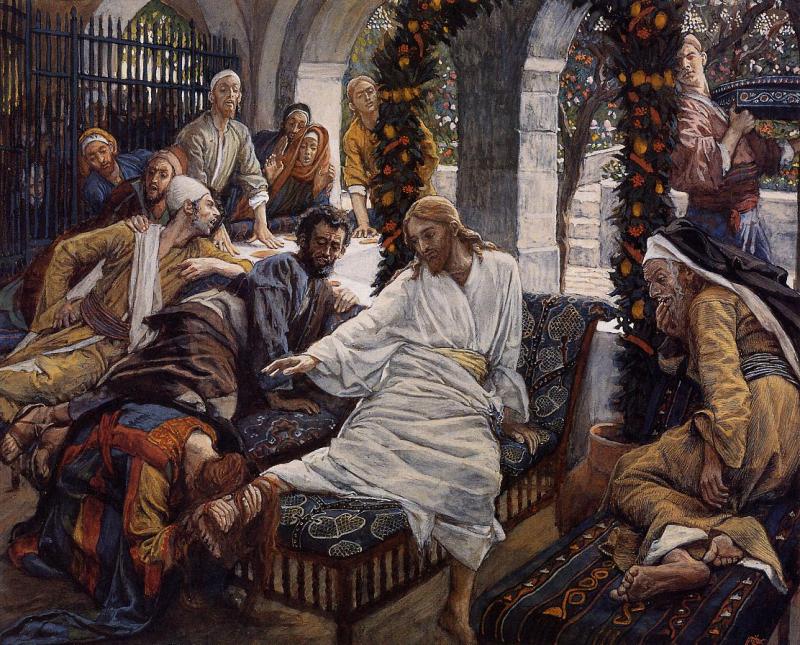
Jesus does not want our sins, our weaknesses and faults, to keep us from coming to Him, to keep us from intimacy with Him.  I post again this painting by James Tissot.  Put yourself in this woman’s place, a great sinner.  Touch His feet, kiss His feet.  And see the Lord reaching out to you in His tender love.

He said to Simon the Pharisee, “You gave me no kiss . . . ” (Lk 7.45).  The Lord of Love will miss your kiss if you don’t draw near to Him . . .