Yesterday was the sixth anniversary of my brother Tim’s death. He would have been 60 this year. As many of you know, he took his own life and the impact on all of us who loved him was devastating. What I want to share here is a set of e-mails between me and my spiritual director from three years ago at this time of year. Fr. Dan, remembering that Tim’s anniversary was coming up, had sent me a short e-mail, simply asking “How are you doing?” My response is very frank. I share this with you for a few reasons.
One: it means so much for people to remember, to remember anniversaries. Every year since she found out, a friend always shows up on my brother’s anniversary with a plant. I, of course, do not expect her to do that every year for the rest of my life, but she obviously knows enough about the pain of a suicide to know how much this touches me. Just saying those four words: “How are you doing?” can make a world of differences. Even if my answer is “I’m really doing fine,” I am still so touched that you have remembered.
Two: Losing someone to suicide is a grief that never goes away and is very paimnful for years. It is unlike any other grief.
Three: I hope that both my frankness and my sharing of how God meets me in my pain and Fr. Dan’s response to me may bring hope to someone out there who may be struggling in a similar way. . .
(I am editing some of this.)
Dear Fr. Dan,
How am I doing? It really depends these days on when you ask. But, if you have the time, I am going to try to verbalize a few things. I am suffering. I am suffering most acutely from Tim’s death, but also the many other losses in my life: at the end of my first of college: the tragic death in a car crash of a very close friend; my parent’s divorce and subsequent disintegration of my family; my brother Paul’s death in a car accident at the age of 24; my mother’s death; Tim’s violent death. They all kind of rush in upon me sometimes. . . . Some days I want to run away. Some days I just want to shout out: “My brother put a gun in his mouth and killed himself!” Most days I don’t even know how to pray. I get irritated by stupid questions people ask me about things. And I have to keep leading us [as Superior of our order] and making decisions and answering stupid questions with love and kindness. I feel alone and afraid a lot. Friends I have depended on are not there as they were. I could cry at the slightest kindness shown me.
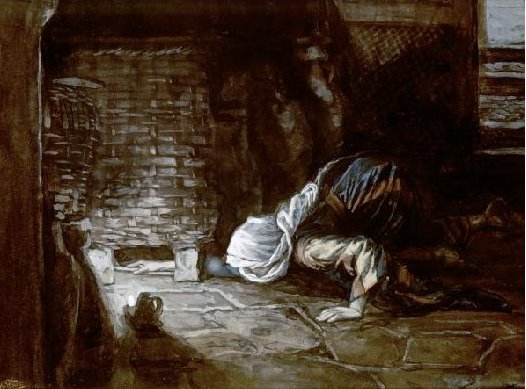
And yet in the midst of the suffering, there’s a desire to offer it up, to kiss this Hand from whom it all comes. . . . There’s also a slight hope that I will come to know Christ and His love through it in a way that I would never know otherwise. There are pinpoints of light. Last night as I was going to sleep and dealing with fear and pain, I starting thinking, I’m walking through the valley of the shadow of death, the valley of deep darkness. And the words from Psalm 23 hit me: “I will fear no evil”–and I knew that Satan couldn’t touch me there. And then this morning when I woke early and was encountering the same things, the rest of that verse came to me: “because You are with me.” And that brought back to mind Dr. Regis Martin’s article on Christ’s descent into hell which, as you know, has spoken eloquently to my soul. Paul of the Cross (among others) counsels us to join our sufferings to the different mysteries in Christ’ life: “I will try with all my strength to follow the footsteps of Jesus. If I am afflicted, abandoned, desolate, I will keep him company in the Garden. If I am despised and injured, I will keep him company in the Praetorium. etc.” Perhaps Christ is inviting me to “live” in the mystery of His descent into Hell, to walk with Him through the valley of the shadow of death. I am once again re-reading Dr. Martin’s article, and once again it clarifies and strengthens me. There’s some experience this morning of His having entered through the ‘barred doors” of my heart, my own little “hell.” The pain is still there, but there”s also a knowledge that He’s there and I’m not alone.
I must thank you for your kindness in asking me how I’m doing. Four small words, but when sincerely said can make such a difference for people. And I don’t mean to complain by anything I’ve said here. Many people have been very kind to me these days, but the suffering continues.
It’s funny, isn’t it–when you’re in the middle of suffering and pain, it just seems like there’s no end, that it just has and always will be this way, and then a few little words: “You are with me” can open up a whole spiritual perspective that makes all the difference. The wounds are still there, but there’s a little balm. The mental torment can continue, but I don’t fear that I’m going crazy. Hell becomes the place where Christ descends and meets me in the scariest places in my life, where one one else can really go but Him.
Fr. Dan’s reply:
Peace be with you.
As you tell of your experience in these days, Paul’s words in Rom 8:38-39 seem so apposite: “For I am sure that neither death, nor life, nor angels, nor principalities, nor things present, nor things to come, nor powers, nor height, nor depth, nor anything else in all creation, will be able to separate us from the love of God in Christ Jesus our Lord.” Christ grasps you firmly. He is walking with you, unobserved by your, through the valley of the shadow of death, and sustaining you by the banquet He has prepared for you. The reality of the fear and terror of events you describe, which leave a remnant of their foul odor in your memory even long after the events themselves have passed, only prove the more the reality of what you hope for. That hope is your anchor in Christ, which allows him–like a great heavenly winch!–to draw you through (not around!) those very terrors into the Kingdom. The psalm says that the banquet is set for you, but “in the presence of my enemies.” The greatness of these enemies is infinitely surpassed by the greatness of His mercy, which is always for you. Keep doing what you know to do: relying on yourself for nothing, and on Him, and His infinite mercy, for everything.
Christ walks with each of you through whatever valley you are in right now.