We had a wonderful time with Deb Mantel last night! See above re: how to listen to her story.
 Here’s a guest post from Ann Voskamp: How to Find Your Perfect Weight (and she’s not talking about dieting or anything along those lines).
We had a wonderful time with Deb Mantel last night! See above re: how to listen to her story.
Here’s a guest post from Ann Voskamp: How to Find Your Perfect Weight (and she’s not talking about dieting or anything along those lines).
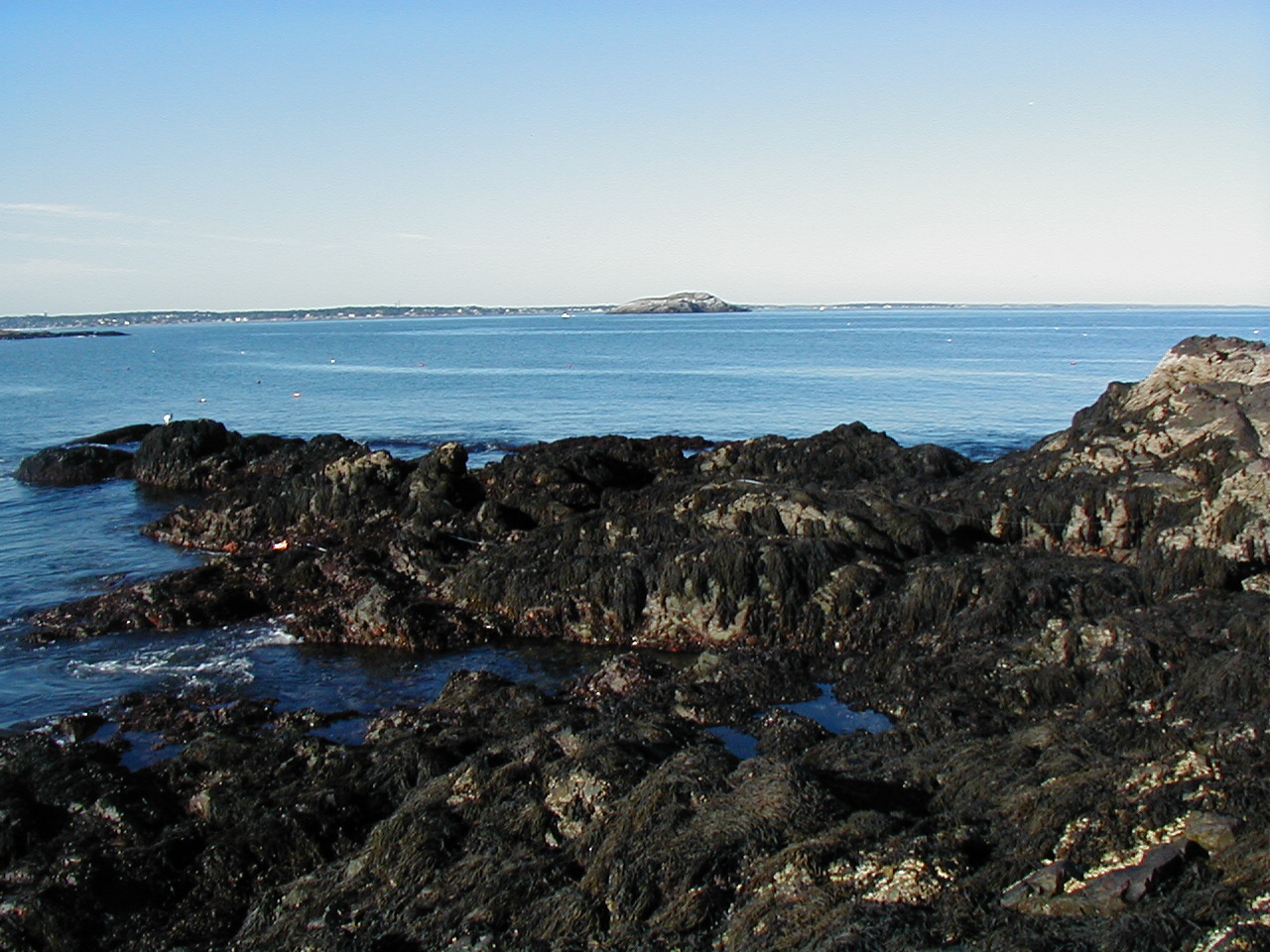
I am just beginning a novel by Peter Kreeft: An ocean Full of Angels. One section I read today reminded me of a concept I have blogged about before: the idea that everything created is a revelation of God, if we can but look for it. The narrator of the book is describing a small island he lives on off the coast of Boston:
Tiny Nahant is a complete world that can teach you everything you need to know, everything the whole planet can teach. The rocks teach you fidelity. The waves teach you the relentless, unceasing heartbeat of love. The winds teach you the power of the invisible. The high cliffs teach you to hope. The caves teach you that all things have a dark and buried side. The grass teaches you humility. The sun teaches you glory. The sand teaches you time. The trees teach you to think tall. The ants and bees teach you industry. The flowers teach you the morality of superfluity, the wild adventure of hospitality, and the beauty of prodigality. The seasons teach you that change and stability are two sides of the same reality. The night teaches you mystery and the day teaches you mindfulness. The tiny town teaches you modesty. And the surrounding sea teaches you that you are rocked at every moment int he arms of a giant angel.
But you learn all these things here only because you learn the precious Lesson One that my Mama used to call “hushing”: the wisdom of slowing down, getting all quiet inside, and entering the holy silence, where you can listen. I believe this is the single most potent of all learning arts. Most follies, of both thought and deed, cannot endure that place, that holy silence. Addictions, aggressions, and aggravations fall out of your soul like birds with broken wings, when the air is fresh with silence. . . .
It means nothing mystical or esoteric. Just listen. Don’t listen for anything, just listen. You must learn to listen, for listening is life’s second greatest art. Only loving is greater. But listening well is the best aid to loving well.
May you find the time, however small, to listen, to listen to God in all that you encounter today.
Hope to see you at Witnesses to Hope tonight!
A singular poem about what it was like for our Lady after the Ascension. How could she stand this separation?
Our Lady of the Assumption
Fold your love like hands around the moment.
Keep it for conference with your heart, that exit
Caught on clocks, by dutiful scribes recorded
Less truly than in archives of yor soul.
Turn back from His going, be His still-remaining.
Lift the familiar latch on cottage door . . .
Discover His voice in corners, hear His footfalls
Run down the porches of your thoughts. No powers
However hoarse with joy, no Dominations
Curved with adoration guess what whispers
Of “Mother, look!” and “Mother, hurry!”
Glance off the cottage walls in shafts of glory.
How shall your heart keep swinging longer, Mary?
Quickly, quickly, take the sturdy needle
Before your soul crowds through your flesh! the needle
And stout black thread will save you. Take the sandal
Peter left for mending. After that,
The time is short, with bread to bake for John.
Mother Mary Francis
I have intermittent internet access in my office. Yesterday, it was mostly non-connected. I finally began this at 8:30 last night. Then I had to take a non-expected long distance phone call. Just to let you know, I really am trying to post. 🙂
I picked up a book at the library–a children’s book–called Psalms for Young Children. I’m usually wary of “paraphrased” scripture books for children. I think it’s better to just expose them to the Word of God directly. On the other hand, I have found concepts so brilliantly distilled in books for children. So this book caught my attention. The first page says: “This selection of Psalms, paraphrased for young readers, uses language and imagery appropriate for children while remaining faithful to the spirit of the biblical texts.”
Psalm 13
Sometimes when I’m very sad,
I worry that you will
forget about me, God.
But then I remember that
you love me always.
So I will sing and be happy!
Derek Kidner, in his commentary on the psalms, points out that in almost every psalm in which the psalmist is complaining of trials and hardships, there comes a turning point, a “but” point, when the attitude of the psalmist changes. One can see that point so clearly in this rendition of Psalm 13. May it be an encouragement to any of you who are worrying that God will forget about you. May you remember that He does love you always, and may a song rise in your hearts.
Mary arose and went to Elizabeth without Elizabeth having asked her. This is the way Christ is always with us. He comes to us without waiting for us to ask Him. May this Feast remind us of that:
The visit that so honored and overwhelmed Elizabeth had not been sought by her: part of the very honor consisted int he fact that Mary had paid it of her own accord. . . . Our God treats us His poor creatures, in the same way. Whether the sinner who needs converting, or the just who is called to a higher life and the way of perfection, be concerned, He alike comes without waiting for us to ask Him. We are often not thinking of Him specifically at all–we may have forgotten Him; but He seeks us out–goes before us–or as sacred language has it, “prevents” us: we feel and know His grace, suddenly present with us, as the Baptist knew it in his mother’s womb, when we have done absolutely nothing to call it down. (Jacques Benigne Bossuet)
“. . . when we have done absolutely nothing to call it down.” What hope-filled words. A blessed Feast!
A Sunday-poem from Mother Mary Francis:
"Be Still, and See That I Am God"
            (Psalm 46:10)

Grief went to serve sub-poena upon God:
Come to the witness stand.  Defend Yourself
From accusation that You've sudden grown
Inadequate to parenting Your world
Or me or all whomevers.
                         Where went Abba?

Has no one seen Him?  Shrill cacophony
Demands Him.  But He's nowhere to be seen.

Down cosmic boulevards loud seekers sought Him,
At impotent Omnipotence raised cries.
How lapsed skills managerial?  Why is
Desk of Divinity left unpresided

While worlds and hearts keep shouting:
                         Where went Abba?

With hounds of noise they hunt Him, turn their beams
To show Him. But He's nowhere to be seen.

Out of loud forum blast the cries for Him
To show His face, exhibit as of old
Ability to order hearts and planets.
That chorus drafts my membership, save I
Venture such cavern as admits no sound,
Enter alone the cave where breathes my being
Contingent wholly on His own and risk
Faith's total silence.
                      But then, You had foretold it!
In stillness I have seen that You are God.
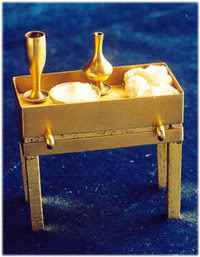 I am reading a fascinating book on the Eucharist by Dr. Brant Pitre, Jesus and the Jewish Roots of the Eucharist. In one section of the book, Dr. Pitre illustrates the connection between the Eucharist and the Bread of the Presence from the Temple. God had commanded the Israelites to keep twelve loaves of bread on a golden table in the Holy Place. “And you shall make a table of acacia wood . . . You shall overlay it with pure gold, and make a molding of gold around it. And you shall make its plates and dishes for incense, and its flagons and bowls with which to pour libations; of pure gold you shall make them. And you shall set the Bread of the Presence on the table before me always.” (Ex 25:23-24)
Later in the chapter, Dr. Pitre explains the custom of the priests bringing this table out from the Holy Place three times a year (the feasts of Passover, Pentecost, and Tabernacles) so that the pilgrims might see it: “They [the priests] used to lift it [the Golden Table] up and exhibit the Bread of the Presence on it to those who came up for the festivals, saying to them, “Behold, God’s Love for you!”
What an amazing foreshadowing of God’s love made manifest in the Eucharist. . . .
I’m just back from vacation. I’m sharing a guest post today since I don’t have time yet to write myself. Here’s something from Ann Voskamp: “Draw me nearer, nearer, blessed Lord” Just her photography is worth the read. Hope you had a great week!
Life can throw us many curve balls, as they say. Some are big and some are small, but all are important in the formation of how we handle life. Sydney Eddison recounts (in Gardening for a Lifetime) a story “of the violinist Itzhak Perlman, who as a boy was struck with polio and who as a man must walk with the aid of leg braces and crutches.
At a concert on the night of November 18, 1995, at Avery Fisher Hall in New York City, one of the strings of his violin suddenly snapped during the performance. Stunned, the audience held their collective breath, expecting Perlman to stop and leave the stage. Instead, he paused, then continued playing–adjusting, creating, compensating as he went along, and when he put down his bow at the end of the concert, a mighty roar of applause filled the hall. When it had died down, he spoke to the audience: “You know, sometimes it is the artist’s task to find out how much music you can still make with what you have left.”
Listen to him playing the theme from Schindler’s List. Our lives can also sound as beautiful if we continue to respond as best we can in God’s grace to all that life brings us.
What do you think when you hear the words: “eternal life”? Life after death, I presume. That’s what I thought until I read this thought-provoking piece by Pope Benedict (from his new book, Jesus of Nazareth, Holy Week). I have to say I kept thinking of Bl. John Paul as I read it . . .
“Eternal life” is not–as the modern reader might immediately assume–life after death, in contrast to this present life, which is transient and not eternal. “Eternal life” is life itself, real life, which can also be lived in the present age and is no longer challenged by physical death. This is the point: to seize “life” here and now, real life that can no longer be destroyed by anything or anyone.
This meaning of “eternal life” appears very clearly in the account of the raising of Lazarus: “He who believes in me, though he die, yet shall he live, and whoever lives and believes in me shall never die” (Jn 11:25-26). “because I live, you will live also”, says Jesus to his disciples at the Last Supper (Jn 14.19), and he thereby reveals once again that a distinguishing feature of the disciple of Jesus is that he “lives”: beyond the mere fact of existing, he has found and embraced the real life that everyone is seeking. On the basis of such texts, the early Christians called themselves simply “the living” (hoi zōntes). They had found what all are seeking–life itself, full and, hence, indestructible life.
Pope Benedict then goes on to describe how, in fact, we obtain this life:
The high-priestly prayer gives an answer that may surprise us, even though in the context of biblical thought it was already present. “eternal life” is gained through “recognition”, presupposing here the Old Testament concept of recognition: recognizing creates communion; it is union of being with the one recognized. But of course the key to life is not any kind of recognition, but to “know you the only true God, and Jesus Christ whom you have sent” (17.3). . . .
“Eternal life” is thus a relational event. . . .
Man has found life because he adheres to him who is himself Life. Then much that pertains to him can be destroyed. Death may remove him from the biosphere, but the life that reaches beyond it–real life–remains. This life, which John calls zōē as opposed to bios, is man’s goal. The relationship to God in Jesus Christ is the source of a life that no death can take away.
Isn’t this what we witnessed in Bl. John Paul in his latter days, this zōē that so clearly sprang from his relationship with the living Christ?
 Witnesses to Hope