A footnote

I was grabbed by a footnote in a book I’m reading.  The author was commenting on the blessing it is for us that the book of Job has survived through the years.  It is a blessing that “God has willed that this great cry of scandal before the ways of Providence should survive until our days.”  He footnotes this statement with:

God has also willed that the only words gathered by the two oldest evangelists from the lips of the dying Jesus were, “My God, my God, why have you forsaken me?” (Mt 27.46; Mk 15.34, so that believers in a state of confusion should never feel that they were intruding, but always find a place to lay down their head in the paradise of Scripture.  (Fr. Dominique Barthélemy)

Keeping Him company

Following up on yesterday’s post, here is another quote from St. Paul of the Cross along the same lines:

I will try with all my strength to follow the footsteps of Jesus.  If I am afflicted, abandoned, desolate, I will keep him company in the Garden.  If I am despised and injured, I will keep him company in the Praetorium.  If I am depressed and afflicted in the agonies of suffering, I will keep him company faithfully on the Mount, and in a generous spirit I will keep him company on the Cross with a lance in my heart.

Fill in the blanks for yourself: “If I’m _________, I will keep him company in the __________________” He is looking for you to be with Him during these days . . .

What is your suffering?

What is your suffering?  Whatever it is, whatever its cause (including your own personal weaknesses), it can be joined to the sufferings of Christ this week.  St. Paul of the Cross was a big advocate of this.  Don’t let your personal sufferings separate you from Christ this week.  Dealing with your tendencies to irritability or depression or anger is a real suffering.  Let it draw you to Christ this week.

Paul connects all sufferings with the Passion, not only pain and distress but everything we do not naturally like.  To make this connection, Paul looked at the different sufferings that Jesus not only endured, but accepted during his Passion: inner anguish, terrible fear and depression, abandonment by his friends, betrayal, deprivation of his freedom, injustice, lies told about him, excommunication, rejection by authority, especially by religious authority, bodily pain, utter fatigue, misunderstanding, helplessness, a sense of failure, the feeling of being abandoned by his Father, and finally death itself.   (Spiritual Direction According to St. Paul of the Cross)

Do not lose heart, O soul

This is the week of penance services.  Along with that can come the temptation–yes, it is a temptation–to overdwell on our sins, on how we have offended God to the point that we never really return to the arms of our loving Father.  We stay in the pig sty rather than running with confidence to the God who comes to meet us.  May this selection from St. Ephrem the Syrian enable you to “leave the city that starves you.”

Do not lose heart, O soul, do not grieve; pronounce not over yourself a final judgment for the multitude of your sins; do not commit yourself to fire; do not say: The Lord has cast me from his face.

Such words are not pleasing to God.  Can it be that he who has fallen cannot get up?  Can it be that he who has turned away cannot turn back again?  Do you not hear how kind the Father is to a prodigal?

Do not be ashamed to turn back and say boldly: I will arise and go to my Father.  Arise and go!

He will accept you and will not reproach you, but rather rejoice at your return.  He awaits you; just do not be ashamed and do not hide from the face of God as did Adam.

It was for your sake that Christ was crucified; so will he cast you aside?  He knows who oppresses us.  He knows that we have no other help but him alone.

Christ knows that man is miserable.  Do not give yourself up to despair and apathy, assuming that you have been prepared for the fire.  Christ derives no consolation from thrusting us into the fire; he gains nothing if he sends us into the abyss to be tormented.

Imitate the prodigal son: leave the city that starves you.  Come and beseech him and you shall behold the glory of God.  Your face shall be enlightened and you will rejoice in the sweetness of paradise.  Glory to the Lord and Lover of mankind who saves us.

The love of God

I have been reading and re-reading one of the homilies that Fr. Cantalamessa gave this Lent to the Roman Curia.  Here are the beginning paragraphs, followed by the link to the whole homily.  In it he stresses–as I have highlighted below–the importance, the necessity, of our being permeated by the knowledge of God’s love for us before we can bring that love to others.  I  find in my own life, and in the lives of many of the women to whom I give spiritual direction, that the most challenging thing can very often be believing in the love of God for me personally.   Sounds so easy, but so hard to do.

The first and essential proclamation that the Church is charged to take to the world and that the world awaits from the Church is that of the love of God. However, for the evangelizers to be able to transmit this certainty, it is necessary that they themselves be profoundly permeated by it, that it be the light of their life. The present meditation should serve this purpose at least in a small part.

The expression “love of God” has two very different meanings: one in which God is object and the other in which God is subject; one which indicates our love for God and the other which indicates God’s love for us. The human person, who is more inclined to be active than passive, to be a creditor rather than a debtor, has always given precedent to the first meaning, to that which we do for God. Even Christian preaching has followed this line, speaking almost exclusively in certain epochs of the “duty” to love God (“De Deo diligere”).

However, biblical revelation gives precedence to the second meaning: to the love “of” God, not to the love “for” God. Aristotle said that God moves the world “in so far as he is loved,” that is, in so far as he is object of love and final cause of all creatures.[1] But the Bible says exactly the contrary, namely, that God creates and moves the world in as much as he loves the world.

The most important thing, in speaking of the love of God, is not, therefore, that man loves God, but that God loves man and that he loved him “first”: “In this is love, not that we loved God but that he loved us” (1 John 4:10). From this all the rest depends, including our own possibility of loving God: “We love, because he first loved us” (1 John 4:19).  (emphasis added)

You can read the whole thing here.

weep and wait

As we approach Holy Week, here is a Sunday-poem by Luci Shaw that will, hopefully, prod us all to never let anything we do keep us from running to Him for mercy–and she is full aware that this often seems the harder path to take:

Judas, Peter

because we are all
betrayers, taking
silver and eating
body and blood and asking
(guilty) is it I and hearing
him say yes
it would be simple for us all
to rush out
and hang ourselves
but if we find grace
to weep and wait
after the voice of morning
has crowed in our ears
clearly enough
to break our hearts
he will be there
to ask us each again
do you love me

Allow Jesus to love you

If you are surprised or discouraged because of falls, that means that you trusted in your own strength instead of allowing yourself to be carried in Jesus’ arms. . . . ‘What does it matter, dear Jesus, if I fall at each moment?’ writes St. Thérèse: ‘I see my weakness through this and this is a great gain for me [. . .] You can see through this what I can do and now You will be more tempted to carry me in your arms.’

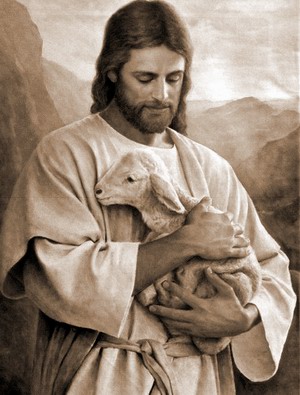
If you feel that you are sinful and weak, you have a special right to Jesus’ arms because He is the Good Shepherd, who looks for lost sheep and those who are weak and helpless and who can’t keep up with the flock.  Allow Jesus to take you upon His shoulders.  Allow Him to love.  Believe in His love.   (Fr. Tadeuz Dajczer, Gift of Faith)