“God loves us not because we are lovable, but because He is love.”
(C.S. Lewis)
(C.S. Lewis)
 One of the best prayers my spiritual director ever taught me to say was Mary’s “Let it be done unto me according to your word.” A very simple prayer, but absolutely life-changing. The part that he particularly focussed on with me was the “Let it be done” part. All I had to do was give God permission to do what He wanted to do, to let Him do it in me. There are many, many times when I simply do not understand what He is about in my life. (Now is one of them.) I like to understand what God is about in my life. The reality, however, is that I seldom have a real clue. With this prayer, I don’t need to understand. I simply need to surrender to what He is about. As long as He knows, that’s really all that is necessary. He will guide me, even in hidden ways.
With the Feast of the Annunciation approaching, it’s a good time to remember the example Mary set for us in her response to what, certainly, was not something she fully understood.
“The Silence of God.” That’s the name of a song on Michael Card’s CD, The Hidden Face of God. After my talk last Monday night, one woman mentioned to me that the part of my talk that gave her the most hope was when I talked about the “door” that I experienced at one point coming down between me and God. She hoped that I would talk more about that sometime, and I promised her that I would. I have recently been reading the book Michael Card wrote, of the same name as his album. In one chapter, he writes about Jesus facing the silence of God–during His agony in the garden. Christ calls out in anguish to His Father.
But where is the response of God? None of the Gospels record a single word. The answer to the most impassioned plea of the Son of God was the silence of God.
God spoke audibly at least three times int he life of Jesus: at the baptism (Matthew 3.16-17), at the “coming of the Greeks” (John 12.28), and at the Transfiguration (Matthew 17.5). In both instances in Matthew God says, “This is my Son.” The words are addressed to the witnesses, not directly to Jesus. . . . In John, at the coming of the Greeks, in response to Jesus’ prayer “Father, glorify your name,” God says, “I have glorified it, and will glorify it again.” But Jesus’ explanation of the Father’s words to the crowd hint that perhaps, even here, God was not talking to Him. “This voice was for you, not for my sake,” Jesus says.
These incidents hint at something that is extremely sad and also wonderfully encouraging at the same time. Perhaps Jesus, even Jesus, lived His life, as we all do, within the context of the silence of God.
We usually imagine Jesus’ prayer sessions as “sweet communion.” But perhaps more often they were like the time of bloody sweat in the Garden of Gethsemane. Perhaps this garden prayer was more representative of His entire prayer life. I must say that this thought brings a certain sadness, to think that still another part of Jesus’ suffering for me was that in His Incarnation, He chose to be silently cut off from God in the same way that you and I are cut off. And yet at the same time, it fills me with a hope that is beyond words, that Jesus, even Jesus, in experiencing every part of humanity (except for sin) knew what it was like to call out to the Father and hear only the silence of God in response! If this is true, you and I are not–and cannot be–alone in this frustrating experience ever again. It means that every time we suffer the silence of God, it is an occasion to be brought closer to Jesus. It means that He has chosen to join us in that silence and fill it with His understanding Presence. (Michael Card, The Hidden Face of God, pp. 152-3)
Today’s Sunday-poem is by Luci Shaw:
Royalty
He was a plain man
and learned no latin.Having left all gold behind
he dealt out peace
to all us wild ones
and the weather.He ate fish, bread,
country wine and God’s will.Dust sandaled his feet.
He wore purple only once
and that was an irony.
A “guest post” from Fr. Pat McNulty from Madonna House:
Did Jesus Laugh?
by Fr. Pat McNulty.
When you fast do not put on a gloomy face like the hypocrites do (Mt. 6:16).
It was the loudest doorbell I had ever heard. And when I pushed the little black button a second time, I was certain that every monk turned toward the door in monastic desperation as if to say, “What? Don’t you know this is a monastery!”
Yet when the door opened, there stood a monk with a smile that was put together with his whole face. It was so delightful I didn’t even notice his almost-shaven head and his foot-long beard.
There is something very special about smiling. So much so that science continues its desperate attempt to explain the phenomenon. Some explanations seem fair and some foolish.
One says that smiling, like exercise, releases powerful natural body elements (endorphins) into our system making it possible for us to tolerate pain more easily. That would make most people I know smile more.
But how about this one: smiling constricts the facial muscles and thus reduces the amount of blood flowing to the brain and temporarily cools it down. The cooler the brain, the happier we are. I guess polar bears must be really happy, huh!
But one thing that is generally agreed on is that there are two kinds of smiles. One involves only the lips and the cheek muscles, and the other involves both these and the eye muscles.
They say you can smile with the cheek and lip muscles even when you are not happy or in agreement with someone else, and most people will never know for sure if it’s a real smile or one put on for the occasion.
But once the eyes are involved the person who is smiled upon can tell exactly what we really mean: it’s there in our eyes.
The cheeks and lips may seem to say, “hello” or “have a nice day,” but the eyes express the real message: “Get a life,” or “Get a job,” or “Don’t bother me, I’m busy.”
I didn’t need any scientific explanation to know immediately, from his eyes, which smile this monk was showering upon me when he opened that monastery door. “Come in, little friend,” he said, “What can I do for you today?” And he meant it.
It didn’t surprise me to learn, not too long after, that I had been staring into the face of Fr. Solanus Casey, who is now up for canonization.
Nor did it surprise me to discover over the years that there were lots more like him in my hometown monastery, monks who would never become famous but whose smiles did.
It was in the eyes, and almost all of them had it.
People often ask, “Did Jesus laugh? I mean, you know, a good ol’ belly laugh?”—as if we might finally find something in common with him if he had.
Well, at least we know that he told us not to be gloomy. When you fast do not put on a gloomy face like the hypocrites do (Mt. 6:16). Gloomy means “dismal, grim, dark, long faced, without laughter.” These are all things you can hide with smiling lips and face muscles but not with the eyes.
You can fast for forty days and forty nights from visiting the mall, from TV, from beer, from coffee, gossip, and eating between meals. You can spend ten hours a day in church on your knees, and then smile like the Cheshire Cat from Alice in Wonderland. But in the end the truth is in the eyes.
So this year it comes to me that maybe a good Lenten discipline which would help me not look gloomy when I fast could be that of simply looking into the mirror every day. Every day I could smile and then look into my own eyes and see what message I find. Do I merely “muscle” my way past other people all day, or does my heart join in the festivities?
I might even go a little further with this Lenten fast from gloom and mention a specific name each day as I look in the mirror and try to smile on that person with my eyes. That ought to crack a mirror or two.
But what if it seems hopeless? What if the mirror on the wall tells me that I am not the fairest of them all, that my smile is just my lips and cheeks? Maybe I could ask Jesus to help me want people to see beyond my own pain and sin into a heart that knows Him anyway and wants them to know Him better, too.
Yes, a Lenten fast from gloom could make Lent go very fast indeed—especially for everyone else around me.
But P. S. you didn’t answer the question: Did Jesus ever laugh?
I would say that if Jesus ever laughed, it was intimately connected to his smiling. And his smile could not have been a polite smile like when you hold a door for someone, or a nodding smile when you pass and greet someone in public, or even the kind of smile you give when someone smiles at you and you return the smile.
Jesus’ smile must have opened up his very heart to those who looked into his eyes. When that happened between him and someone else, I imagine they suddenly smiled “out loud” together. And thus was born, I think, a new kind of laughter.
It must have been something like what happened that day at the monastery door when Fr. Solanus smiled at me: we both started laughing. It was not nervous laugher, and it was not polite laughter.
The laughter flowed through the smile, from the heart, and was visible in the eyes. Suddenly we were smiling together “out loud.”
I remember it with Catherine Doherty, too. Her smile was so profound you knew she was looking into your very soul. At first it was a fearful thing, but then one day you realized she was letting you look into her soul, too, and the fear was gone. And after that, every now and then, unexpectedly, eye-to-eye, you smiled together “out loud.”
Perhaps when Jesus tells us not to be gloomy during our Lenten fast, he is trying to teach us how to smile from the heart so that we notice less and less the other person’s physical condition, social or economic status, woundedness, or personal sins or our memories of the same.
Then perhaps by Easter, we will rise from the gloom-tomb again and suddenly find ourselves smiling together with Jesus “out loud” the laughter of Resurrection.
Mirror, mirror on the wall, what does my smile say to them all?
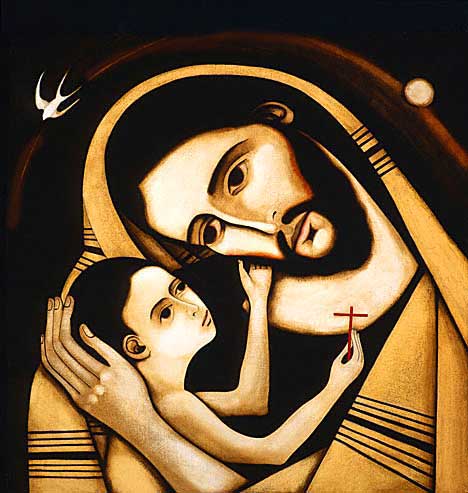
“St. Joseph helped God be a man.” ~Ernie (L’Arche, Clinton, Iowa)
I received many kind words yesterday on the anniversary of my brother Tim’s death. I thought I would share those from two dear friends in the hope that they many console any of you who have lost a loved one.
I remember my mother talking about the death of her brother, Tom, in World War II on the battlefields of France. It had been 40 years, and still she wept. The great losses in life, those people God makes in his own image and likeness and gives to us in love, I think are right to always mourn.
If time has done anything, it deepens our grief. The longer we live, the more fully we become aware of who they were to us and the more intimately we experience what their love meant for us. (Henri Nouwen)
Of course, we do not mourn as those who do not know Christ and place our hope in Him . . . but we also know that Jesus wept. And we take great comfort in that.
My brother, Tim, loved to take photos. In fact, we used to joke about it. He would show up at a family event and always announce that he had some pictures to show us. The reason we joked about it was because they were predominantly of dead dear and caught fish. (You’ve seen one, you’ve seen them all.)
But at the same time, he also had an eye for beauty. He loved the outdoors. Here are a couple of pictures he sent me taken at the place on the lake where he lived.

 He definitely has the best view from where he is now. (Can’t wait to see it myself.) “He leads me beside the waters of rest; he restores my soul.” (Ps 23.2)
I love you, Tim. Always will.
It’s worth quoting again. One of the quotes from the talk I gave last night at Witnesses to Hope, that is. It’s from Michael Card’s book, The Hidden Face of God:
“Those who are lost in this wilderness of grief, most especially at the loss of a child, have come to know that there is no comfort for what they are experiencing, no morning at the end of this long dark night. Theirs is an honest hopelessness that sees with a disturbing clarity through their tears that there is no hope. It simply does not exist . . . anywhere. Neither is there the seed of the hope that it ever will exist.
“At this darkest stage—in order for comfort to exist—it must be created out of the nothingness that smothers the sufferer. Comfort ex nihilio, which is to say, a comfort that can only come from the God who alone can create something out of nothing.”
So if you feel hopeless and that you have nothing, that’s actually a very good place for God . . . who loves to create something out of nothing.
Thank you to all of those of you who were at my talk last night. Thank you for being such a warm and safe environment, for “sitting with me.”
Two songs are coming to mind today. One was written by a friend of mine, Kitty Donohoe, on 9-11 which she was later invited to sing at the dedication of the Pentagon Memorial. The name of the song is “There are No Words.” Michael Card in his book, A Sacred Sorrow, talks about the importance of lament in our lives, the need to struggle through our griefs to God, as Job did. In listening to Kitty’s song (which you can do here), you may wonder where God is in it. My take on it is that it’s the beginning stage of a lament, trying to begin to grieve. In the beginning, Job himself cursed the day he was born . . . but he stayed in the struggle with God, and we know the ending. And we know there is “a balm that can heal these wounds that will last a lifetime long.”
The second song is by Michael Card: “Lift Up Your Sorrows”, an encouragement to true lament, to stay in the pain and grief, wrestling through it to find the Lord.
And one more here, another by Michael:”Underneath the Door.” It is in a sense a testimony to his own struggling through pain in his life to meet God in it. “But our wounds are part of who we are and there’s nothing left to chance/And pain’s the pen that writes the songs and they call us forth to dance.”

