“A word for the year”

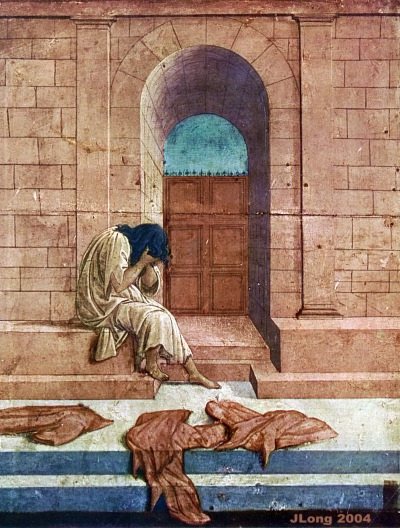
Yesterday I came across this blog post about having a “word for the year”.  I have a very good friend who always takes time at the end of the year to do just this thing: seek the Lord about a word or phrase that He might have for her to focus on for the coming new year.  I find myself doing the same just because of my friendship with her.  (She’s another of the “lighted coals” in my life.)  Sometimes the phrase carries over for a longer time.  “Blessed is he who takes no offense at Me” is one that continues to form my life after coming across it four years ago.  If you asked me about this year, I would probably say it has something to do with keeping my lamp filled with oil and lit at close to midnight–it’s dark and I wonder if He’s ever going to come . . . 

Do you have a word for your year?  I’m sure we would all love to hear you share about it.

John must have wondered . . .

I have a number of “lighted coals” in my life.  One of them is Amy Carmichael whom I have quoted quite often in this blog.  She never fails to “rekindle” me.   And one of my favorite things is to introduce my good friends to one another.  Here is another gem from her:

I have been reading Luke 1.  “With God nothing shall be impossible” [Luke 1.37].   Then I read Acts 12.  James was killed in prison; Peter was set free.  God, with whom nothing is impossible, did not answer the prayers of those who loved James in the same way as He answered prayers of those who loved Peter.  He could have done so, but He did not.  “And blessed is he who takes no offense at Me” [Luke 7.43].  The words seem to me to be written across Acts 12.  John must have wondered why the angel was not sent to James, or at least have been tempted to wonder.  Again and again in Acts the Lord Jesus seems to say those words under His breath, as it were.  Let us turn all our puzzles, all our temptations to wonder why, into opportunities to receive the blessing of the unoffended.
     And now all the grief of those days has been utterly forgotten by those who loved James; they have all been together with him in the Presence of the Lord for 1900 years, and the one thing that matters now is how they lived through those days when their faith was tried to the uttermost.
     So it will be with any who are longing to see the answer to their prayers for those who are in affliction, or any other adversity.  In a few years–how few we do not know, but few at most–we shall all be together in joy.  So with us, too, all that matters is how we live through these days while we are trusted to trust.   (Thou Givest . . . They Gather, p. 76)

The same day that my good friend, Deb, was in her bad car accident, I heard of another person who spun out on the expressway, hit a truck, ended up facing the right direction, and was able to drive off without injury.  I, too, have wondered, but I also know only too well: “Blessed is he who takes no offense at Me.”

A lighted coal

“A friend comes to the rescue in time of need, and if he is aware of the truth of friendship, he directs his friend just as if her were himself and puts his own members at his disposal if he has lost his . . . A friend is a lighted coal, and if placed beside it, it can rekindle a dead one.” (Bl Simon Fidati of Casica)

“God loves to light little lights”

When I found out that St. Peter’s keeps their Christmas tree and crèche up in the square until February 2, I decided we would keep our crèche in the chapel and all our Christmas lights up until then as well.   I always felt gypped that there were not 40 days to celebrate after Christmas as there are after Easter.  Then I discovered that February 2, the Presentation of the Lord (Candlemas), is indeed 40 days after Christmas.  So, to me, it makes total sense to keep those Christmas lights lit.  If you drive past our house right now, you will still see our candle lights in the windows. I personally love clusters of little white lights. When we begin the Salve Regina at the end of night prayer, the guitarist dims all the lights in our chapel.  During this season, that leaves only the Christmas lights and the sole candle lit before the icon of the Mother of God. Yet the chapel still seems bright.

In the beginning of his Christmas message, Pope Benedict spoke of how God “loves to light little lights.”  I found that particularly encouraging as I thought of all of us who are desiring to be God’s witnesses to hope.  May it encourage you as well, and may you call it to mind whenever you see Christmas lights and candles:


The liturgy of the Mass at Dawn reminded us that the night is now past, the day has begun; the light radiating from the cave of Bethlehem shines upon us. . . .
At first, beside the manger in Bethlehem, that “us” was almost imperceptible to human eyes.  As the Gospel of St. Luke recounts, it included, in addition to Mary and Joseph, a few lowly shepherds who came to the cave after hearing the message of the Angels. The light of that first Christmas was like a fire kindled in the night.  All about there was darkness, while in the cave there shone the true light “that enlightens every man” (Jn 1.9).  And yet all this took place in simplicity and hiddenness, in the way that God works in all of salvation history.  God loves to light little lights, so as then to illuminate vast spaces.

May we allow God to light each of us, little lights in this darkened world.

Wrestling

This Sunday’s poem is one by Luci Shaw.  There is always risk in wrestling with God.

     With Jacob

Inexorably I cry
as I wrestle
for the blessing,
thirsty, straining
for the joining
till my desert throat
runs dry.
I must risk
the shrunken sinew
and the laming of
his naming
till I find
my final quenching
in the hollow
of his thigh.

Saturday morning

On Saturday mornings I play guitar for Morning Prayer and worship time, so usually the first prayer out of my mouth when I wake us is “Lord, I need your help.”  I need His help for inspiration for which songs to play, to be sensitive to His Holy Spirit.  This morning, however, what came out of my mouth was, “Lord, You need my help.”  And then I burst out laughing and immediately corrected myself.  As I thought about it later though, I realized that there is some truth to what I prayed.  God is always needing our help, our help to be His hands and His feet, His voice to others.  I’ve been pondering that the rest of this day . . .

Responding to Haiti

If you’re like me, you feel heartsick and helpless about Haiti.  I found a lot of consolation in this excerpt from a letter of Caryll Houselander’s:

It struck me last night that many people are increasing their fear by thinking in crowds, i.e. they think of hundreds and thousands suffering etc., whilst the fact is, God is thinking of each one of us separately; and when–say–a hundred or a million are suffering, it is God who has each one separately in His own hands and is Himself measuring what each one can take, and to each one He is giving His illimitable love.  This thought, though obvious, consoles me a lot.

May each suffering soul know that “illimitable love” of God.

“If he had leaned on Jonathan . . .”

Continuing from yesterday. . .  In this meditation, Amy writes about the importance of our not leaning so much on our friends for support to the point that we don’t lean on the Lord–especially in those times when our friends can’t be there for us.  David is in serious trouble–not just a slight emotional blip on the screen–and Jonathan is not there for him.

Next time we read of David being in serious trouble he had no Jonathan to strengthen his hands.  “And David was greatly distressed; for the people spoke of stoning him . . . .But David encouraged himself in the Lord his God.” [1 Samuel 30.6]  Long afterwards when he was delivered from Saul he sang one of his songs, “It is God who girded me with strength . . . You have girded me with strength . . . . The Lord lives.” [Ps 18.32, 39, 46]  (His dear Jonathan was dead, but he does not even speak of him, all that matters is, “The Lord lives; and blessed be my Rock.”.)
     If he had leaned on Jonathan, if Jonathan had made himself necessary to David, he would not have leaned on his Rock and proved the glorious strength of his Rock; his whole life would have been lived on a lower level, and who can tell how many of his songs would have been left unwritten, with great loss to the glory of God and to the Church of all ages?
     So let us not weaken those whom we love be weak sympathy, but let us love them enough to detach them from ourselves and strengthen their hands in God.

God knows what and whom we need in our distress, and first and foremost, He will gird us with strength and be our Rock.

“God make us all His Jonathans.”

I thought, over the next few days, I would share some meditations by Amy Carmichael.  Today’s focusses on those times when we can feel “hunted” and alone–or when a friend feels hunted and alone and how we can strengthen their hands.

1 Sam 23.16 And Jonathan, Saul’s son, arose, and went to David into the wood, and strengthened his hand in God.

God make us all His Jonathans.  There is a great hunter abroad in the world.  Like Saul who sought David every day, he seeks souls every day, never a day’s respite, always the hunt is on.  Although the words stand forever, “but God did not give him into his hands” [v. 14], yet sometimes souls tire of being hunted, and like David they are in a wilderness in a wood.  Then is Jonathan’s chance.  But notice what he does, he does not so comfort David that he becomes necessary to him.  “He strengthened his hand in God.”  He leaves his friend strong in God, resting in God, safe in God.  he detaches his dear David from himself and he attaches him to his “Very Present Help” [see Psalm 46.1].  Then Jonathan went to his house, and David abode in the wood–with God.

May God help us each to be Jonathans for each of the people in our lives.

We are just human

As you can imagine, with our good friend in the hospital and her family out-of-state, we have been very busy.  In addition, two of the four residents in one of our Emmanuel Houses were admitted to two different hospitals this week.  Saturday night during Evening Prayer I could hardly keep my eyes open.  (I had been at the hospital from 8:00 a.m. until 10:30 p.m. the day before and had not slept well that night.)  As a result of my temperament, I started thinking, “Lord, I wish I was serving you better.  I’m sorry that I’m so tired and don’t have more to give.”  Then I remembered–I am just a human.  I had given all I could give, and part of loving is bearing the cost of giving everything you have.  Feeling drained and empty does not necessarily mean that you are doing something wrong.  I remembered this piece by Caryll Houselander that has encouraged me in the past.  I hope it encourages you as well:

When you have done something really healing, it happens so often that the only way you know it at first is by your own feeling of emptiness.  Even our Lord experienced this; when the woman who touched the hem of His garment was healed, He knew it by the sense of something having gone out of Him, and emptying “[power] has gone out of Me.”  It is the same for His followers–we know the moment of healing, not yet evident, not by exaltation and triumph but by emptiness and a sense of failure.   (from Maise Ward, That Divine Eccentric,  p. 136)