Prayer request

I came home early from retreat because a very good friend was in a serious car accident.  Her entire family is out-of-state, so I am currently having to spend quite a bit of time at the hospital.  I will start posting again as soon as I have some breathing space.  Please keep her in your prayers. 

A blessed New Year!

“This is the night of the Humble One”

A sermon for the Feast of the Nativity by St. Isaac the Syrian.

This Christmas night bestowed peace on the whole world;
So let no one threaten;

This is the night of the Most Gentle One –
Let no one be cruel;

This is the night of the Humble One –
Let no one be proud.

Now is the day of joy –
Let us not revenge;

Now is the day of Good Will –
Let us not be mean.

In this Day of Peace –
Let us not be conquered by anger.

Today the Bountiful impoverished Himself for our sake;
So, rich one, invite the poor to your table.

Today we receive a Gift for which we did not ask;
So let us give alms to those who implore and beg us.

This present Day cast open the heavenly doors to our prayers;
Let us open our door to those who ask our forgiveness.

Today the Divine Being took upon Himself the seal of our humanity,
In order for humanity to be decorated by the Seal of Divinity.

St. Joseph and the Tempter . . . and us

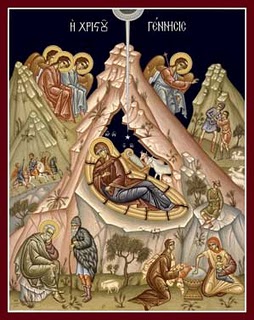
In this more lengthy reading, Pope Benedict explains part of the Christmas icon shown below:

The Christmas icon of the Eastern Orthodox Church developed its essential form as early as the fourth century and in it has captured the complete mystery of Christmas.  It represents the intimate connection between Christmas and Easter, between crib and Cross, the harmony between the Old and the New Testaments, the unity of heaven and earth in the song of the angels and the devotion of the shepherds.  Each figure in it has a profound underlying significance.  Remarkable in all this is the function reserved for St. Joseph.  He is sitting to the side, lost in deep reflection.  In front of him stands the Tempter, disguised as a shepherd, who addresses him, according to the text of the liturgy, in this way: “Just as your root cannot produce leaves, just as an old man cannot become a father anymore, so also the virgin cannot give birth.”  The liturgy then adds: In his heart there raged a storm of contradictory thoughts; he was confused; but enlightened by the Holy Spirit he sings Alleluia.  Through the figure of Saint Joseph the icon presents a drama that recurs time and again–the drama of ourselves.  It is always the same.  Time and again the Tempter tells us: There is nothing but the visible world, there is no Incarnation of God, and there is no birth of the Virgin.  This is the denial that God knows us, that he loves us, that he has the power to be active in the world.  And thus it is, in its core, the refusal to give God the honor.  It is the temptation of our time, which presents itself with so many clever and seemingly brand-new reasons as to appear utterly convincing.  Yet it is still the same old temptation.  We ought to pray to Almighty God that he may send into our hearts also the light of the Holy Spirit.  We ought to pray that he may grant to us also the grace to leave the stubbornness of our own reasoning behind, to gaze at his light with joy and to sing out, “Alleluia”–Christ is truly born, God has become man.  We ought to pray that in us also the words of the Easter liturgy may become reality: “We present to you a Virgin and Mother.  We present to you ourselves as well, more valuable than any gift of money: the wealth of true faith–to you, our God, and Savior of our souls.” Amen.  (Pope Benedict XVI, Lob der Weihnacht, p. 45)

The stars were brighter

Two short Christmas poems:

Starry, Starry Night

     The stars were brighter
         than ever before.
     The night was different,
crackling with new beginnings.
     Something was happening
          in the dark, smelly stable;
Gift of God was before us.      (Anonymous)

Wee One in a Manger

A Wee One in a manger
Praise Him where He lies,
Angels singing carols,
Listening winter skies!   (Hayashi)

Milk or incense?

A beautiful meditation by St Basil on what Mary may have pondered:

She asked Him, “What shall I call you?
Man? But your conception was divine.
God? but you are clothed with our flesh and blood.
What shall I do for you? Shall I nurse you with my milk or glorify you?
Shall I care for you like a mother or worship you like a maidservant?
Shall I kiss you like my son or pray to you like my God?
Should I give you milk or incense?
What an ineffable mystery!
Heaven uses you as a throne and you lie in my arms!
You give yourself wholly to the inhabitants of the earth,
Yet you do not deprive Heaven of your presence.

Christmas is so incarnational

Christmas is so incarnational.  That may sound redundant, but it is worth pondering: the whole mystery of the divine taking on flesh and blood.  Some thoughts about this from Caryll Houselander:

Christ used the flesh and blood of Mary for his life on earth, the Word of love was uttered in her heartbeat.  Christ used his own body to utter his love on hearth; his perfectly real body, with bone and sinew and blood and tears; Christ uses our bodies to express his love on earth, our humanity.
     A Christian life is a sacramental life, it is not a life lived only in the mind, only by the soul; through the bodies of men and women Christ toils and endures and rejoices and loves and dies; in them he is increased, set free, imprisoned, restrained.  In them he is crucified and buried and rises from the dead.
     Our humanity is the substance of the sacramental life of Christ in us, like the wheat for the host, like the grape for the chalice.
     Christ works his love through material as well as spiritual things.  Into his worship, following his own lead, the Church, his Church, brings material things, pure wax, flame, oil, salt, gold, water, linen, the voices of people, the gestures and actions of people, our own souls and bodies–the substance of our flesh and blood.  All this is consistent with the Incarnation, when Christ took the human nature of our Lady to be himself.   (The Comforting of Christ, pp. 26-27)

Awake, Mankind!

Awake, Mankind!  For your sake God has become man.  Awake, you who sleep, rise up from the dead, and Christ will enlighten you.  I tell you again, God became man.
     You would have suffered eternal death, had he not been born in time.  Never would you have been freed from sinful flesh, had he not taken on himself the likeness of sinful flesh.  You would have suffered everlasting unhappiness, had it not been for this mercy.  You would never have returned to life, had he not shared your death.  You would have been lost if he had not hastened to your aid.  You would have perished, had he not come.
     Let us then joyfully celebrate the coming of our salvation and redemption.  Let us celebrate the festive day on which he who is the great and eternal day came from the great and endless day of eternity into our own short day of time. 

~St. Augustine, Sermon 185

God’s homely Christmas tree

I am remembering a homily given years ago by a priest friend of mine.  It went something like this.  He and some other priests had moved into a new place together shortly before Christmas. They wanted to put up a Christmas tree, but none of them had ornaments, so they purchased new ones.  It turned out to be a beautiful tree.   On Christmas day, this priest went home to visit his parents and noticed the family Christmas tree, replete with the ornaments they had used all through the years.  Some were quite simple, others were those he had made in school and given to his parents, while others just had so many memories attached to them.  He could look at each ornament with such fondness because of the history behind it, yet this tree was in no way as “beautiful” or perfect as the new one at his home with the other priests. In his homily the priest went on to say that we are the ornaments on God’s Christmas tree and that He looks at each one of us with love and fondness.  We, all together, do not make a “beautiful” tree, but we make up God’s Christmas tree which He loves.