His love for me

A blessed Feast of the Nativity to each of you and your loved ones!

from an ancient writing, the Odes of Solomon:

His love for me brought low his greatness.
He made himself like me so that I might receive him.
He made himself like me so that I might be clothed in him.
I had no fear when I saw him,
for he is mercy for me.
He took my nature so that I might understand him,
my face so that I should not turn away from him.

Songs, music, good feelings

Most years as I approach the Feast of the Nativity, I feel fairly “emotioned” out.  This year seems to be no exception.  There’s been a lot going on on the home front.  It was good to read this meditation from Henri Nouwen, to be reminded that celebration and thanksgiving really are not about emotions and feelings, but about something way beyond them. 

Somehow I realized that songs, music, good feelings, beautiful liturgies, nice presents, big dinners, and many sweet words do not make Christmas.  Christmas is saying “yes” to a hope based on God’s initiative, which has nothing to do with what I think or feel.  Christmas is believing that the salvation of the world is God’s work and not mine.  Things will never look just right or feel just right.  If they did, someone would be lying . . . . But it is into this broken world that a child is born who is called Son of the Most High, Prince of Peace, Savior.  (The Road to Daybreak)

Searching for the Christ Child

Life, for women especially, can be so very busy before this most holy day that is approaching so swiftly.  Sometimes we miss the Christ Child because we are so busy, but take hope from this meditation by Fulton Sheen.  God works everything for the good.

The Russian peasantry for centuries has propagated a curious tradition.  It is about an old woman, the Baboushka, who was at work in her house when the wise men came from the East and passed on their way to Bethlehem to find the Child.  “Come with us,” they said.  “We have seen his star in the East, and we go to worship him.”
     “I will come, but not now.  I have much housework to do, and when that is finished, I will follow and find him.”  But her work was never done.  And the Three Kings had passed on their way across the desert, and the star shone no more in the darkened heavens.
     Baboushka never saw the Christ Child, but she is still living and searching for him.  And though she did not find him, out of love for him, she takes care of all his children . . . . The tradition has it that she believes that in each poor child whom she warms and feeds, she may find the Christ Child whom she neglected long ago.  But she is not doomed to disappointment, for the Divine Child said, “He who receives one of these little ones in my name, receives me.”

Carrying a baby prince

I just sent this poem by Margaret Smith to one of my godchildren who is expecting her first child in January:

Advent

Shepherds, donkeys, comets, kings . . .
This year I ponder private things:
How Mary, innocent and poor,
Felt carrying a baby prince
Inside, until she bore
Him whimpering.  I wonder, since
This Christmas I am filled
With my firstborn to carry . . .
And when the wind is stilled
At night I think of Mary.

~Margaret D. Smith

For those who are grieving or suffering loss during Advent

Today’s post is a reflection on today’s first reading from the book of Judges.  It is the story of Manoah and his wife who was barren.  By the message of an angel and the grace of God, they became the parents of Samson.  This story is obviously a foreshadowing of the Gospel story that follows of Zechariah and Elizabeth.  Listen to what Kathleen Norris has to say:

Today our readings ask us to reflect on a mystery: when our lives are most barren, when possibilities are cruelly limited, and despair takes hold, when we feel most keenly the emptiness of life–it is then that God comes close to us.  This is a day for those who are grieving or suffering loss during Advent, lamenting that just as we are suffering, and need to weep, the world force-feeds us merriment and cheer.  But we are not without hope, for it is because we are so empty, having used the last scrap of our own resources, that God can move in.  To work on us, and even to play.  Even our bitter emptiness gives God room to play, as at the Creation, placing whales in the sea and humans on dry land, then bringing all the animals to Adam to see what in the world he will call them.  This is not a scene of imposed merriment, but of genuine delight and joy.  (from God With Us, Rediscovering the Meaning of Christmas, p. 105)

It’s easy to feel very lonely, to feel very alone, when you are grieving during such a joyous season.  It gives me hope to know that God is drawn to those who are empty and lonely and alone.  He was born in an “empty” stable.  So let’s come to God with our barrenness and our grieving.  It is there that He will come close to us.

“Your flame is touching ours”

There is a little known Advent tradition–at least little known to me–of using an Advent log, instead of an wreath.  “It contains a candle hole for each day of Advent, plus one for the Christmas holy day itself.”  Here is a poem I came across that refers to this lovely tradition:

Prayer at the Advent log

The small lights steady
against the dark,
Your flame is touching ours.
Today is the fifth day.
It is a safe fire,
the candles still tall
above the brittle wood
of the birch, the air
damp and chill.
But the days will draw us
inexorably toward
Your celebration,
and again we’ll stand
in the crackling air,
the first days’ flames
licking the log
with their shortened lives,
the length of it
threatened by Your fire,
Your love dazzling our eyes,
and, O Christ,
Your love searing
our nakedness.
(Jean Janzen)

“She is burning still.”

One of the things I love about the Advent season (and Christmas, for that matter) are all the candles and lights.  They are a sign of hope for me–the candles in the windows bringing a light into the darkness of this time of year–like the wise virgins keeping their lamps burning bright for the coming of the Bridegroom. 

I love this reading from Amy Carmichael.  It’s the reading for today, December 17, which also happens to be my birthday.  I share this only because its occurrence on this day reminds me that the Lord, from all time, knew today would be my birthday and that I would be reading this.  It also has significance for me because the passage she refers to from Lk 7.23 is one of those passages that have shaped my spiritual life–a word spoken by Jesus to John the Baptist when he was in prison: “Blessed is he (she) who takes no offense at me.”  But that’s a sharing for another time  . . . 

“She hath neither rusted out, nor burned out.  She is burning still.”  I read that in an Australian magazine and I prayed that it might be true of each one of us.  We want most earnestly not to rust out, we would gladly be burned out, but till that day comes, the Lord keep us “burning still.” 
     Perhaps some of us are sorely tempted to think that just now there is not much that is “burning” about our lives.  Some are ill, some have duties of a very simple sort–where does the burning come in?  Where did it come in when John the Baptist was shut up in prison?  He could not do anything but just endure, and not be offended, and not doubt his Lord’s love.  But when our Lord Jesus spoke of him, He said he was burning and shining–“a burning and a shining light”. [John 5.35]
     It is not the place where we are, or the work that we can or cannot do, that matters, it is something else.  It is the fire within that burns and shines, whatever our circumstances.   (Edges of His Ways, pp. 182-3)

Till that day comes, the Lord keep us all “burning still”.

“What, indeed, is lower than a cave?”

Something I wrote a couple of years ago, and still so true–and I am writing this foremost for myself!

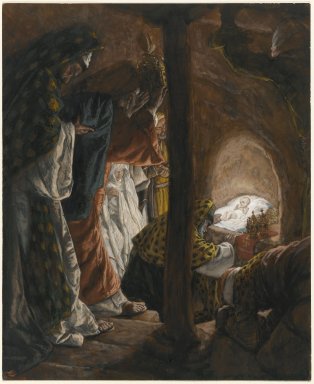
Christmas!  Who doesn’t love this time of year?  Many people say to me of Advent and Christmas, “This is my favorite season!”  I’m sure we can all easily think of our reasons for that: lighting Advent wreaths, Christmas lights and caroling, Midnight Mass, etc.  And yet I know there are many of us who are only too aware of how little prepared we actually are for His coming, of how our weaknesses and faults, anxieties and busyness, seem to keep us from any kind of adequate preparation for this Feast.  The Prayer from the Divine Liturgy for Christmas in the Eastern Church gives hope: “O little Child lying in a manger, by means of a star, heaven has called and led to you the Magi, the first-fruits of the Gentiles, who were astounded to behold, not scepters and thrones, but extreme poverty.  What, indeed, is lower than a cave?  What is more humble than swaddling clothes?  And yet the splendor our your divinity shone forth in them resplendently.  O Lord, glory to you!”  Take heart!  We need not be afraid of the “stable” of our lives–as Fr. David May form Madonna House says: “The Child teaches us not to be afraid of the barren, winter of our wounded hearts, of our human emptiness.  For, by grace, these have become an Advent for us. . . . He awaits us there where we are most in need and most afraid: in the dark cave of our poverty.”  Yes, take heart.  At a mere opening of the door of your “stable,” Christ can shine resplendently therein!