reblogged from Barnstorming

barnstormingblog's avatarBarnstorming

There will be rest, and sure stars shining
Over the roof-tops crowned with snow,
A reign of rest, serene forgetting,
The music of stillness holy and low.
~Sara Teasdale

May we sit in silence,
content to know
the heavenly realms
circle slowly above us,
continuous and consistent,
in reign of rest fulfilled
in His serene forgetting our sins
and forgiving our flaws.
We hear Him now,
still and low,
saying our name,
inviting us to rest
with Him and
in Him
forever.

View original post

Brier

Brier (Good Friday)

Because, dear Christ, your tender, wounded arm
Bends back the brier that edges life’s long way,
That no hurt comes to heart, to soul no harm,
I do not feel the thorns so much to-day.

Because I never knew your care to tire,
Your hand to weary guiding me aright,
Because you walk before and crush the brier,
It does not pierce my feet so much to-night.

Because so often you have hearkened to
My selfish prayers, I ask but one thing now,
That these harsh hands of mind add not unto
The crown of thorns upon your bleeding brow.

E. Pauline Johnson (Tehahionwake)

What can man do to me?

Ps 118.6: The Lord is on my side; I will not fear; what can man do to me?

Job 34.29: When He gives quietness, who then can make trouble?

The Lord is for me (margin).  What can man do to me?  Nothing.  Nothing that really matters.  Nothing that can do any harm.  Nothing that will not be turned to golden good.

Sometimes we feel as though man could do a great deal. A perverse child can cloud a whole day.  The sight of deadly sin, injustice and suffering can overwhelm us.  And deeper things, the inward assaults of the never-resting foe (though he is not man but stronger than man) can seem to do appalling things.

But still the word stands, the question that can have only one answer.  The Lord is for me.  What can man do to me?  Nothing.

And to another questions there is only one answer.  When He gives quietness, who then can make trouble?  No one.

However things seem, the answers to those two questions are among the things that cannot be shaken.

~Amy Carmichael

He makes them better by loving them

It’s midway through Lent.  You may be wanting to give up.  Here’s a reminder of what Lent is all about.  Read it for yourself . . . as well as for others.

Jesus loves as a pure gift, for the sake of nothing; he gives by taking the initiative, gratuitously . . . 

He makes others better by loving them.  Not only does he not accuse their mediocrity, although it is his full right to do so–infinitely more than we could–but he takes up their defense and gives his heart, his time, his trust.

Against Simon the Pharisee, Judas, and Martha, he defends Mary Magdalene, as he defended the Samaritan woman and Zacchaeus against public opinion or his Apostles.  He knew that if such people were weak, small, mediocre, it is precisely because they lacked the love to grow and because others did not love them enough.

What does our Lord do?  He calls forth, arouses, renews the best part in man, the part that is good and filled with hope and is always hidden in each and every person.  Because Christ loves, and shows his love in creating new and good things–and for no ulterior motive–everybody who meets him once again begins to believe, to have trust in God and in themselves.  His love is above all a pure, gratuitous gift, and in this way he manifests the Father and shows us that the first step in love is to be a source of life, and that only he who loves shares in the life of God.  “Experience has shown me too late that we cannot judge people by their vices, but on the contrary by what they hold intact and pure, by the childlike qualities that remain in them, however deeply one must search for them.” (George Bernanos)

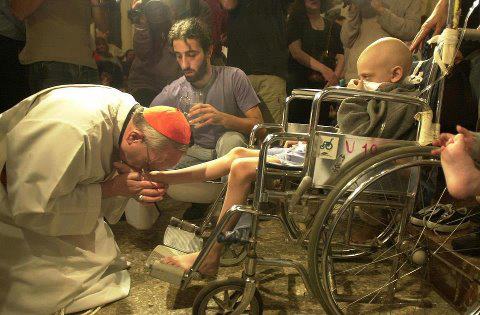
Not only does Christ give, but he does so by making himself smaller than we are; at Christmas an infant, at the agony a beggar, and before the Samaritan woman, Zacchaeus, and Mary Magdalene, with the washing of the feet.  At every moment, Christ puts himself on a lower level than those he loves, accepts the fact that he needs them, not for the sake of some strategy or clever calculation, but to evoke in such people the best part of their being–their heart, their generosity–in order to make them capable of giving in their turn.

Fr. Bernard Bro

Hard-pressed

It’s been a good while since I’ve quoted anything from my friend, Amy Carmichael . . . and she is always so good:

Is 53.7 Hard-pressed–yet He humbled Himself, nor opened His mouth.

The assault of our great enemy comes in waves.  Sometimes we cannot do the work committed to us to do, and this is indeed a trial of faith.  “Hard-pressed” is the word that describes it all.

It is the word spoken of our Lord Jesus in Rotherman’s translation. Hard-pressed–yet He humbled Himself, nor opened His mouth.  To ask why, even to wonder why, is to open our mouth.  Our Lord Jesus Christ shows us the way here as everywhere.  Am I hard-pressed in any direction inward or outward?  The only word I speak must be a word of acceptance  “Even so, Father.”  Underfoot is the rock of Romans 8.28.  Overhead is the banner of Eternal Love.  Nothing is going wrong, however wrong it seems.  All, all is well.