I love pondering the post-Resurrection appearances of Christ. I guess I feel in good company when those who had spent three solid years with Christ failed to recognize Him. It’s always a reminder to me of the need to sharpen our eyes of faith, to look for Him in His many disguises. In today’s Gospel, we see Jesus showing a sense of humor (in my opinion). He repeats advice that He had given them when He first met them: put the net down on the other side. How many times does that happen to us, that God comes to us in a familiar way? Let’s not miss His appearances to us in our every day life.
One of the things I love about the week after Easter is that the Church relates to each day of the octave as though it is Easter Day. In the Preface of Easter I, the priest is directed to pray during the octave: “We praise you with greater joy than ever on this Easter day when Christ became our paschal sacrifice.” (Unfortunately most of the priests where I attend daily Mass pray “in this Easter season.”) In the Liturgy of the Hours, we pray Morning, Evening, and Night Prayer of Easter Day all week. To me this is a foretaste of heaven when each day will be as the first. “This is the day the Lord has made. Let us be glad and rejoice in it!”
It’s hard to find a lovelier description of our response to this day that that in today’s Office of Readings:
Let us run to accompany him as he hastens toward his passion, and imitate those who met him then, not by covering his path with garments, olive branches or palms, but by doing all we can to prostrate ourselves before him by being humble and by trying to live as he would wish. Then we shall be able to receive the Word at his coming, and God whom no limits can contain, will be within us. (St. Andrew of Crete)
Awake, Mankind! For your sake God has become man. Awake, you who sleep, rise up from the dead, and Christ will enlighten you. I tell you again, God became man.
You would have suffered eternal death, had he not been born in time. Never would you have been freed from sinful flesh, had he not taken on himself the likeness of sinful flesh. You would have suffered everlasting unhappiness, had it not been for this mercy. You would never have returned to life, had he not shared your death. You would have been lost if he had not hastened to your aid. You would have perished, had he not come.
Let us then joyfully celebrate the coming of our salvation and redemption. Let us celebrate the festive day on which he who is the great and eternal day came from the great and endless day of eternity into our own short day of time.
A blessed Feast of the Nativity to each of you and your loved ones!
from an ancient writing, the Odes of Solomon:
His love for me brought low his greatness.
He made himself like me so that I might receive him.
He made himself like me so that I might be clothed in him.
I had no fear when I saw him,
for he is mercy for me.
He took my nature so that I might understand him,
my face so that I should not turn away from him.
I just didn’t have any inspiration this morning for a post, so instead–and hopefully this is an inspiration–I’ll share a picture by James Tissot, Saint Joseph seeks a Lodging in Bethlehem. (A picture is worth a thousand words, right?)
Have you ever been in a funk–one of those times when you’ve been walking along fine, experiencing great hope in the Lord about something, but all of a sudden that hope just disappears? (Rhetorical question) Your thoughts just swirl around you. You’re not able to concentrate on the truth. Your thinking at the moment is not helpful, to say the least?
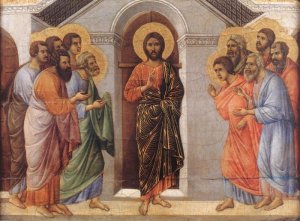
Christ Appears to the Apostles Behind Closed Doors (Duccio)
Often our thoughts are like a crowd of people talking together in a room whose doors are shut, and because of the setting of some hope that had a bright sunrise, it is a sorrowful time.
There may be love, understanding love, all around us, and yet we may be needing some word of life in our own soul, something that would do what only the Divine can do. “Lord, to whom shall we go? You have the words of eternal life” (Jn 6.68).
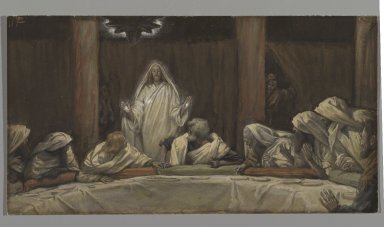
One day lately, when feeling like this, I took my New Testament, and it opened of itself at John 20, and the first words I read were these: “The same day at evening . . . when the doors were shut . . . Jesus came and stood in their midst, and said . . . Peace be with you. And when He had said this, he showed them His hands and His side.” It is all there–the shut doors (for we cannot say aloud all that fills our mind), the dreary evening, then the risen Lord, and peace. (Amy Carmichael, Edges of His Ways, pp. 131-2)
My prayer for you today is that the Lord may enter through any of your shut doors . . .
My prayer consists in falling down at Christ’s feet like the poor lepers in the Gospel; I come before God like the poor man who lay on the road to Jericho, wounded and stripped; I say nothing. I only show God my misery and await help from His mercy. (Dom Marmion)
This is a powerful Easter poem by Luci Shaw. I know it’s not the Easter season, but I think it’s at times like these–as we’re moving into the physically darker seasons of fall and winter, and sometimes simultaneously darker emotional seasons for some of us–that we need to remember that we are always an Easter people.
Open
John 20:19, 26
Doubt padlocked one door and
Memory put her back to the other.
Still the damp draught seeped in, though
Fear chinked all the cracks and
Blindness boarded up the window.
In the darkness that was left
Defeat crouched, shivering,
In his cold corner.
Then Jesus came
(all the doors being shut)
and stood among them.
Luci Shaw
The Appearance of Christ at the Cenacle (James Tissot)
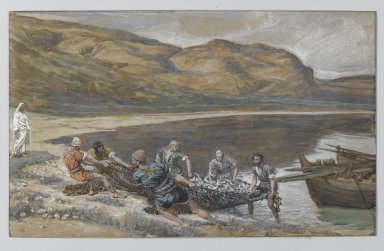 I love pondering the post-Resurrection appearances of Christ. I guess I feel in good company when those who had spent three solid years with Christ failed to recognize Him. It’s always a reminder to me of the need to sharpen our eyes of faith, to look for Him in His many disguises. In today’s Gospel, we see Jesus showing a sense of humor (in my opinion). He repeats advice that He had given them when He first met them: put the net down on the other side. How many times does that happen to us, that God comes to us in a familiar way? Let’s not miss His appearances to us in our every day life.
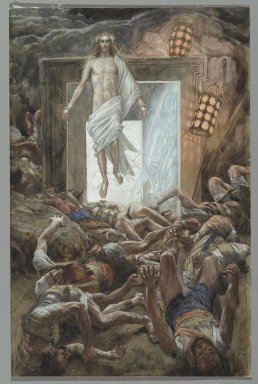 One of the things I love about the week after Easter is that the Church relates to each day of the octave as though it is Easter Day. In the Preface of Easter I, the priest is directed to pray during the octave: “We praise you with greater joy than ever on this Easter day when Christ became our paschal sacrifice.” (Unfortunately most of the priests where I attend daily Mass pray “in this Easter season.”) In the Liturgy of the Hours, we pray Morning, Evening, and Night Prayer of Easter Day all week. To me this is a foretaste of heaven when each day will be as the first. “This is the day the Lord has made. Let us be glad and rejoice in it!”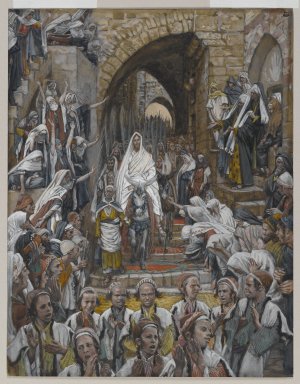
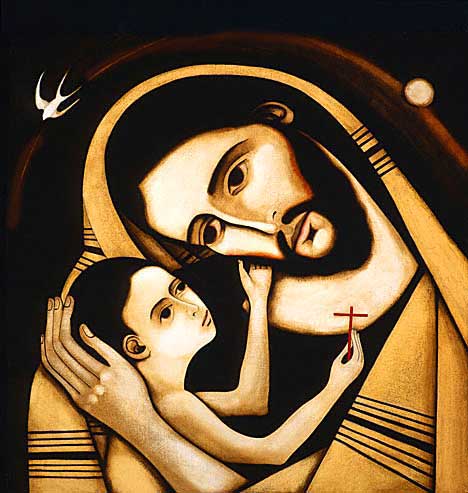
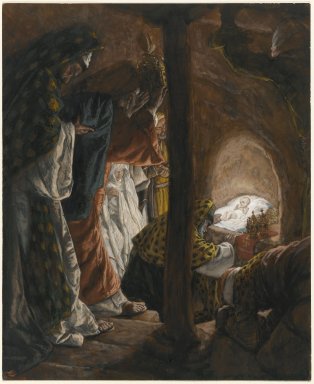 Awake, Mankind! For your sake God has become man. Awake, you who sleep, rise up from the dead, and Christ will enlighten you. I tell you again, God became man.
from an ancient writing, the Odes of Solomon: